Solid wood suits furniture you want to repair and keep for decades, while veneer suits pieces where stability, budget or a rare grain pattern matter more than longevity. The right choice depends on humidity control and how the piece will be used day to day, which is why checking construction and understanding veneer checking matters before you buy. The sections below cover inspection, maintenance and a buying checklist to help you decide.
TL;DR:
- Solid wood furniture is more durable and easier to repair, but it is susceptible to movement from humidity fluctuations, which can cause warping or joint issues.
- Veneer typically offers better stability and cost efficiency, making it suitable for large panels and environments with fluctuating humidity, but it has limited refinishing options.
- Inspecting edges, weight, and joinery can reliably distinguish veneer from solid wood, with solid showing continuous grain and veneer often revealing thin edges or different grain patterns.
- Veneer checking caused by moisture imbalance is a common defect, and maintaining indoor humidity levels can significantly reduce the risk of surface cracking or delamination.
- Long-term value favors solid wood, especially if well-maintained, but high-quality veneered furniture also retains resale value if constructed properly with durable substrates.
Solid wood furniture is made from a single piece of timber throughout, so the same material runs from the visible surface to the back and edges. This is what allows it to be sanded, carved or refinished repeatedly over its life, since solid wood is the same material throughout, making repairs and refinishing straightforward in a way engineered products cannot always match.
Veneer, by contrast, is a thin slice of natural wood bonded to a substrate, typically plywood, MDF or particleboard. The substrate provides strength and stability, while the face veneer gives the appearance of solid timber at a fraction of the material cost.
It is worth distinguishing veneer from laminate, since the two get confused constantly in retail listings. Laminate is a printed paper or plastic layer designed to mimic a wood grain pattern, whereas veneer is real wood, just thin. Product descriptions sometimes use “wood effect”, “wood finish” or “veneer” loosely, so it pays to read the small print or ask directly what the surface material actually is.
Solid wood’s biggest advantage is repairability. A scratch, dent or water mark can usually be sanded out and refinished, and pieces made from dense hardwoods can realistically become family heirlooms. The trade-offs are cost and movement: solid timber expands and contracts with humidity, which can cause doors to stick or joints to loosen over a heating season.
Veneer trades some of that longevity for stability and access. A veneered panel resists warping and bowing better than a solid plank in a centrally heated home, and it opens up species that would be prohibitively expensive or simply unavailable as solid boards. The downsides are that refinishing options are limited, since you cannot sand through a 0.6 millimetre face without hitting the substrate, and veneer can develop fine surface cracks known as checking, or delaminate at the edges if moisture gets underneath.
A few quick checks in a showroom or from online photos will usually settle the question.
Veneer checking is a recognised defect: fine, evenly spaced hairline cracks running parallel to the grain, caused by differential shrinkage between the face veneer and the substrate beneath it, according to research on veneer checking. It tends to appear where moisture content was not properly matched during manufacture, or where a piece has been stored or used in a room with swinging humidity levels.
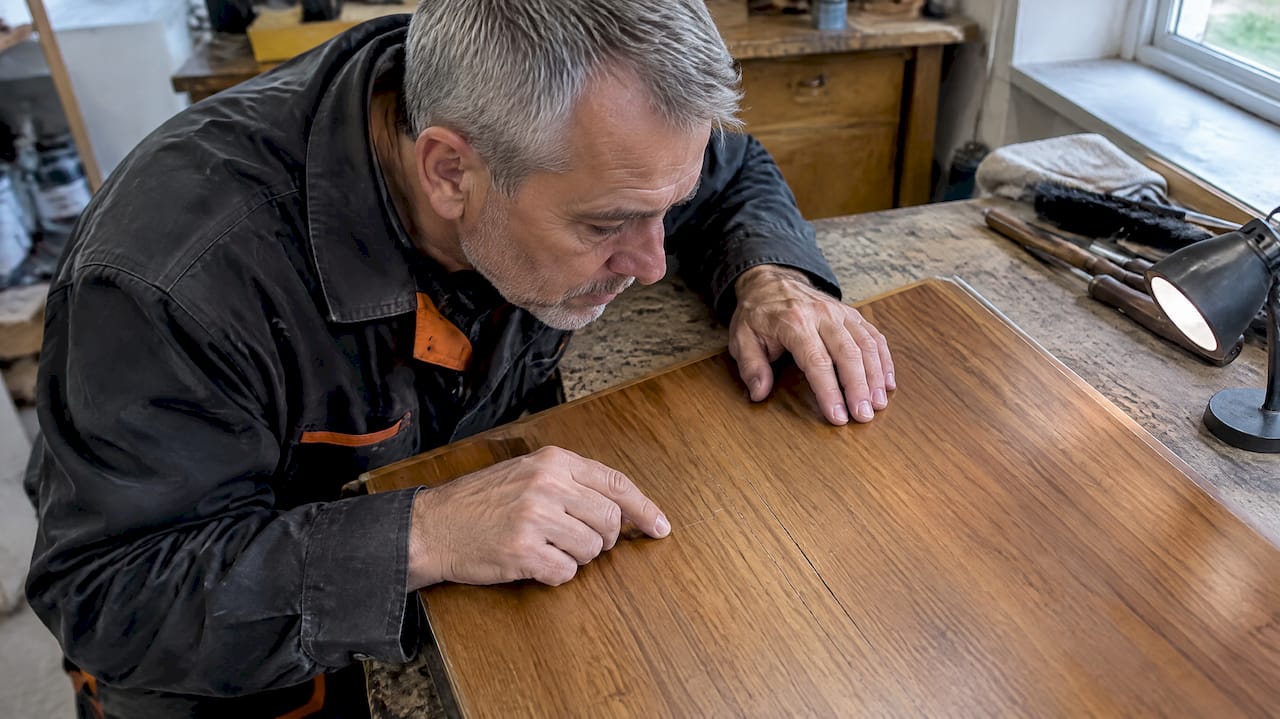
Aim for indoor relative humidity within a typical moderate range suitable for wood furniture, avoiding extremes in dryness or dampness, and avoid placing veneered or solid wood furniture directly against radiators or in direct sun, both of which accelerate drying and movement. Tight-cut veneer and fine-pored species are less prone to checking than loose-cut veneer, and five-ply, hot-pressed panels hold up better than cheaper three-ply, cold-pressed equivalents, per the same manufacturing research.
When damage does happen, the repair routes diverge sharply. Solid wood can usually be sanded back and refinished multiple times over its life, while veneer repairs are generally limited to spot patches, colour-matched fillers or, in bad cases, replacing the whole panel face.
Pro Tip: Dust with a slightly damp cloth rather than polish spray, and keep a coaster or mat under anything that generates heat or condensation.
Solid wood typically carries a higher purchase price but a longer realistic lifespan, since refinishing can reset a worn surface rather than replace it. Veneer sits at a lower price point upfront and performs well for panels that need to stay flat and stable, but its lifespan depends heavily on how well it was made and cared for.
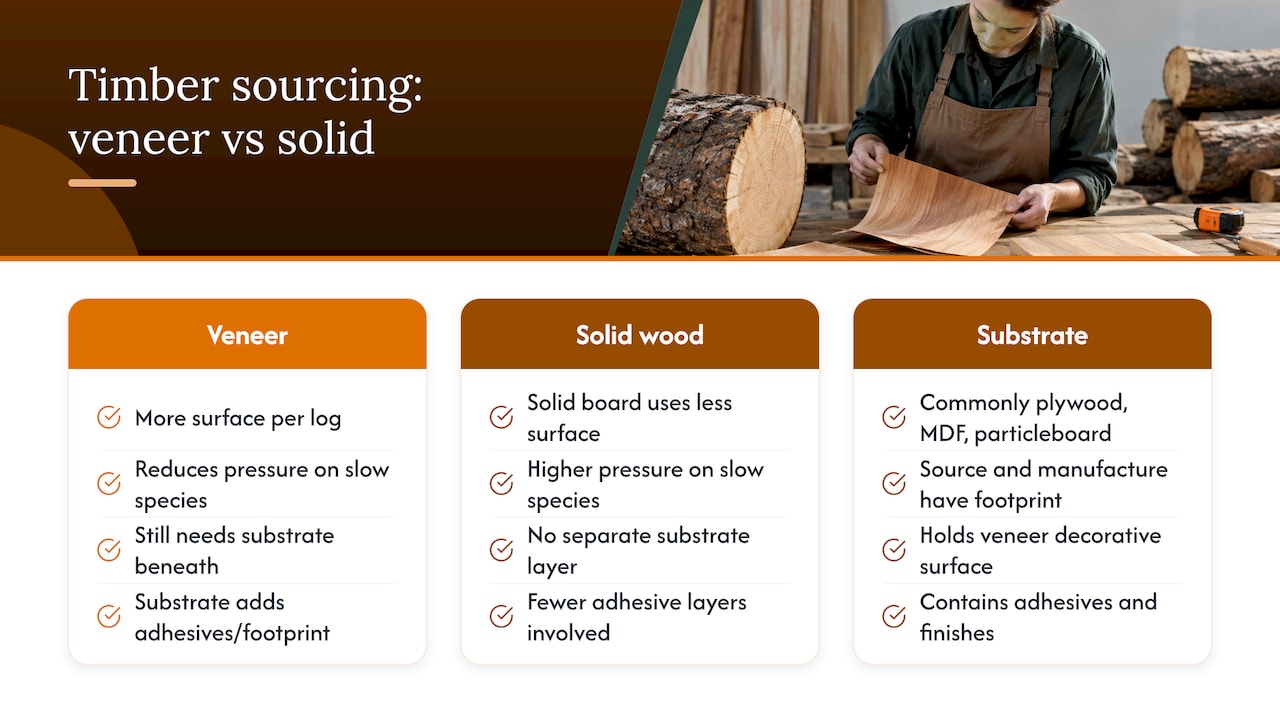
Veneer also uses timber efficiently: a single log can be sliced into far more usable surface area as veneer than it could ever provide as solid boards, which is part of why natural wood veneer gives access to rarer species at a realistic price. Looking for FSC certification on either solid wood or veneered products is a reliable way to check that timber was sourced to a recognised sustainability standard, as FSC UK explains.
There are also cases where an engineered core with a veneer face is the more sustainable option outright, particularly compared with low-grade solid wood that may come from less responsibly managed forestry. Buying well-made veneer from a certified source can be a sounder environmental choice than buying cheap, poorly sourced solid timber.
Sustainability labelling tells you how timber was harvested, but it is worth looking slightly further into sourcing practice as well. Certification schemes such as FSC exist precisely because forestry standards vary enormously between regions and suppliers, and a certified label gives you a traceable claim rather than a vague one.
Veneer production, by its nature, draws more furniture-grade surface area from each log than solid board production does, which reduces pressure on slower-growing or rarer species. That efficiency matters more as demand grows for decorative hardwoods that are slow to replace. At the same time, the substrate beneath a veneer, whether plywood, MDF or particleboard, has its own sourcing and manufacturing footprint, including the adhesives used to bond layers together.
None of this means veneer is automatically the greener choice or that solid wood is automatically the worse one. It means the honest answer depends on the specific supply chain: where the timber was grown, how it was certified, and what adhesives and finishes went into the substrate. Asking a retailer directly whether their veneer or solid wood ranges carry FSC certification is a reasonable, specific question, and one a credible seller should be able to answer without hesitation.
Well-maintained solid wood furniture tends to hold resale value better over the long run, largely because it can be refinished rather than simply replaced once the surface wears. A solid oak table with decades of use can be sanded back to look close to new, which keeps it attractive to second-hand buyers and makes it a realistic candidate for passing down.
Veneer furniture can still hold value well if it was built properly, with a quality substrate, good edge sealing and a tight-cut face veneer resistant to checking. Mid-range veneered pieces from recognised ranges often depreciate faster than solid wood equivalents, simply because buyers are more wary of hidden damage like delamination or checking that is not visible in a photograph.
In both cases, construction quality matters more to long-term value than the surface material alone. A poorly built solid wood piece with weak joints will not outlast a well-made veneered panel with a sound substrate and proper edge detail, which is why specification details are worth asking about regardless of which material you lean towards.
Solid wood earns its price for heirloom pieces and anything that takes daily heavy use, since it can be refinished rather than replaced, as outlined in the art selection checklist for interior design. Veneer is a sensible, cost-effective choice for stable panels and design-led surfaces on a tighter budget. Treat it as a practical trade-off, not a rule.
— Furniture
We supply commercial-grade furniture built around construction details that determine how well veneer or solid wood holds up: solid edge sealing, quality substrates and finishes chosen for high-use environments. Businesses furnishing offices or refurbishing workspaces can benefit from delivery options, pricing for bulk orders, and straightforward returns.

If you’re specifying furniture for a workspace rather than a single room at home, browse our office desks, office storage and office chairs ranges, built to handle daily commercial use.
Veneer can develop fine surface cracks called checking, caused by differential shrinkage between the face veneer and its substrate, and it offers limited refinishing because the face layer is too thin to sand repeatedly. Poor-quality veneer can also delaminate at the edges if moisture gets underneath.
Retail ranges from large furniture brands use a mix of laminate, veneer and solid components depending on the specific product, so labelling is inconsistent across a catalogue. Always check the individual product specification rather than assuming one material applies across an entire range.
Check the edges and underside for continuous grain, which indicates solid wood, versus a thin edge line or interrupted pattern, which points to veneer. Weight, sound when knocked, and visible joinery like dovetails are also reliable clues.
No, veneer is a thin slice of real wood bonded to a substrate such as plywood or MDF, unlike laminate, which is a printed paper or plastic surface designed to imitate wood grain. Veneer gives genuine timber appearance while using significantly less of the raw material than solid boards.

Phone: 0330 043 4114
VAT no. GB 991 8681 60
Company no. 07250570