BS 6396:2022 governs desk electrics for any UK workplace running power, data or USB circuits from a 13 A plug or a battery up to 48 V DC. Whether you specify or install desk power, three things matter immediately: a suitably rated RCD (usually 30 mA), respecting socket and load limits, and commissioning the installation with permanent labelling before anyone plugs in. Everything else in this guide fills in the detail, the procurement checklist and where compliant components fit into your fit-out.
TL;DR:
- RCD protection with 30 mA sensitivity is essential for desk circuits, which must also include USB loads in the total current calculation.
- Power socket groups are typically rated at 3.15 A or 5 A, and metal enclosures generally require earthing while plastic units may not.
- All wiring, including from battery or inverter sources up to 48 V DC, must be protected with RCD and thoroughly tested at system level before commissioning.
- Installation must include proper cable separation, support, and correct grommet sizing to avoid interference and physical damage, with re-testing required after reconfiguration.
- Procurement should specify required tests, labelling, and documentation upfront, with compliance verified through detailed commissioning and testing performed by qualified electricians.
BS 6396:2022 is the current British Standard for power, data and telecom distribution built into furniture, and it applies up to 250 V AC or 48 V DC. It excludes special-purpose lab and workshop workstations, which sit under different equipment rules entirely. BSI’s own product listing confirms this scope and the exclusions, framing BS 6396 as the reference point for office and educational furniture specifically, not industrial benches.
The key distinction is how the power gets there. A desk module plugged into a wall socket via a 13 A fused plug falls under BS 6396. A circuit permanently wired into the building’s electrics falls under BS 7671, the wiring regulations that govern fixed installations. Get that distinction wrong at tender stage and you end up with the wrong test regime applied to the wrong kind of installation.
BS 6396 itself is voluntary. Nobody prosecutes you for not following a British Standard. But it is the document that inspectors and enforcement bodies reach for when judging whether a furniture power system meets the Electricity at Work Regulations 1989, so treating it as optional is a poor bet for anyone signing off a fit-out.
Once you get past scope, the requirements get specific fast, and this is where most tender documents fall short.
RCD protection. Guidance built around BS 6396 commonly points to a 30 mA RCD fitted within the circuit, sized to protect people rather than just equipment. That sensitivity matters because desk circuits sit close to hands, water bottles and the daily wear of an occupied office.
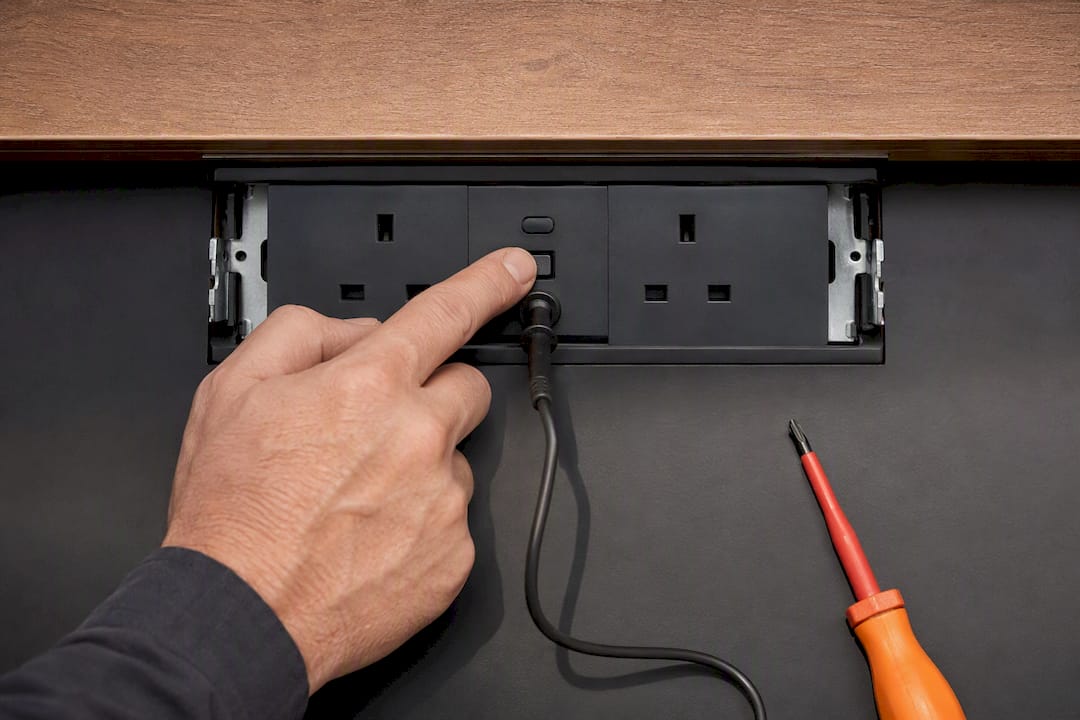
Socket and load limits. BS 6396 sets caps on how many sockets can sit on a single fused supply, and current guidance references limits such as groups of 3.15 A or 5 A fused sockets, plus specific allowances for extra-low-voltage outputs. USB charging counts towards that load: high-power USB-C supplies are no longer a rounding error in the calculation, and treating them as electrically insignificant is a common specification mistake.
Earthing. Metal-housed modules generally need an earth connection carried through to the desk frame; plastic-bodied units with double insulation often do not, but that depends on the specific product design, not a blanket rule.
Battery and inverter supplies. Where power is derived from a battery rather than mains, the 48 V DC ceiling still applies, and an RCD requirement doesn’t disappear just because the source isn’t a wall socket.
Power and data cables need physical separation inside a desk run, not just because a standard says so, but because induced interference from a power cable running alongside a network cable genuinely degrades data performance. Where separate channels aren’t practical, screened cable is the usual workaround.
Installation guidance from desk electrics suppliers points to concrete constraints worth putting in a spec: exposed cable between plug and desk entry point should be kept short, with around 2 metres commonly cited as a practical maximum before strain relief becomes essential. Grommet sizing matters more than most people assume: too tight, and the cable jacket abrades against the edge every time the desk gets nudged.
Pro Tip: When linking desks in a bank of four or more, route the master cable entry through the central desk rather than an end unit. It halves the average cable run length and makes future reconfiguration far less disruptive.
Cable ports deserve their own consideration at spec stage, and getting the choice of cable port right upfront avoids retrofitting grommets into desks that were never designed for the load.
A compliant-looking desk module means nothing without commissioning tests behind it. FIRA’s guidance is blunt on this point: compliance is achieved at the system level, not the component level, which means the finished, wired installation needs testing, not just the modules that went into it.
All of this should be carried out by a suitably qualified electrical engineer, with results kept on file rather than verbally confirmed and forgotten.
The line between the two standards is simpler than it looks once you frame it around the plug. Furniture power that runs through a 13 A fused connection into a wall socket sits under BS 6396. Anything permanently wired into the building’s fixed circuits sits under BS 7671, and that’s a job for a qualified electrician working to the wiring regulations, not a furniture installer.
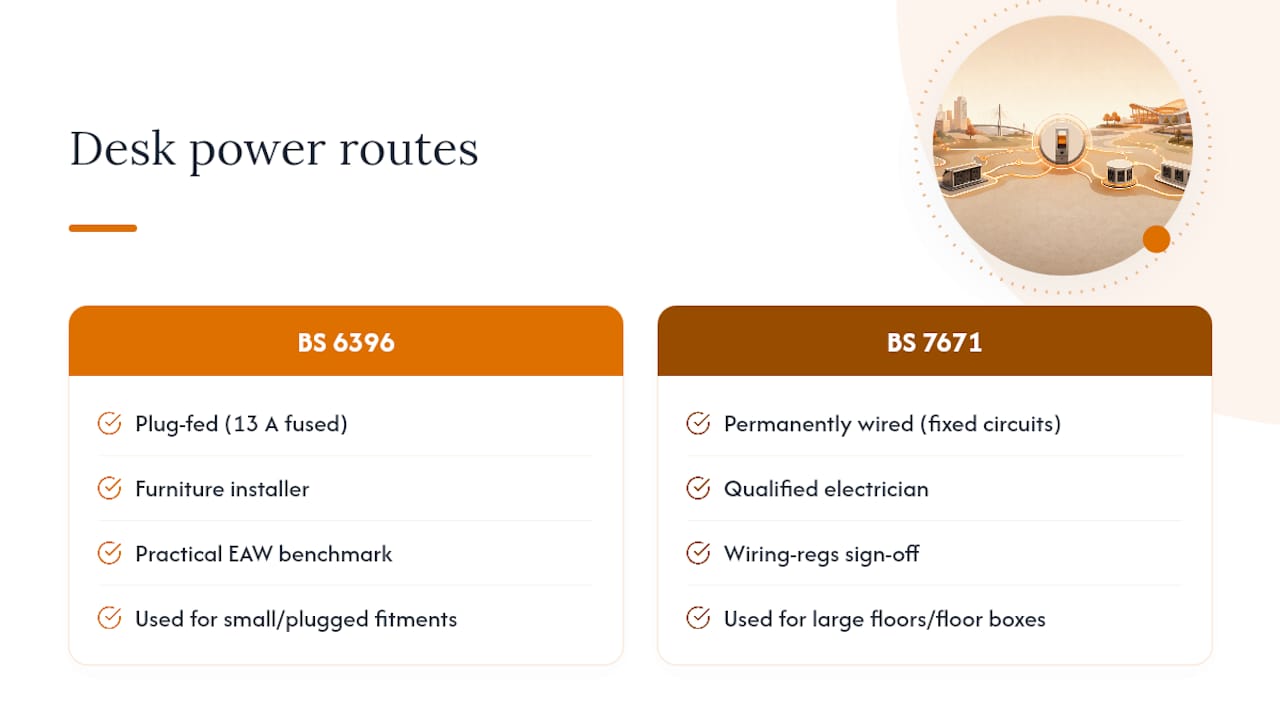
Inspectors treat BS 6396 as the practical benchmark for interpreting compliance with the Electricity at Work Regulations 1989, even though the standard itself carries no statutory force. In practice, that means a badly commissioned desk installation is exactly the kind of thing that gets flagged in an HSE visit.
The trigger for choosing permanent wiring over a BS 6396 approach is usually scale: large open-plan floors with fixed floor boxes and hard-wired power tend to need BS 7671 sign-off regardless of what sits on top of the desk.
Specify BS 6396 testing and commissioning as an explicit, priced deliverable in the tender, not an assumed inclusion. Set that expectation early, because it’s the single biggest gap procurement teams miss.
Pro Tip: Ask the contractor for a sample label wording before installation, not after. It’s a two-minute email that saves a return visit if the label doesn’t meet the required content or character size.
A construction management platform such as CivroBuild can help larger fit-out teams track these deliverables against the contract rather than relying on a spreadsheet that nobody updates after week two.
Desktop power modules, cable trays and linking bars all play a specific role: a desktop module with UK sockets delivers the sockets, a cable tray such as the Oslo cable management tray keeps runs supported and segregated, and linking bars carry power between desks in a bank. None of it makes the installation compliant on its own. Confirm every component against your design, and request datasheets, installation instructions and labelling wording from the supplier before it ships.
The most common failure isn’t a bad component, it’s assuming a compliant-looking module makes the whole system compliant. Cable segregation gets skipped under deadline pressure, and reconfigured desks rarely get re-tested. The cleanest split of responsibility: procurement specifies the requirements, the furniture supplier provides compliant modules with proper documentation, and a qualified electrician commissions the system and issues the certificates.
— Furniture
Suppliers provide desktop modules, cable trays and linking bars used in BS 6396 compliant installations, specifically sourced for UK office fit-outs rather than generic international specs.

Every product listing carries the technical detail procurement teams need at tender stage, and we’d always encourage you to check the datasheet and request installation instructions and labelling wording before you order, rather than after the desks arrive on site. Browse the current range of office desks to see the modules and accessories available for your next fit-out, and get in touch if you need documentation ahead of a commissioning date.
Fixed building wiring follows BS 7671, the IET Wiring Regulations, while furniture-integrated power such as desk electrics follows BS 6396:2022. The two apply to different parts of the same office, split by whether the power is hard-wired or delivered through a 13 A plug.
BS 7671 is the IET Wiring Regulations, covering permanently wired electrical installations in buildings. It governs the fixed circuits that feed your sockets and floor boxes, while BS 6396 takes over once power reaches a piece of furniture through a plug.
Socket installations in buildings follow BS 7671, while sockets built into desks and furniture follow BS 6396, which sets limits on fused ratings such as 3.15 A and 5 A groups and requires RCD protection, typically at 30 mA sensitivity.
Skirting-mounted sockets aren’t illegal in UK offices, provided the installation meets BS 7671 requirements for fixed wiring, including appropriate protection and accessibility. They fall outside BS 6396 entirely, since that standard covers furniture-integrated power, not building-fixed sockets.
Yes. High-power USB supplies must be counted into the total load calculation for the desk circuit, not treated as separate from mains sockets. Guidance built around BS 6396:2022 makes specific allowances for ELV outputs including USB.
No. Compliance is assessed at the whole-system level, meaning the finished, wired installation needs commissioning tests and permanent labelling regardless of how compliant the individual components are.

Phone: 0330 043 4114
VAT no. GB 991 8681 60
Company no. 07250570