Choose a commercial anti-tilt metal filing cabinet with a verified drawer interlock, and use a 2-drawer interlock design as your safety baseline before considering taller units. Furnitureforbusiness’s office storage range is a practical starting point, stocking cabinets built to this standard alongside the specification sheets procurement teams need.
Two things to do right now:
A verified 2-drawer interlock is the safety baseline for office filing cabinets, and taller units need correct fixing, not just a bigger interlock, to stay stable.
| Point | Details |
|---|---|
| Interlock baseline | Start with a 2-drawer interlock design; treat multi-drawer extensions as needing separate structural testing. |
| Carpet reduces stability | Carpeted floors can significantly reduce tip resistance, so wall or floor fixing matters more on soft flooring. |
| Fixing trades against mobility | Wall anchoring and ganging cut tip risk sharply but reduce how easily a cabinet can be moved later. |
| Maintenance protects the interlock | Regular checks on slide wear and load distribution keep the anti-tilt mechanism working as designed. |
| Furnitureforbusiness as a starting point | Its Impulse and Qube ranges publish spec sheets, offer free UK mainland delivery, and support bulk orders with warranty terms in writing. |
An anti-tilt interlock is a mechanical device inside the cabinet frame that physically blocks a second drawer from opening while another is already out. Patent records for these systems describe activator rails and segmented lock bars that only release the next drawer once the open one is pushed back in. It’s a simple piece of engineering, and it works because most tipping incidents happen when several loaded drawers are open at once, shifting the cabinet’s centre of gravity forward.
Here’s the catch: an interlock reduces tip risk, it doesn’t remove it. A cabinet can still overturn if it sits unfixed on carpet, if it’s overloaded at the top, or if someone leans on an open drawer. The mechanism is one layer of protection, not a substitute for correct installation.
Pro Tip: Ask your supplier for the interlock’s technical name (the S1010 lock is the recognised standard for 2-drawer units) rather than accepting “anti-tilt” as a generic marketing label. It tells you exactly what you’re buying.
When comparing spec sheets, check:
Most commercial ranges come in three footprints: 2-drawer pedestals designed to sit under a desk, 3-drawer pedestals for general office use, and 4-drawer vertical towers for higher-volume archiving. Each has a different job. A 2-drawer pedestal suits personal or team-level filing where floor space is tight. A 4-drawer tower suits a shared records room, but it also carries the highest centre of gravity, so it needs the strongest anti-tip provision.
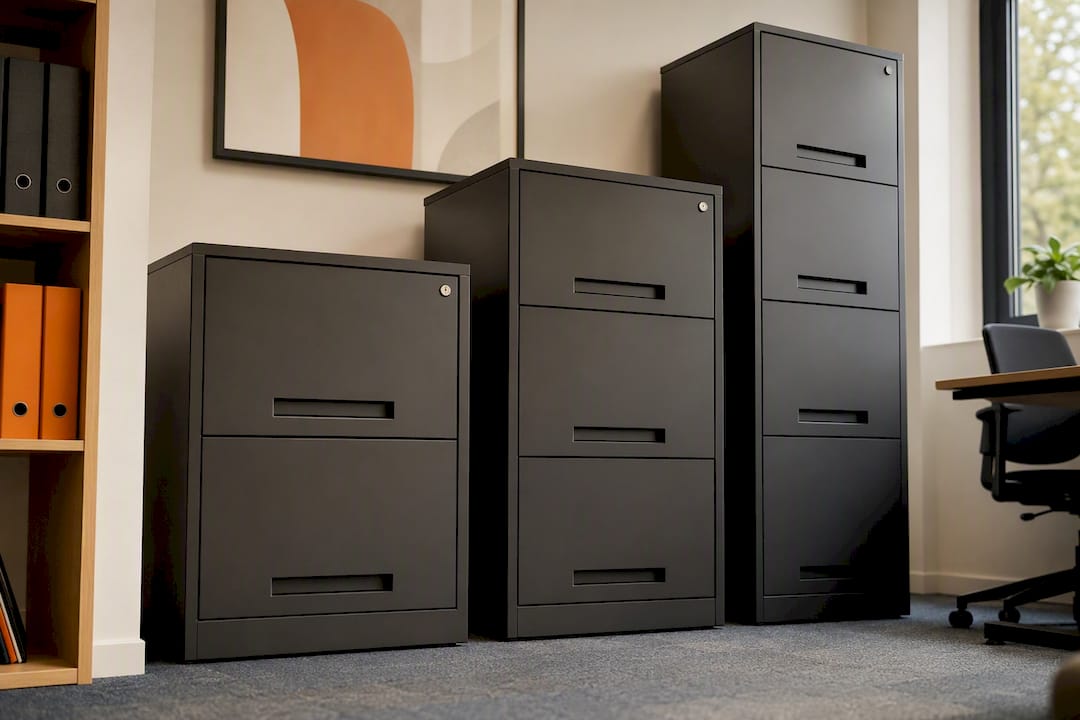
Before ordering, check three dimensions against your files rather than just the cabinet’s footprint: overall height, width, and internal depth. Depth matters most, since it determines whether standard A4 or foolscap hanging folders sit properly on the rails without catching. Vendor listings for filing cabinets typically publish drawer counts alongside dimensions and locking claims, so cross-check these against your actual filing format before you order, not after delivery.
Width affects more than the cabinet itself. A row of 4-drawer towers along a corridor needs enough clearance for drawers to open fully without blocking a fire escape route or a shared walkway.
An interlock only does its job if the cabinet itself is stable. Follow this sequence when fitting new units:
Fixing trades off against mobility. A wall-anchored or ganged cabinet is far harder to tip, but it’s also harder to move during a reshuffle or refit. Where full mobility is essential, footprint extenders or outriggers are a middle ground.
Carpet is the detail most offices miss. Testing shows carpeting can significantly reduce a cabinet’s tip resistance (https://pubs.sciepub.com/ajme/8/1/4/index.html) compared with a hard floor, because the pile lets the base rock rather than sit flat. For tall or heavily loaded units on carpet, treat wall or floor fixing as close to mandatory rather than optional.
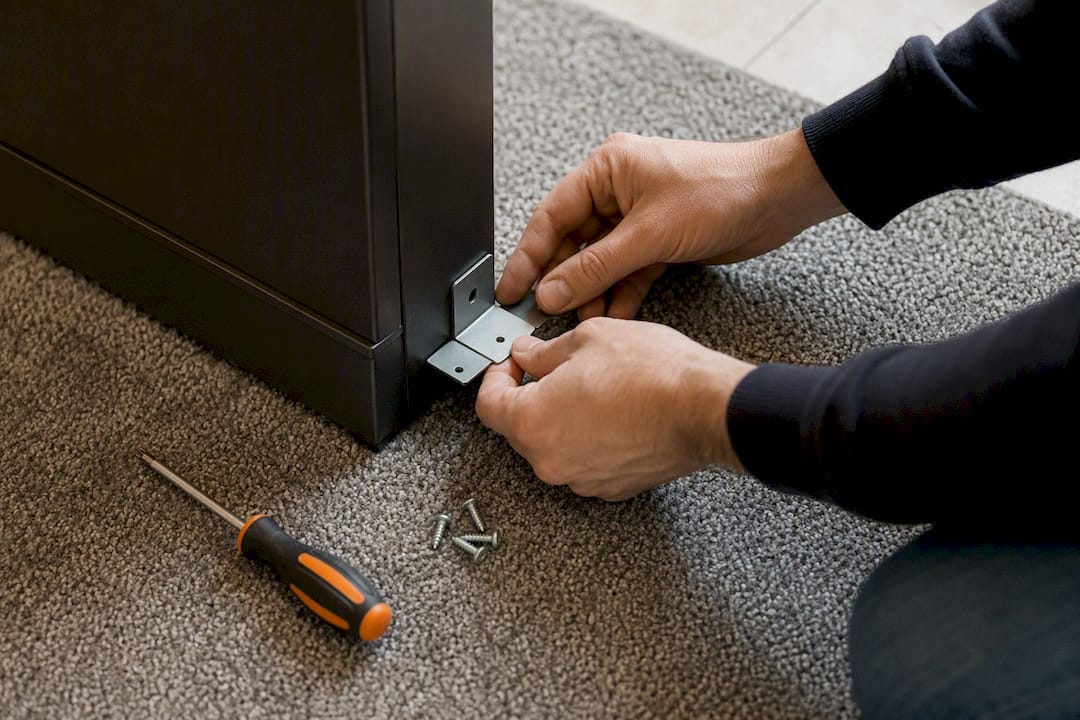
For most standard office fit-outs, in-house facilities teams can fit brackets using the fixing kit supplied. For ganged runs or load-bearing wall fixings, ask your supplier whether on-site fitting is included, since getting the anchor points wrong undermines the whole safety case.
Run any quote against a short safety checklist before you sign off. Interlock type comes first: confirm it’s a verified mechanical interlock, not just a label. For anything taller than a 2-drawer unit, ask specifically whether the extension to a multi-drawer interlock has been structurally tested, since manufacturer guidance recommends treating the 2-drawer interlock as the baseline design and only extending it after separate stiffness and slide testing.
Beyond the interlock itself, check slide rating, drawer material and finish, and the length and scope of the warranty. A cabinet that’s cheap upfront but carries a one-year warranty on a five-year expected lifespan isn’t actually the better deal.
Commercial factors matter just as much for a bulk order:
Before placing a large order, ask your supplier directly:
Pro Tip: Treat vague answers as a red flag before treating them as a negotiating point. A supplier who can’t quote a specific load rating or confirm who fits the anchor brackets usually can’t back the claim on the box either.
Watch for listings with no visible warranty term, no mention of installation guidance, or locking details that just say “secure” without specifying central or individual locks. These are the gaps that cause problems eighteen months in, not on delivery day.
For offices working through this checklist, two ranges are worth specifying directly. The Impulse filing cabinet covers the core 2, 3 and 4-drawer options with published dimensions and warranty terms, making it a straightforward like-for-like comparison against any quote you’ve already received. The Qube filing cabinet range adds a lockable option suited to offices that need central locking across drawers rather than individual keys per drawer.
If your files don’t actually need extra vertical drawers, the Qube roll out suspended filing frame is worth a look. It reorganises lateral filing without adding another tall unit to your floorplan, which can be the simpler fix for a records room that’s already tight on space.
Furnitureforbusiness backs these ranges with:
| Point | Details |
|---|---|
| Product families | Impulse covers standard drawer counts; Qube adds central locking; Qube roll out frame suits lateral filing without extra height. |
| Service | Free UK mainland delivery and bulk pricing apply across the office storage range. |
| Documentation | Spec sheets are downloadable per product, covering dimensions and warranty terms. |
Lead times on commercial filing cabinets vary by drawer count, finish and whether you’re ordering in bulk. Single units of standard sizes tend to move faster than bespoke finishes or large multi-unit orders, so it’s worth confirming a firm delivery window at the point of quote rather than assuming stock availability.
Warranty terms differ by range and should be checked against the product page rather than assumed. A longer warranty on the frame and slides usually signals a supplier confident in the build, particularly on ball-bearing slide mechanisms that see daily use.
Delivery and installation are often offered as separate line items. Free UK mainland delivery gets the cabinet to site, but fitting brackets, ganging kits or wall anchors is a distinct step that may or may not be included depending on the order. For a single pedestal going under a desk, this rarely matters. For a ganged run of 4-drawer towers along a wall, it’s worth confirming in writing whether installation is quoted separately or bundled in.
If your fit-out includes multiple furniture categories at once, coordinating delivery windows across desks and storage can save a separate delivery charge and reduce disruption to a live office. Ask your supplier whether combined scheduling is available before placing separate orders.
A typical procurement journey runs through four stages. First, the spec and quote stage: you confirm drawer count, interlock type, finish and load rating, and get a written quote with lead time attached. This is also when you should resolve any installation questions, since retrofitting a wall anchor after delivery is more disruptive than planning it upfront.
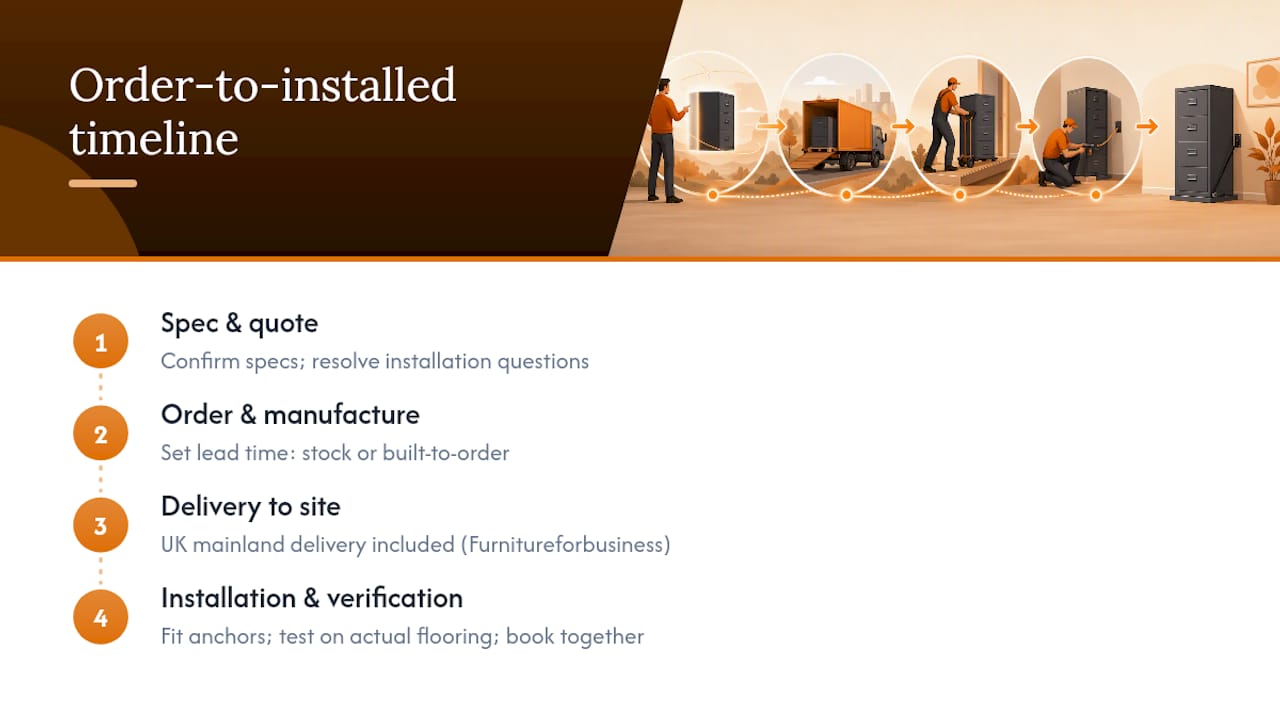
Second is order confirmation and manufacturing or stock allocation, where lead time is set based on whether the unit is in stock or built to order. Third is delivery to site, which for UK mainland orders through Furnitureforbusiness is included free of charge as standard. Fourth is installation and verification: fitting anchor brackets or ganging kits, then testing the interlock and drawer movement on the actual floor covering, not a showroom floor.
Building in time for that final verification step matters more than most procurement schedules allow for. A cabinet that passes a warehouse check can still behave differently once it’s sitting on office carpet with a full load of files. Booking installation and a stability check as one step, rather than two separate visits, keeps the timeline tight and avoids a cabinet sitting half-fitted in a corridor for a week.
The sticker price on a filing cabinet is the smallest part of the real cost. Base price covers the unit itself, but installation, whether that’s a simple bracket fit or a full ganged and anchored run, adds a separate cost that scales with the number of units and the fixing method chosen.
Maintenance is the piece most procurement plans miss entirely. Slides wear with daily use, and a worn slide changes how a drawer sits when open, which affects the interlock’s timing. Periodic checks on slide condition and correct load distribution are a small task, but skipping them is how a compliant installation quietly becomes a less safe one over several years.
Load management also has a cost dimension that’s easy to overlook: overloading the top drawer of a tall unit, or leaving a drawer half-empty while others are full, shifts the balance point in ways that increase tip risk regardless of how good the interlock is. Building a simple annual check into a facilities schedule costs almost nothing against the price of a full cabinet replacement, and it’s the cheapest insurance available against exactly the failure mode an anti-tilt interlock is designed to prevent.
When you’re comparing quotes, ask whether warranty covers slide wear specifically, not just structural defects. That distinction is often where a longer warranty on paper turns out to be narrower in practice.
Most clients specifying filing cabinets for shared office space default to a 2-drawer interlock as the safety baseline, then scale up drawer count only once they’ve confirmed the taller option has been properly tested rather than just marketed as “anti-tilt.” One recurring pattern: a facilities team ordering a run of 4-drawer towers for a records room chooses ganged, wall-fixed units over freestanding ones on castors, even though the freestanding option looked cheaper on the quote. If your site has unusual floor coverings or a tight footprint, it’s worth talking through the specifics with a Furnitureforbusiness advisor rather than guessing from a spec sheet alone.
Furnitureforbusiness supplies anti-tilt filing cabinets built around verified interlock designs, and can provide the spec sheet, load rating documentation and bulk pricing your procurement process needs before you sign off an order. If you’re specifying for a records room, a shared office floor, or a multi-site refit, the office storage category is the fastest way to compare drawer counts, finishes and warranty terms side by side.
Every order to a UK mainland address includes free delivery, and warranty terms are published on each product page rather than buried in a separate document you have to request. For larger runs, bulk pricing applies once you’re ordering multiple units, and installation support is available where wall or floor fixing is part of the job. If your fit-out extends beyond storage, the office accessories range covers the smaller items that tend to get missed in a furniture order. For teams managing installation across a wider refurbishment, this guide to fast office setup covers practical fitting sequencing worth reviewing alongside your own plan.
Start by requesting a quote on the drawer count and finish you need, and ask for the interlock specification in writing before you place the order.
What is an anti tilt filing cabinet?
It’s a filing cabinet fitted with a mechanical interlock that stops more than one drawer opening at once, reducing the risk of the unit tipping forward under load.
Do anti-tilt interlocks make a filing cabinet completely safe?
No. Interlocks reduce tip risk significantly but don’t remove it. Floor covering, load distribution and whether the cabinet is fixed in place all still affect stability.
Should I fix a filing cabinet to the wall or floor?
For tall units (4-drawer towers) or cabinets on carpet, yes. Fixing reduces tip risk substantially, though it also reduces how easily the unit can be relocated later.
What drawer count is safest for a busy office?
A 2-drawer interlock is the tested safety baseline. Taller units can be just as safe, but only when the interlock extension has been structurally tested and the cabinet is properly fixed or ganged.
Can I install anti-tilt fixings myself?
Standard bracket fitting is usually manageable in-house. For ganged runs or load-bearing wall fixings, ask your supplier whether on-site installation support is available, since incorrect anchoring undermines the whole safety case.

Phone: 0330 043 4114
VAT no. GB 991 8681 60
Company no. 07250570