A footrest helps most office workers — provided their feet don’t already rest flat on the floor with a correctly adjusted chair. The core benefits are well-supported by ergonomics research and HSE DSE guidance: reduced lower-back load, better lower-limb circulation, and noticeably less leg fatigue over a working day.
Primary benefits at a glance:
Who should consider one:
| Point | Details |
|---|---|
| Core benefit | A footrest restores neutral pelvic tilt and encourages backrest use, reducing lower-back load. |
| Primary sign you need one | Feet don’t rest flat on the floor when your chair is at the correct height for your desk. |
| Backrest contact evidence | A controlled study found an angled footrest increased backrest use by around 10% for participants who used the backrest. |
| Setup priority | Set chair height for correct wrist and elbow position first, then use a footrest to fill the gap to the floor. |
| Procurement tip | Furnitureforbusiness supplies adjustable footrests alongside ergonomic chairs and desks, with bulk-order pricing and free UK mainland delivery. |
The clearest sign is a gap between your feet and the floor. Sit at your workstation with your elbows at keyboard height, and your back supported. If your feet hang or only the balls of your feet make contact, a footrest will almost certainly help. If your thighs press hard against the front edge of the seat pan, that’s another signal — the chair is too high for your frame, and a footrest corrects the mismatch without forcing you to lower the chair and lose your ideal desk height.
Common scenarios where a footrest earns its place:
Fixed-height desks are the most frequent culprit. Most standard office desks sit at around 720–730mm, which suits someone roughly 175–180cm tall. Anyone shorter than that is likely sitting with their feet unsupported.
Shared workstations create a rotating mismatch. One person’s ideal chair height is another’s awkward compromise. A footrest lets each user fine-tune their position without touching the chair or desk settings.
Sit-stand desks introduce a different problem. When you lower the desk for seated work, the chair height may not change, leaving a gap. Setting up a height-adjustable desk correctly includes accounting for this seated interval, and a footrest fills it neatly.
Frequent leg crossing is worth noting too. If you habitually cross your legs or tuck one foot under you, your body is compensating for a lack of foot support. A footrest removes the need for those habits.
The biomechanical case for footrests rests on one key chain: foot position affects pelvic tilt, pelvic tilt affects lumbar curve, and lumbar curve determines how much load your spinal discs and back muscles carry.
When your feet hang unsupported, the pelvis tends to rotate posteriorly — tilting backward — which flattens the natural inward curve of the lower back. That flattening increases compressive load on the lumbar discs and pulls the thoracic spine into a rounded position. The knock-on effect reaches the neck and shoulders.
A footrest at the right height restores the foot-to-floor contact that keeps the pelvis in a neutral, slightly forward-tilted position. That, in turn, maintains the lumbar lordosis and allows the backrest to do its job. Without foot support, many workers unconsciously lean forward to stabilise themselves, losing contact with the backrest entirely.
Laboratory research backs this up directly. The study, published in Applied Ergonomics, also analysed electromyographic data, meaning it measured actual muscle activity rather than relying on self-report.
Statistic callout: In the laboratory study, an angled footrest increased backrest contact noticeably for participants who used the backrest — a meaningful shift given that backrest use is directly linked to reduced spinal muscle load.
Mayo Clinic’s office ergonomics guidance frames this consistently: correct foot support is one component of a neutral seated posture, alongside wrist position, monitor height, and lumbar support. No single adjustment works in isolation, but foot support is often the missing piece for shorter workers.
In practical terms, a footrest helps posture by:
Sitting with unsupported feet compresses the soft tissue on the underside of the thighs against the seat edge. That compression restricts venous return — the flow of blood back up the legs toward the heart. The result over a long working day is the familiar heaviness, tingling, or swelling around the ankles and feet.
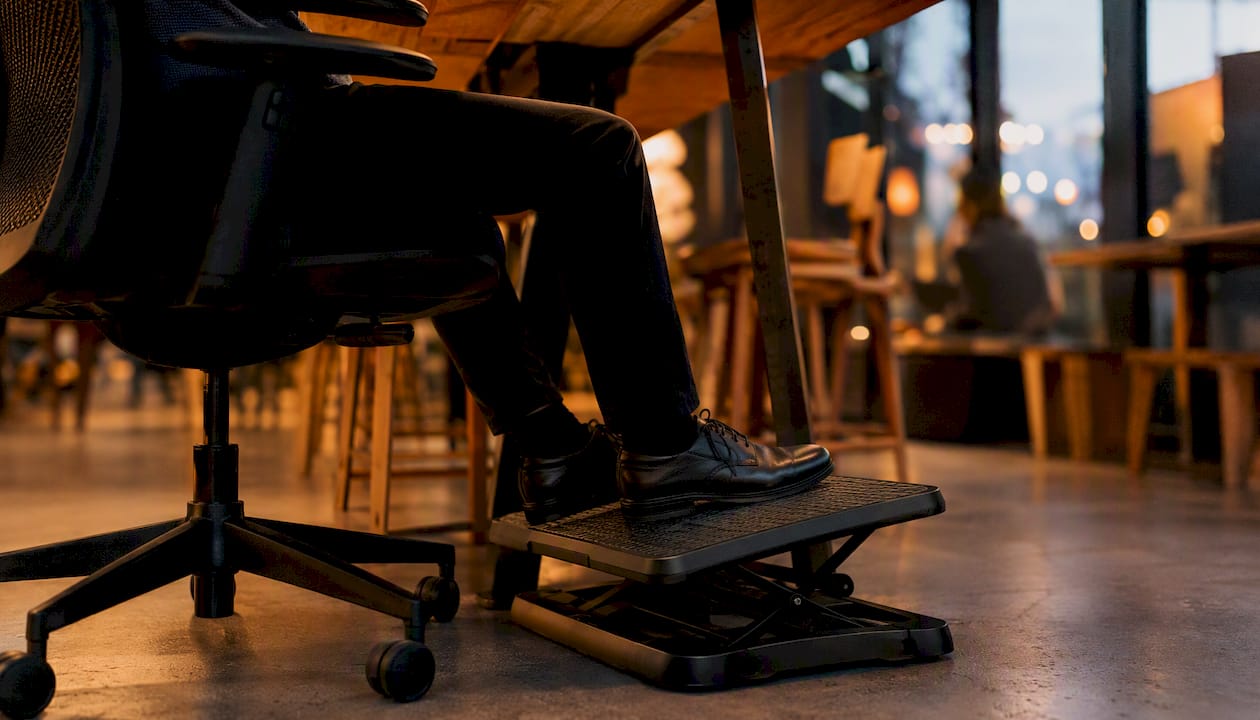
A correctly positioned footrest reduces that thigh compression by distributing leg weight more evenly. Dynamic or rocking footrests go further: the subtle ankle movement they encourage activates the calf-muscle pump, which plays a significant role in pushing blood back up the lower limbs during prolonged sitting. Ergonomics specialists note that this active-sitting effect is one of the more underappreciated benefits of a footrest, particularly for workers who sit for five or more hours a day.
For most healthy office workers, these circulation benefits are meaningful but modest. Reduced numbness, less end-of-day swelling, and fewer pins-and-needles episodes are realistic outcomes. Framing a footrest as a treatment for diagnosed vascular conditions would be an overstatement. If you have a diagnosed circulatory condition, varicose veins causing significant symptoms, or a history of deep vein thrombosis, speak to a clinician before relying on a footrest as a management tool.
Pro Tip: If your ankles swell noticeably by mid-afternoon, try a rocking footrest rather than a static platform. The gentle motion keeps the calf pump active without requiring you to think about it.
Footrests divide into four broad types, each with a different best-fit scenario.
Angled wedge (static platform)
A fixed-angle platform, typically set at 15–20 degrees. Simple, stable, and inexpensive. Best for workers who need consistent foot support at a set height and don’t want to fiddle with adjustments. The limitation is that the angle is fixed, so it suits one posture rather than adapting to movement.
Adjustable height platform
A flat or lightly angled platform with height settings, often in 25mm increments. The right choice for shared workstations where multiple users need different support heights, and for workers who alternate between sitting positions during the day. Ergonomic consultants recommend adjustable models specifically when there is an anthropometric mismatch — that is, when the worker’s body dimensions don’t match the furniture.
Rocking or active footrest
A curved base allows the footrest to tilt and rock with foot movement. Activates the calf-muscle pump, reduces static load on the legs, and suits workers who find static positions uncomfortable over long periods. Slightly less stable than a flat platform, which can feel odd initially.
Cushioned or massaging footrest
A padded surface, sometimes with massage nodes or a textured top. Prioritises comfort over biomechanical correction. Useful for workers whose feet are already well-supported but who want pressure relief, particularly on hard flooring. Less effective for correcting a genuine height mismatch.
| Type | Best for | Adjustable? | Active movement? |
|---|---|---|---|
| Angled wedge | Single user, consistent posture | No | No |
| Adjustable platform | Shared desks, varied users | Yes | No |
| Rocking/active | Long sitting periods, circulation | Limited | Yes |
| Cushioned/massaging | Comfort, hard floors | No | No |
Correct set-up takes about five minutes and makes the difference between a footrest that helps and one that creates a new problem.
Set your chair height first. Sit with your back against the backrest. Adjust the chair so your elbows rest at roughly keyboard height with your forearms roughly parallel to the floor. Your wrists should be neutral, not bent up or down. This is your working height — don’t compromise it to get your feet to the floor.
Measure the gap. With the chair at the correct height, note how far your feet are from the floor. If there’s a gap of more than a few centimetres, or if only the balls of your feet make contact, you need foot support at that height.
Position the footrest. Place it directly under your feet, close enough that your feet rest on it naturally without stretching forward. The front edge should sit roughly under your knees.
Set the angle. Aim for a position where your knees are at roughly 90–100 degrees and your hips are at or slightly above knee height. A slight forward tilt on the footrest (toes higher than heels) tends to encourage a more neutral pelvic position for most people.
Test and adjust. Sit for 10–15 minutes and check in. Your lower back should feel supported by the backrest, not braced by your core. If you’re still leaning forward or your thighs are pressing hard on the seat edge, adjust the footrest height up or down by one increment.
HSE DSE guidance is clear that if you cannot achieve a comfortable, neutral posture with the furniture available, your employer has a responsibility to provide appropriate adaptations — including a footrest. If self-adjustment doesn’t resolve the problem, request a formal DSE workstation assessment through your line manager or HR team. This is a legal entitlement for display screen equipment users in the UK, not a favour.
Pro Tip: A simple self-check: once the footrest is in place, try to slide a hand between your thigh and the seat edge near your knee. You should be able to do so with light pressure. If it’s tight, the footrest may be too high.
A footrest helps only when it corrects a real setup gap. Used incorrectly, it creates new problems.
The most common mistake is over-elevation. Raising the footrest too high tilts the pelvis forward excessively, increasing lumbar lordosis beyond the neutral range and loading the facet joints at the back of the spine. It also reduces the contact area between the thighs and the seat pan, concentrating pressure on a smaller surface. Practical guidance on footrest use flags this as a frequent error among workers who assume higher is better.
Common myths:
Seek professional input — from a DSE assessor or a physiotherapist — if you have persistent lower-back, hip, or knee pain that doesn’t resolve with workstation adjustments. A footrest is a tool, not a treatment.
Pro Tip: Before buying a footrest, spend 10 minutes doing a basic DSE check on your chair and desk settings. If your feet already rest flat with correct knee and hip angles, you don’t need one.
Lower-back pain: Often yes, when the pain stems from poor pelvic positioning and loss of lumbar curve. A footrest that restores neutral pelvic tilt and encourages backrest use reduces the muscular effort required to hold the spine upright. The effect is most pronounced for shorter workers on fixed-height desks. Persistent or severe back pain warrants a physiotherapy assessment regardless of workstation changes.
Knee pain: A footrest can help when the chair is too high and the knees are hanging at an acute angle, creating pressure on the patellar tendon and knee joint. Bringing the feet to a supported position at the right height reduces that downward pull. It won’t help knee pain caused by structural issues.
Neck and shoulder tension: Indirectly, yes. When the lower back is unsupported, the upper body compensates by rounding forward, which loads the neck extensors and upper trapezius. Correcting the pelvic position with a footrest can reduce that compensatory tension over time.
Foot and ankle discomfort: A footrest reduces the pressure of the seat edge on the underside of the thighs, which often relieves the referred tingling that workers mistake for foot problems. For plantar fasciitis or other structural foot conditions, a cushioned footrest may offer comfort but is not a clinical intervention.
If any of these symptoms persist after workstation adjustments, consult a clinician. Workstation ergonomics addresses posture and load; it doesn’t replace medical assessment.
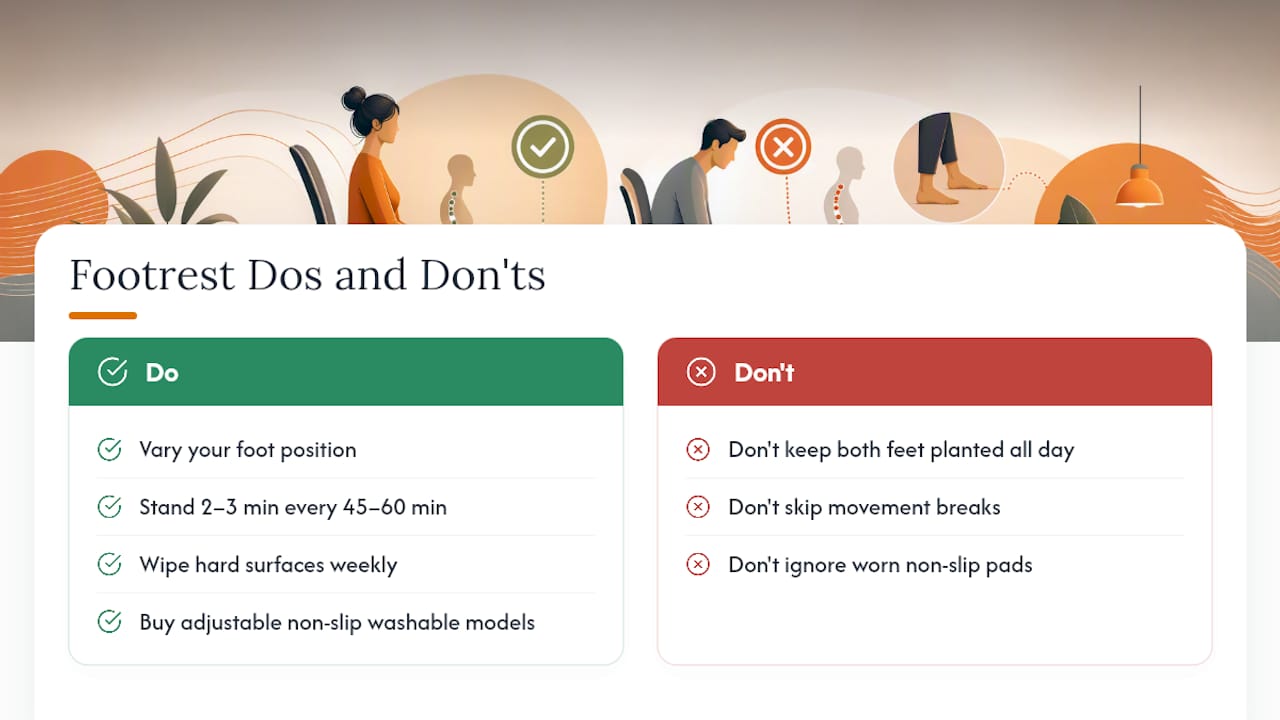
Vary your foot position. Don’t plant both feet in exactly the same spot all day. Shift weight from one foot to the other, flex your ankles periodically, and use a rocking footrest if you tend to sit very still.
Micro-movements matter. Stand up for two to three minutes every 45–60 minutes. A footrest reduces static load during sitting, but it doesn’t eliminate the benefit of regular movement breaks. The NYT’s ergonomic workstation guidance includes movement breaks as a core recommendation alongside physical adjustments.
Cleaning and maintenance. Wipe down hard plastic or metal surfaces weekly with a damp cloth. Fabric-topped footrests benefit from a lint roller and occasional spot cleaning. Check the non-slip base regularly — worn grip pads reduce stability and can cause the footrest to slide, which defeats the purpose. For workplace managers handling multiple units, office maintenance guidance covers equipment upkeep schedules worth building into your facilities routine.
Employer and DSE responsibilities. Under the Health and Safety (Display Screen Equipment) Regulations 1992, employers must provide a footrest when a DSE assessment identifies one as necessary. Workers don’t need to purchase their own. If you’ve identified a need, raise it with HR or your line manager and request a formal assessment. Procurement teams buying footrests in bulk should match them to the chair and desk specifications in use — an adjustable model covers the widest range of users and avoids the need for multiple SKUs.
Pro Tip: For bulk procurement, choose an adjustable-height model with a non-slip base and a washable surface. It covers the most user types, reduces complaints, and is easier to maintain across a large office.
The footrest is one of the most overlooked items in a commercial fit-out. Procurement teams spend considerable time specifying chairs and desks, then treat accessories as an afterthought. In practice, a £30–£50 footrest can resolve the discomfort that a £400 chair fails to address for a shorter worker — because the chair was specified for an average frame, not theirs.
What we see repeatedly when specifying ergonomic setups for UK offices is that fixed-height desks create a predictable mismatch for a significant portion of any team. The solution isn’t always a height-adjustable desk for every workstation. For many offices, pairing a quality ergonomic chair with an adjustable footrest resolves the issue at a fraction of the cost of a full desk replacement.
The practical buying tip for procurement managers: specify adjustable-height footrests as standard for any workstation where the desk height is fixed. Don’t wait for complaints. A DSE assessment will identify the need, but you can pre-empt it by including footrests in the initial fit-out specification. Match them to the chair range — seat pan height and depth affect how much footrest height you need — and prefer models with a textured, non-slip surface that can be wiped clean easily.
Equipping a UK office with the right ergonomic accessories doesn’t need to be complicated. Furnitureforbusiness supplies office accessories including footrests alongside its full range of ergonomic chairs and height-adjustable desks, with free delivery to the UK mainland and bulk-order pricing for teams.

For procurement managers fitting out multiple workstations, the practical advantage is sourcing footrests, chairs, and desks from a single supplier — matched specifications, consistent delivery, and no chasing multiple vendors. The office chairs range includes task and operator chairs suited to pairing with footrests for shorter users or fixed-height desk setups. If your DSE assessment has flagged foot support as a requirement across a team, contact Furnitureforbusiness to discuss bulk pricing and matched ergonomic bundles.
This article is general information, not a substitute for advice from a qualified doctor. Consult a qualified healthcare professional about your own circumstances before acting on anything here.

Phone: 0330 043 4114
VAT no. GB 991 8681 60
Company no. 07250570