Set the number of desks your hybrid office needs by multiplying your peak daily attendance by 1.1 (a 10% buffer), then divide total headcount by that figure to get your desk sharing ratio. According to YAROOMS, peak attendance in hybrid offices generally sits within a moderate range, and a buffer around 10–15% is commonly used for planning.
The two numbers you need to track are:
Pro Tip: Never run a desk-sharing programme without a booking system. Without one, the ratio is theoretical — staff arrive early to claim desks and the whole arrangement collapses into first-come, first-served anxiety. A booking tool turns a number on a spreadsheet into a workable policy.
| Point | Details |
|---|---|
| Use peak attendance, not averages | Plan desks around your busiest day (typically Tuesday–Thursday), not the weekly mean. |
| Apply a 10% buffer | Multiply peak attendance by 1.10 to get desks needed; push to 15% for fast-growing teams. |
| Benchmark by hybrid intensity | Balanced hybrid teams (2–3 days in) typically land at 1.2 to 1.— employees per desk. |
| Segment by team function | Finance, legal, and IT often need ratios closer to approximately 1.1 to 1.3 due to equipment and regulatory needs. |
| Furnitureforbusiness for procurement | Convert your desk count into an order via the office desks and chairs collections, with free UK mainland delivery. |
The calculation has two layers: a quick static check and a more accurate effective ratio that accounts for real attendance patterns.
Do not use average attendance. Tuesdays, Wednesdays, and Thursdays consistently draw the highest footfall in UK hybrid offices, and planning to the average leaves you short on those days. Measure over 4–6 weeks using one or more of these sources:
Record the highest single-day figure from each week and take the average of those peaks. That is your planning peak.
PointGrab recommends calculating desks needed from peak attendance plus a planning buffer rather than from raw headcount. The formula:
Desks needed = peak attendance × (1 + buffer)
Employee:desk ratio = total headcount ÷ desks needed
Quick conversions for procurement planning:
Deskbird’s benchmarking guide puts the common range at 1.2–2.0 employees per desk, with the right figure depending on how often staff actually come in. The table below maps attendance intensity to practical ratio ranges and the team types that typically fit each.
| Hybrid model | Typical attendance | Employee:desk ratio | Best suited to |
|---|---|---|---|
| Office-first (4–5 days) | around 90% | approximately 1.1 to 1.3 | Finance, legal, regulated functions, IT support |
| Balanced hybrid (2–3 days) | around 70% | 1.2 to 1.— | General office teams, HR, marketing, project management |
| Flex/field (1 day or less) | around 30–50% | above 1.8 | Sales, consultants, field engineers, remote-first teams |
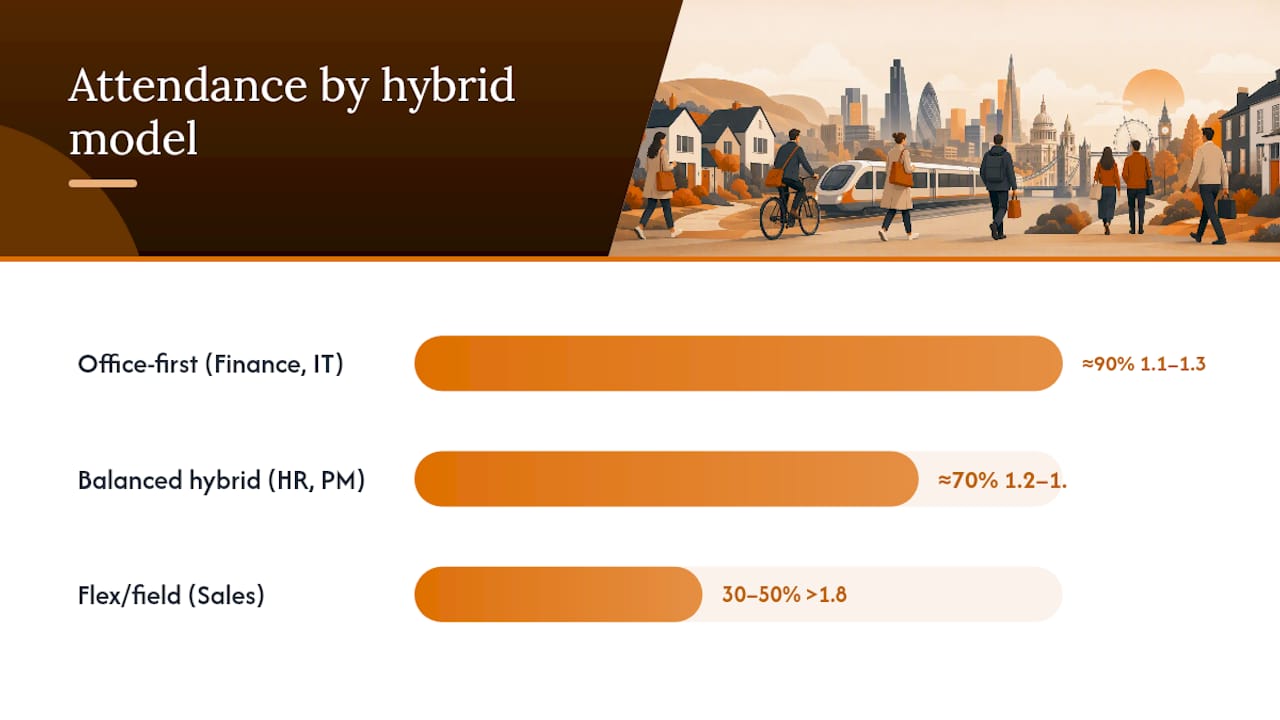
A ratio below 1.10 is effectively one desk per person with a small buffer. That is appropriate for teams with fixed equipment, regulatory requirements, or confidentiality needs. Pushing above 2.0 requires strong booking governance and a culture comfortable with hot-desking.
UK-specific considerations that push a team toward a lower ratio:
Pro Tip: Resist the temptation to set one ratio for the whole company. A single company-wide figure almost always under-serves your most office-dependent teams and over-provisions for your most remote ones. Segment by department or function and set a ratio for each group.
Getting the benchmark right is only the starting point. Several real-world variables should push your target ratio up or down before you commit to a desk count.
Attendance patterns. The gap between average and peak attendance is the single biggest driver of ratio errors. Many organisations discover their Tuesday-to-Thursday peak is 20–30 percentage points higher than their Monday-to-Friday average. Build the ratio around the peak, not the mean.
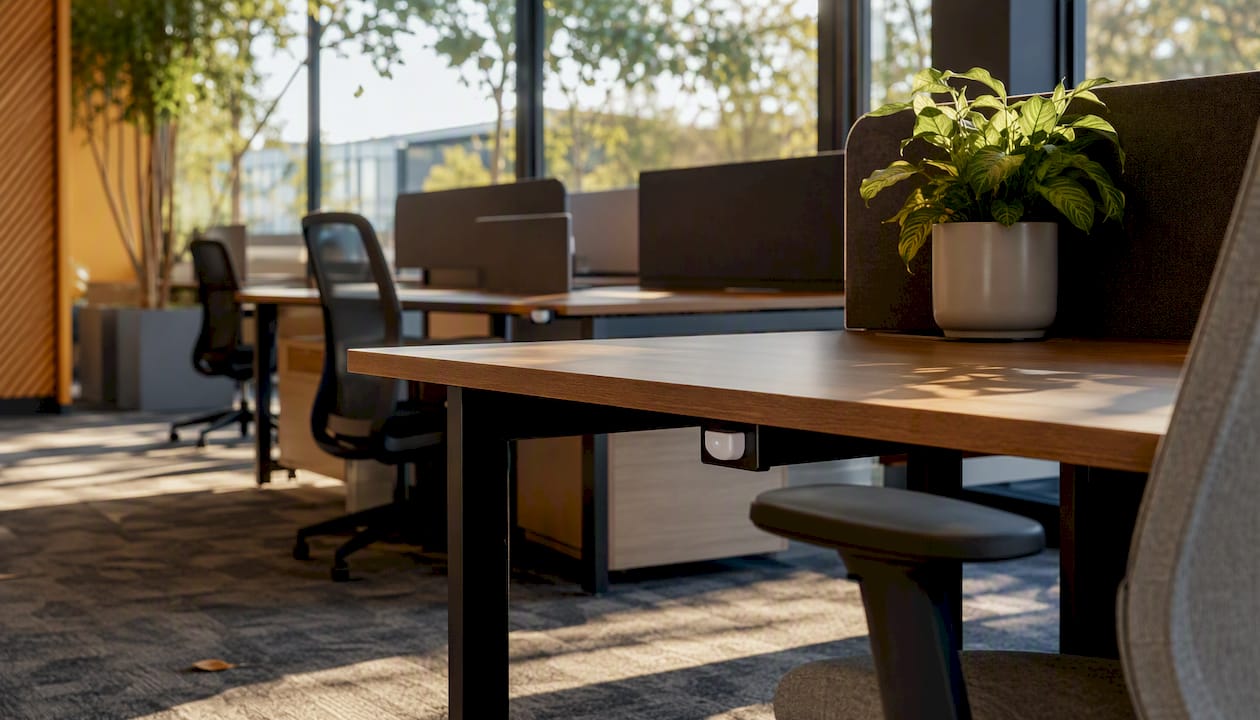
Team function and collaboration needs. Teams that spend most of their office time in meeting rooms or collaboration zones need fewer individual desks than teams doing heads-down focused work. A product team that books a project room for three hours a day needs fewer solo desks than an accounts team processing invoices all morning.
Technology and equipment. Fixed dual-monitor setups, specialist headsets, drawing tablets, and secure workstations all create a case for dedicated desks. Every dedicated desk reduces the pool available for sharing and effectively lowers the usable ratio for everyone else. Audit equipment dependencies before finalising numbers.
Build anticipated headcount into the denominator, not just current staff. Seasonal spikes — common in retail head offices, accountancy practices, and public sector teams — deserve their own peak-attendance measurement.
Policy and culture. Mandated in-office days compress attendance into a narrower window and raise peak figures sharply. If your policy requires all staff in on Wednesdays, Wednesday becomes your planning peak by definition. Team agreements that spread attendance more evenly across the week allow a higher ratio with less risk.
Geographic and multi-site differences. A London office with expensive per-sq-m costs has a stronger financial case for a higher ratio than a regional office where space is cheaper. Lease terms also matter: if you are 18 months from a break clause, a conservative ratio now preserves optionality later.
According to Stealth Agents’ 2026 hot-desking research, many North American companies have adopted hot-desking arrangements, with utilisation and savings data that support the business case for right-sizing. UK adoption follows a similar trajectory, particularly in professional services and technology sectors.
A ratio calculated from assumptions rather than evidence is a guess with a formula attached. The tools below turn attendance into data you can actually plan from.
| Source | Strengths | Weaknesses |
|---|---|---|
| Badge entry | Accurate headcount; widely available | Building-level only; no floor or desk granularity |
| Wi-Fi logs | Floor-level granularity; no hardware needed | Counts devices, not people; VPN users may not register |
| Desk booking system | Shows intent and team-level patterns | Misses walk-ins; inflated by no-shows |
| Occupancy sensors | Real-time, seat-level accuracy | Hardware cost; installation time |
For most UK offices, a combination of desk booking data and badge entry gives enough accuracy to set a reliable ratio. Add occupancy sensors when you need floor-level granularity or are managing a large estate across multiple sites.
Report these monthly during the first six months of a new ratio, then quarterly once patterns stabilise. Visualising occupancy trends before committing to a new configuration is a sound approach, as Mapiq’s space analytics methodology recommends.
Privacy note: When collecting occupancy data in a UK office, minimise the collection of personally identifiable information. Badge data tied to named individuals, Wi-Fi logs linked to personal devices, and booking records all carry data-handling obligations under UK GDPR. Work with your Data Protection Officer to confirm that your collection method aligns with your internal privacy policy and that staff are informed about what is collected and why. Aggregated, anonymised reporting is usually sufficient for ratio planning and carries lower compliance risk.
For broader policy implications of hybrid attendance rules, CIPD’s workplace guidance is a useful reference for UK employers navigating the HR side of desk-sharing arrangements.
The ratio is the maths. Implementation is where it either works or falls apart. A well-communicated, well-governed rollout makes the difference between a policy staff trust and one they route around.
Governance essentials:
Pro Tip: Keep a small “always-available” pool of five to ten desks that require no booking. These act as a pressure valve on high-demand days and reduce the anxiety that comes with a fully booked system. Staff who know there is always somewhere to sit are more relaxed about the whole arrangement.
For practical layout and signage guidance, workspace organisation tips for UK office managers covers zoning, storage, and clear-desk setups in detail.
A ratio set once and left alone will drift out of alignment with real behaviour within a year. Attendance patterns shift, teams grow, policies change, and the ratio needs to follow.
| Review type | Frequency | What to examine |
|---|---|---|
| Routine review | Quarterly | Peak utilisation, no-show rate, booking friction, team feedback |
| Triggered review | Immediately | Sustained overcrowding, headcount change of 10%+, policy shift |
| Annual reset | Annually | Full recalculation using yearly data; update procurement plan |
At the quarterly review, compare peak utilisation against your target.
Triggers that should force an immediate recalculation:
Post-change verification checklist:
Experts consistently recommend reassessing ratios quarterly and segmenting by team, particularly for functions such as finance, legal, and IT that may need lower sharing ratios due to equipment and regulatory requirements. Pair that cadence with the essential elements for hybrid offices guide to keep furniture and technology choices aligned with your evolving numbers.
Once the maths is done, the next question is what to actually order. The example below uses the 200-person organisation from the calculation section.
Allocating 30% of the order to height-adjustable desks is a practical starting point for a mixed hybrid team. Hot-desking environments benefit from sit-stand capability because staff of different heights share the same workstation across the day.
Product checklist for a hybrid desk order:
Ordering tips for UK buyers:
For space-efficient desk options suited to flexible seating arrangements, the space-efficient desks guide covers bench configurations and layout options relevant to shared-desk environments.
The ratio is not a facilities management technicality. It has a direct line to three things leadership cares about: cost, sustainability, and whether staff actually want to come in.
Cost. Office space in UK cities is priced per sq m, and every unnecessary desk consumes floor area that costs money. Right-sizing from 200 desks to 143 in the worked example above frees 57 workstations worth of space. At typical London Grade B rents, that is a material saving on an annual lease. Organisations that have moved to shared desking report meaningful reductions in real estate costs, a finding supported by Stealth Agents’ 2026 hot-desking data.
Sustainability. Fewer desks means less furniture to manufacture, less energy to heat and light unused workstations, and a smaller fit-out footprint. For organisations with net-zero or ESG commitments, right-sizing the desk count is one of the more straightforward contributions to a lower carbon footprint.
Employee experience. A ratio that is too high produces daily seat shortages and erodes trust in the hybrid model. A ratio that is too low wastes money and signals poor planning. The right ratio, governed by a booking system and reviewed regularly, means staff arrive knowing they will have a seat, and that predictability matters more than most facilities teams realise. Office layout and well-being research consistently links desk availability and workspace quality to employee satisfaction with hybrid arrangements.
Helping UK businesses convert a ratio calculation into a physical fit-out is exactly where furniture choices become consequential. The number of desks is one decision; the type of desk, the chair paired with it, and the storage solution that makes a clean-desk policy workable are the decisions that determine whether the arrangement actually functions day to day.
Height-adjustable desks in shared zones reduce friction when multiple users rotate through the same station. Bench configurations work well in zoned team areas where the same group occupies the same run of desks most days. Personal storage, whether pedestals or lockers, is not optional in a hot-desking environment — without it, staff leave belongings on desks overnight and the clean-desk policy breaks down within a fortnight.
The procurement example above is a starting framework. Every organisation’s split between bench desks, height-adjustable stations, and dedicated desks will differ based on team composition, budget, and floor layout.
Furnitureforbusiness supplies commercial office furniture to UK businesses, with free delivery to the UK mainland. When you have run the calculation and know how many desks you need, the office desks collection covers bench desks, height-adjustable stations, and desk bundles suited to shared-desk environments.
Pair desks with task chairs from the office chairs range and add meeting room furniture for the collaboration space your ratio frees up. Bulk order pricing is available, and the team can advise on product selection for hybrid fit-outs of any size. Browse the collections or get in touch to discuss your desk count and layout requirements.
The sources below were used in preparing this guide and are worth consulting directly for benchmarking data, calculation tools, and UK policy context.
Phone: 0330 043 4114
VAT no. GB 991 8681 60
Company no. 07250570