Crib 5 upholstery refers to seating or upholstered furniture whose complete build — cover fabric, foam, interliner and any barrier layer — has passed BS 5852 Ignition Source 5, the wooden-crib fire test required across most UK contract environments. The single most important thing you can do before placing an order is request the composite test certificate, not just a fabric roll certificate, because a Crib 5 rating belongs to the entire assembly, not to any one component.
Before you approve a supplier, ask for all of the following:
Pro Tip: If a supplier can only provide a fabric roll certificate with no foam or interliner listed, that certificate does not prove your finished piece will pass. Ask specifically: “Does this certificate describe the full upholstery build as it will be manufactured?”
Crib 5 compliance belongs to the entire upholstery composite — fabric, foam and interliner together — and no single component certificate is sufficient on its own.
| Point | Details |
|---|---|
| Composite certificate is mandatory | Always request the full BS 5852 IS5 certificate listing fabric, foam and interliner, not a fabric-only declaration. |
| UKAS accreditation matters | Insist on a named UKAS-accredited test house on the certificate for defensible compliance evidence. |
| Inherent FR outlasts topical treatment | Inherently FR fibres maintain performance through repeated cleaning; topical treatments can degrade and may fail water-soak retests. |
| Record batch numbers and maintenance | File fabric roll codes, foam batch references and cleaning records with each asset for audit or inspection readiness. |
| Furnitureforbusiness supplies documentation | Contract-grade upholstered seating is available with full test certificates and composite details supplied on request. |
Crib 5 is the informal name for Ignition Source 5 within BS 5852, the British Standard for fire testing of upholstered furniture composites. The standard defines a progressive series of ignition sources, from Source 0 (a smouldering cigarette) through Source 1 (a small butane flame) up to Source 5 (a wooden crib). Each test must be completed on the same composite in sequence — you cannot skip straight to the crib test without first passing the cigarette and match tests.
The wooden crib itself is a small lattice of pine sticks, ignited and placed against the junction of the seat and back of the test specimen. The pass criterion is straightforward: no flaming or progressive smouldering in the composite within a defined observation period after ignition of the crib burning out. The lab records timings, photographs the specimen at intervals, and notes whether any char extends beyond the immediate ignition zone.
What the test actually measures is the behaviour of the complete upholstery build under a sustained ignition source. That means:
Pro Tip: A fabric that passes Crib 5 in one composite can fail in another if the foam grade or interliner changes. The certificate is only valid for the exact build described on it.
Crib 5 is not universally mandatory for all commercial furniture, but it is the de facto minimum in most UK contract procurement specifications. Sectors where you will almost always encounter it as a contractual or regulatory requirement include:
The legal framework sits within the Furniture and Furnishings (Fire) (Safety) Regulations 1988, which set out the ignition resistance requirements for upholstered furniture supplied in the UK. The 20latest amendment guidance clarifies which schedules apply to different furniture categories and is worth checking before specifying for any regulated premises.
Beyond the regulations themselves, fire risk assessments carried out under the Regulatory Reform (Fire Safety) Order 2005 frequently specify Crib 5 as a condition of the assessment outcome. Insurers for hospitality and care-sector premises often go further, making Crib 5 compliance a condition of cover. If your fire officer or insurer has specified it, treat it as mandatory regardless of whether the base regulations technically require it for your furniture category.
Legal note: The Furniture and Furnishings (Fire) (Safety) Regulations apply to furniture supplied in the course of business. If you are procuring for a regulated premises, always verify which schedule applies to your specific furniture type and confirm with your fire risk assessor or legal adviser before finalising specifications. This article is general guidance, not legal advice.
For hospitality fit-outs in particular, the hospitality furniture checklist for UK offices covers additional specification considerations worth reviewing alongside fire compliance.
This is where most specification errors happen. A Crib 5 certificate covers the assembly that was actually tested in the lab, and only that assembly. Swap any one component and the certificate no longer applies.
The components that must be described on the certificate are:
Consider a practical scenario: a supplier holds a Crib 5 certificate for a fabric tested over CMHR foam with a certified interliner. You ask them to use a different, lower-cost foam because it is in stock. That substitution invalidates the certificate entirely, even if the fabric itself is unchanged. The same applies if the interliner is omitted to save cost.
Trade experts consistently recommend requesting the full assembly certificate, not a fabric-only roll certificate, and checking that the composite description on the certificate matches the production specification you have agreed with the manufacturer.
There are three main routes to a Crib 5-compliant upholstery build, each with different cost, durability and maintenance profiles.
Fabrics woven from fibres that are fire-retardant by their chemical nature — modacrylic, Trevira CS, certain wool blends and FR polyester — do not rely on a surface treatment to pass. The FR performance is built into the fibre itself, so it cannot wash out or wear off. These fabrics tend to have a longer service life in high-cleaning environments such as healthcare and hospitality, and they are the preferred choice where repeated laundering or wet cleaning is likely.
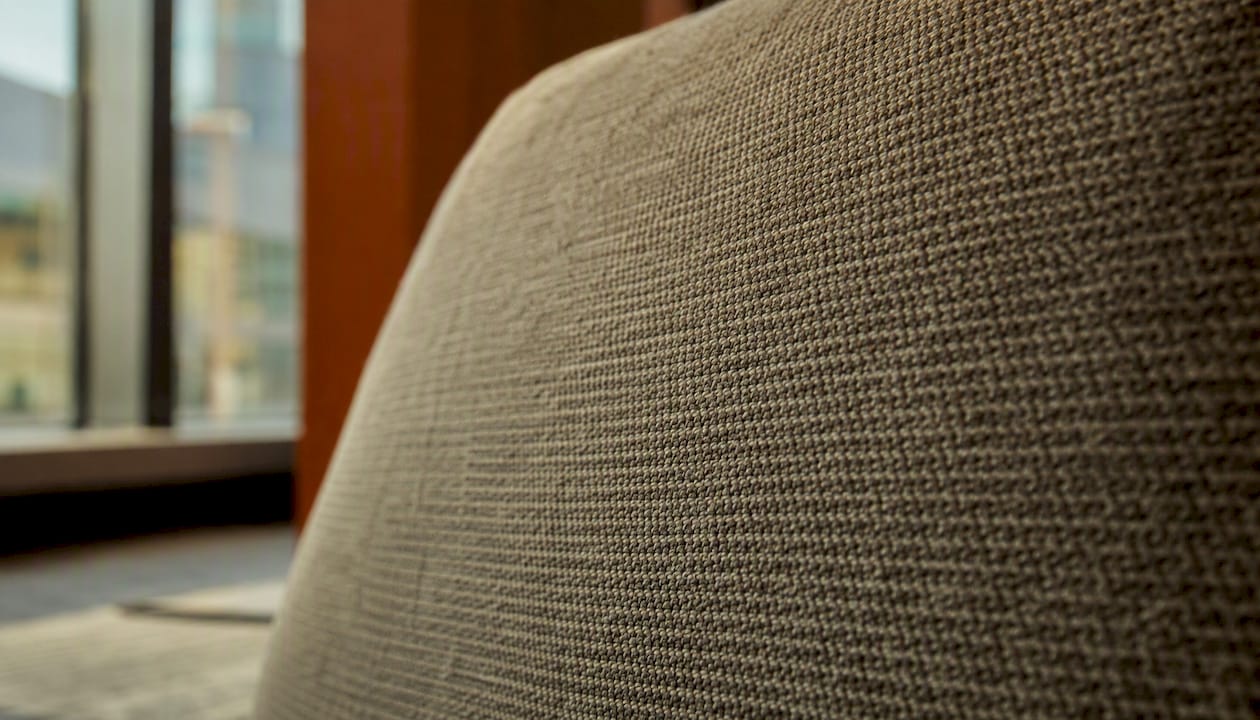
Many standard contract fabrics that would not pass Crib 5 untreated can be treated by a specialist FR treatment house. Back-coating applies a chemical compound to the reverse of the fabric; impregnation saturates the fibre structure. Both approaches can achieve a pass, but topical treatments can be less durable than inherently FR fibres and may fail water-soak retests. If the certificate does not confirm that the water-soak stage was completed, the treatment’s durability under wet conditions is unverified.
Combustion-modified high-resilience foam is the standard choice for contract seating. It is formulated to resist ignition and limit flame spread, and it forms the backbone of most Crib 5 composites. Where a chosen fabric would not pass on its own, a certified interliner — a barrier cloth placed between the fabric and foam — can bring the composite up to standard. This is also a recognised cost-saving route: a certified Crib 5 interliner paired with a non-certified top fabric can achieve compliance, provided the entire assembly has been tested and certified together.
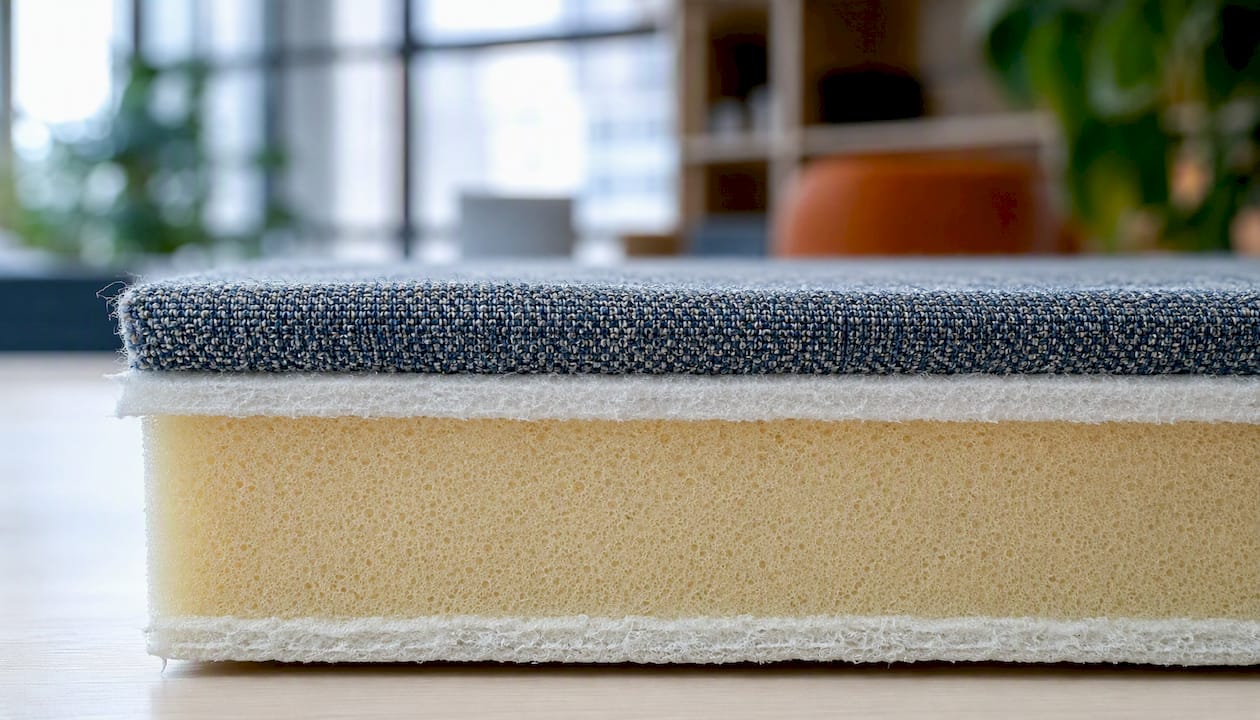
The table below summarises the key differences between the three approaches.
| Approach | Durability | Cleaning tolerance | Cost profile | Water-soak risk |
|---|---|---|---|---|
| Inherently FR fibres | High — FR is permanent | Suitable for repeated wet cleaning | Higher fabric cost | None — FR is structural |
| Topically treated fabric | Moderate — treatment can degrade | Limited; check care label | Lower fabric cost | Potential fail if water-soak not completed |
| CMHR foam + interliner | High for foam; interliner varies | Depends on cover fabric | Mid-range | Depends on interliner certification |
For contract-grade Crib 5 fabrics, a Martindale abrasion rating in the range typical for general contract use, with healthcare and heavy-use environments specifying higher abrasion resistance standards. Always check the datasheet, as FR treatment does not automatically confer high abrasion resistance.
Understanding the broader criteria for contract-grade upholstery helps place Crib 5 in context alongside durability, cleanability and warranty requirements.
Several established UK contract fabric suppliers list Crib 5 products as a filterable category on their websites. The following are worth knowing when sourcing materials.
Camira (Camira Contract) is one of the UK’s largest contract textile manufacturers, with a broad range of woven fabrics carrying Crib 5 certification across healthcare, hospitality and office sectors. Their datasheets list composite details and test references.
Panaz specialises in FR contract fabrics for hospitality and healthcare, with inherently FR options and treated ranges. Their technical team can supply composite certificates on request.
Enduratex offers vinyl and coated fabrics with Crib 5 ratings, commonly specified for healthcare seating where wipe-clean performance is as important as fire compliance.
Spradling Contract produces coated and vinyl upholstery materials with documented FR performance, widely used in transport and public-space seating.
Sunbury Textiles carries a range of contract fabrics including Crib 5-rated options across woven and plain weave constructions, with technical support for specification queries.
Loome Fabrics and Upholstery Fabrics UK both list Crib 5 as a searchable filter, making them practical starting points for upholsterers sourcing compliant cover fabrics for bespoke projects.
When requesting samples from any supplier, ask for the following in writing:
A short sample-request email you can adapt:
A clear procurement checklist prevents the most common compliance failures. Work through these steps before approving any order.
For a broader procurement workflow covering fit-out projects, the furniture procurement workflow guide sets out a useful step-by-step process.
Pro Tip: For the highest level of assurance, request a signed declaration from the manufacturer confirming that the finished furniture piece — not just the fabric — was assembled using the exact components described in the test certificate. This is the document a fire officer or insurer will want to see.
The lab procedure follows a fixed sequence. The composite is first subjected to Source 0 (a smouldering cigarette placed on the horizontal surface) and Source 1 (a small butane flame applied to the vertical face). Both must be passed before the Source 5 wooden crib test begins.
For the crib test, the specimen is assembled in a standard seat-and-back configuration. The wooden crib is placed at the seat-back junction, ignited, and left to burn. The technician observes the composite for 10 minutes after the crib has burned out, recording any flaming, progressive smouldering or char spread. A pass means no progressive burning beyond the immediate ignition zone within that window.
Test reports typically include:
When reviewing a report, check these fields carefully:
| Report field | What to look for | Red flag |
|---|---|---|
| Composite description | Full fabric code, foam grade, interliner reference | “Fabric only” or missing foam/interliner detail |
| Test house | Named UKAS-accredited laboratory | No UKAS number or unnamed lab |
| Water-soak stage | Completed and documented | “Not applicable” on a topically treated fabric |
| Result | Pass for IS0, IS1 and IS5 | Pass for IS5 only, with IS0/IS1 not recorded |
| Sample batch | Lot or roll number recorded | No batch reference — cannot tie to production |
Inherently FR fabrics are the most forgiving in service. Because the fire-retardant property is part of the fibre, wet cleaning, steam cleaning and repeated laundering do not remove it. Follow the manufacturer’s care label, but there is no FR-specific restriction on cleaning method for inherently FR materials.
Topically treated fabrics are more sensitive. The FR chemical sits on or within the fibre surface, and aggressive cleaning — particularly alkaline detergents, high-temperature washing or abrasive scrubbing — can degrade it. Industry guidance recommends checking whether the full water-soak stage was completed as part of certification, because a certificate without that stage does not confirm the treatment survives wet conditions. For premises where upholstery is cleaned frequently, inherently FR fibres are the lower-risk choice.
For ongoing compliance, maintain the following:
Patch repairs and partial reupholstery are a particular risk area. Replacing even a small section of cover fabric with a different material, or using a different foam for a cushion replacement, can mean the finished piece no longer matches the tested composite. If a repair is necessary, use the same fabric code and foam grade as the original, and retain the supplier’s written confirmation that the materials match.
For more on maintaining durable upholstery in commercial spaces, the considerations around cleaning regimes and service life apply directly to Crib 5-rated pieces.
Myth: A Crib 5 fabric certificate covers any furniture it is used in.
Fact: The certificate covers only the composite tested. Use the same fabric with a different foam or without the specified interliner, and the certificate is void for that build.
Myth: Any fabric labelled “Crib 5” is automatically compliant for contract use.
Fact: “Crib 5” on a fabric label or datasheet may refer to a fabric-only indicative test, not a full composite test. Always check whether the certificate lists foam and interliner, and whether the water-soak stage was completed.
Myth: Topical FR treatments last the lifetime of the furniture.
Fact: Topical treatments can degrade with cleaning and use. Treatments may fail water-soak retests if the water-soak stage was not part of the original certification. For long-life contract furniture, inherently FR fibres carry less maintenance risk.
Myth: Crib 5 and Crib 7 are interchangeable for high-risk premises.
Fact: Crib 7 (Ignition Source 7) is a more onerous test, typically required for very high-risk premises such as prisons, secure psychiatric units and some NHS facilities. If your fire risk assessment or contract specification calls for Crib 7, a Crib 5 certificate does not satisfy it. Check the requirement carefully before specifying.
Myth: Curtain and blind standards are the same as upholstery standards.
Fact: Curtains and blinds are tested to different standards (typically BS 5867). A Crib 5 upholstery certificate has no bearing on curtain compliance, and vice versa.
Furnitureforbusiness sources contract-grade upholstered seating with fire compliance as a standard specification consideration. For buyers who need to demonstrate compliance, the process is straightforward.
When you order upholstered seating through Furnitureforbusiness, you can request:
For compliance officers managing a fit-out or refurbishment, Furnitureforbusiness can provide this documentation alongside your order confirmation, so your compliance file is complete from day one. If you are specifying upholstered office chairs for a regulated premises, contact the team directly with your compliance requirements before placing an order, and the relevant certificates will be confirmed as part of the product selection process.
Specifying compliant upholstery for a regulated premises takes more than picking the right fabric. You need the full composite certificate, the foam and interliner details, and a supplier who can confirm the production build matches the tested assembly.
Furnitureforbusiness supplies contract-grade upholstered seating for offices, hospitality venues and professional workspaces across the UK, with free delivery to the UK mainland. For procurement teams and compliance officers, the team can provide BS 5852 IS5 test certificates, composite descriptions and UKAS test house details alongside your order. Browse the office chairs range to see contract-grade upholstered options, or contact Furnitureforbusiness directly with your compliance specification and the relevant documentation will be confirmed before you commit to an order.
The most consistent mistake in Crib 5 procurement is treating it as a fabric decision rather than a systems decision. Buyers focus on the cover material, approve a fabric datasheet that says “Crib 5 rated,” and move on. Then, months later, a fire officer or insurer asks for the composite certificate and the foam specification, and neither exists in the compliance file.
The fix is not complicated. Require the composite certificate at the point of specification, before the order is placed. Record the fabric roll code, foam batch and interliner reference in your asset register. Keep the cleaning instructions with the certificate. If a piece is reupholstered or repaired, document the replacement materials and confirm they match the tested build.
There is a tendency in commercial fit-outs to treat fire compliance as a box-ticking exercise and aesthetics as the real decision. The better approach is to treat them as the same decision. The UK contract fabric market is large enough that you do not have to choose between a fabric you want and one that is properly certified. Inherently FR fabrics from suppliers such as Camira and Panaz cover a wide range of textures, weights and colourways. The constraint is rarely the fabric; it is the documentation discipline around it.
This article is general information, not a substitute for advice from a qualified lawyer. Consult a qualified legal professional about your own circumstances before acting on anything here.
The following authoritative references are the primary sources to consult when checking certificates or verifying requirements.

Phone: 0330 043 4114
VAT no. GB 991 8681 60
Company no. 07250570