TL;DR:
- Contract grade upholstery involves verifiable performance standards for durability, fire safety, and cleaning, not self-declared labels. It requires consulting actual lab test data like Martindale rub counts, fire certificates, and cleaning codes to ensure quality. The right choice depends on application and use intensity, with higher initial costs providing better whole-life value.
Contract grade upholstery is a performance-based classification for fabrics and furniture construction intended for commercial or high-traffic use, verified through specific lab tests covering abrasion resistance, fire safety, and cleaning durability. It is not a single legal standard but a cluster of performance credentials you should verify on a technical data sheet before signing off any commercial procurement.
Three things to act on immediately:
The practical specification checklist is in Section 8 if you want to skip straight to procurement language.
The phrase “contract grade” is shorthand for a set of performance credentials, not a single badge a supplier can self-award. A fabric or piece of furniture earns the label by meeting defined thresholds across several dimensions: abrasion resistance, dimensional stability, fire treatment, foam specification, and construction method. Strip away any one of those and the claim becomes hollow.
On the construction side, genuine contract upholstery typically includes:
The ACT Voluntary Performance Guidelines offer a practical symbol-based classification covering light and heavy public use, lightfastness, colourfastness, and abrasion, and are widely referenced by UK specifiers even though they originate from the US contract textiles industry. They are a useful cross-check when reading a supplier’s data sheet.
Critically, “contract grade” is not a standardised legal term in the UK. A supplier can print it on a brochure without any test data to back it. Your job is to look past the label.

Pro Tip: When reviewing a technical data sheet, look for three specific entries: the Martindale rub count with the test method cited, the fire test reference (e.g. BS 5852 Crib 5 or equivalent), and the cleaning code (W, S, WS, or X). If any of those three are absent, ask for them before proceeding.

Buyers who rely on marketing language rather than lab results frequently end up respecifying within two or three years. The tests below are the ones worth demanding in writing.
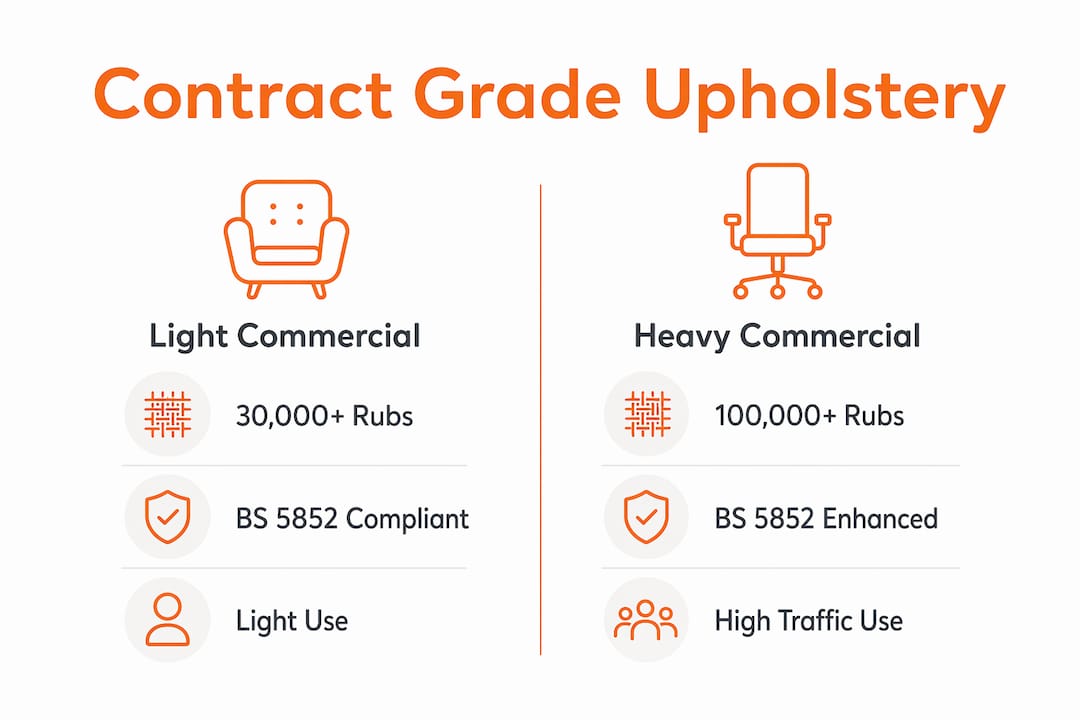
| Metric | What it measures | Light commercial minimum | Heavy commercial minimum |
|---|---|---|---|
| Martindale abrasion (rubs) | Fabric wear resistance under friction | — | 30,000–40,000 or more rubs |
| Pilling resistance (ISO 12945-2) | Surface fibre bobbling under use | Grade 3–4 | Grade 4–5 |
| Tensile/tear strength | Fabric resistance to pulling and tearing | Moderate | High |
| Colourfastness (ISO 105 series) | Resistance to fading from light and cleaning | Grade 4 | Grade 4–5 |
| Seam slippage | Seam integrity under load | Low slippage | Very low slippage |
A few points worth noting. The Martindale test is the primary abrasion metric in the UK and EU: for most commercial contexts, a high rub count is typically required for durability, while even higher counts may be specified for long-term heavy use such as airport seating or hotel lobbies. Pilling resistance is a separate test entirely. A fabric can score 50,000 rubs on Martindale and still pill badly, which is why pilling grade ISO 12945-2 should always be requested alongside abrasion data.
Must-ask tests for UK commercial procurement:
Always ask for the full laboratory test report, not a certificate image. The report should show the lab’s accreditation (UKAS or equivalent), the test date, the specific product code tested, and the actual result against the pass threshold. A certificate image with no report number or accreditation mark is not sufficient for a commercial specification.
Fire compliance is the area where procurement teams most often get caught out, partly because the regulatory picture involves more than one piece of legislation.
The key references for UK buyers:
Which standards are mandatory versus commonly requested? BS 5852 Crib 5 is not universally mandatory for all commercial furniture, but it is the standard most procurement teams and fire risk assessors will expect to see evidenced. For healthcare and education settings, it is effectively non-negotiable. For private offices with lower occupancy, Crib 1 or Crib 5 may both be acceptable depending on the fire risk assessment.
When requesting certificates, check:
Pro Tip: To verify a BS 5852 certificate quickly, search the lab name on the UKAS directory at ukas.com and cross-reference the accreditation scope. If the lab is not listed or the scope does not include furniture flammability testing, treat the certificate as unverified.
Choosing the right material within the contract-grade category matters as much as choosing contract grade over domestic. A fabric that performs brilliantly in a hotel lobby may be entirely wrong for a healthcare waiting room.
Common contract-grade materials:
Typical finishes and when to specify them:
A word of caution: finishes that improve one property can compromise another. A heavy backing that improves abrasion performance may make a fabric stiffer and less comfortable for long-duration seating. An anti-microbial coating may affect colourfastness over repeated disinfection cycles. Always request test data for the finished fabric, not the base textile.
Contract-grade fabric is appropriate when the use intensity, cleaning frequency, or occupancy level exceeds what domestic upholstery is built to handle. The practical triggers:
Sector examples:
Domestic grade may suffice for a private director’s office used by one person, a low-traffic breakout space, or decorative accent seating that sees minimal daily contact. Over-specifying adds cost without benefit in those cases, though the margin between contract and domestic pricing has narrowed enough that many procurement teams default to contract grade across the board for simplicity.
The upfront price of contract-grade upholstery is higher than domestic equivalents, but the comparison that matters for procurement is cost per year of service, not cost at point of purchase.
Pro Tip: When evaluating suppliers, ask for historic return or reupholstery rates on the specific product you are considering. A supplier who cannot or will not provide that data is telling you something. Also request warranty terms in writing, including what voids the warranty, before committing to a bulk order.
Furnitureforbusiness offers bulk order pricing and free delivery to the UK mainland, which affects the total cost calculation for larger fit-outs. The office furniture lifecycle guide on their site covers how specification choices affect replacement cycles in more detail.
Use this as a template for your procurement documents or RFQ.
Step-by-step specification checklist:
Sample RFQ specification snippet:
Red flags to watch for:
For new fabric suppliers, always start with a small pilot order and run it through your standard cleaning regime for at least four weeks before committing to volume.
Contract grade upholstery is defined by verifiable performance credentials, not supplier claims, and specifying it correctly requires demanding actual test reports covering abrasion, fire compliance, and cleaning compatibility.
| Point | Details |
|---|---|
| Martindale threshold matters | Specify 30,000 rubs minimum for standard commercial use; 40,000 or more for heavy-traffic environments. |
| Fire compliance is non-negotiable | Require a BS 5852 Crib 5 certificate from a UKAS-accredited lab, with report number and test date. |
| Match finishes to use case | Anti-microbial for healthcare, stain-repellent for hospitality, heavy backing for high-turnover office seating. |
| Whole-life cost beats unit price | Higher upfront spend on contract grade typically reduces reupholstery frequency and maintenance cost over the asset’s life. |
| Furnitureforbusiness for UK procurement | Furnitureforbusiness supplies commercial-grade seating with bulk pricing and free UK mainland delivery for fit-out projects. |
At Furnitureforbusiness, we work with procurement teams, office managers, and hospitality operators across the UK who need furniture that performs under real commercial conditions, not just looks good on a spec sheet. Our range of commercial office chairs and meeting room furniture is selected with durability, compliance, and whole-life value in mind. We offer free delivery to the UK mainland, bulk order pricing for larger fit-outs, and warranty support to back every purchase. If you are specifying for a refurbishment or new fit-out and want guidance on which products meet your Martindale, fire, or cleaning requirements, our team is here to help.
Specifying contract grade upholstery is straightforward when you have the right supplier behind you. Furnitureforbusiness supplies commercial-grade seating and furniture to UK businesses, with free delivery to the UK mainland and bulk pricing for orders of any scale. Whether you are fitting out a single meeting room or a multi-floor office, the range covers ergonomic and executive chairs, meeting room solutions, and accessories built for commercial use.
Need help matching a product to your Martindale threshold, fire standard, or cleaning code? Contact Furnitureforbusiness for specification support, sample requests, or a bulk order quote. Post-purchase warranty support is available on all commercial products. Get in touch at furnitureforbusiness.co.uk to start your specification.
Use these as primary references when verifying certificates and test reports:

Phone: 0330 043 4114
VAT no. GB 991 8681 60
Company no. 07250570