Welcome to Furniture For Business
£0.00 0

Cart

No products in the cart.

Improving meeting productivity tips for UK offices 2026


TL;DR:

  • Effective meetings depend on thorough preparation, small group sizes, and sharing clear agendas early. Ergonomic furniture and flexible layouts enhance focus, reduce fatigue, and adapt to changing team needs. Proper planning and environment design foster sustained productivity and accountability in UK office spaces.

The most effective meeting productivity tips at a glance

The single biggest lever in any meeting is preparation. Get that right and everything else follows more naturally.

  • Keep groups small. Decision-making meetings work best with 5–7 participants. Beyond that, discussion becomes unwieldy and individual accountability drops.
  • Share the agenda early. Sending it well in advance means participants arrive ready to contribute, not to catch up.
  • Front-load complexity. Tackle the hardest items first, when attention is sharpest. Save routine updates for the end.
  • Schedule around energy, not convenience. If your attendees have already sat through two back-to-back calls, your meeting starts at a disadvantage. Matt Abrahams at Stanford’s Graduate School of Business puts it plainly: “It’s about what’s best for your participants.”
  • Open with engagement. Starting with a relevant story and direct eye contact synchronises participant focus from the first minute.
  • Prompt goal reflection beforehand. Pre-meeting nudges that ask attendees to consider the meeting’s purpose heighten self-reported awareness and alignment before anyone enters the room.

Table of Contents

Best practices for organising productive meetings in UK offices

Good meeting management is less about inspiration and more about process discipline applied consistently.

Start by questioning whether the meeting is necessary at all. A decision that can be made over email, or an update that belongs in a shared document, should never become a calendar invite. Once you have confirmed a meeting is the right format, define its purpose in a single sentence before you do anything else.

From there, the structure largely takes care of itself:

  • Write a time-boxed agenda with named owners for each item, estimated durations, and a clear label for each point: decision, discussion, or information only.
  • Limit attendance to people whose input is genuinely required. Anyone who only needs the outcome can receive the notes afterwards.
  • Assign three roles before the meeting starts: a chair to lead discussion, a note-taker to capture decisions and actions, and a timekeeper to keep things moving. Assigning these roles increases process discipline and reduces the drift that kills focus.
  • Open with action, not recap. Rather than reviewing what happened last time, begin with a question or a short collaborative task. It gets people thinking immediately.
  • Manage hybrid and remote participants actively. In mixed-format meetings, start with whichever group has fewer people when inviting input. This prevents the room from dominating and the remote attendees from going quiet.
  • Close with explicit accountability. Every action item needs a named owner and a deadline. “We’ll look into that” is not an action item.
  • Follow up promptly. Send concise notes within 24 hours, highlighting decisions made and next steps. Memory fades fast; a prompt summary keeps momentum.
  • Use a “parking lot” for tangents. A corner of the whiteboard or a shared document where off-topic ideas are noted, not dismissed, keeps the main discussion on track without losing good thinking.

Pro Tip: For recurring meetings with the same group, rotate the facilitator and note-taker roles. As Stanford’s Matt Abrahams notes, this helps everyone understand why participation matters — and how demanding it actually is to run a meeting well.


How ergonomic furniture directly improves meeting outcomes

The physical environment shapes how long people can focus, how freely they contribute, and how quickly fatigue sets in. Furniture is not a peripheral concern for office managers; it is a direct input into meeting quality.

Seating is the most immediate factor. Uncomfortable chairs produce restless attendees who are thinking about their posture, not the agenda. The OE Austin Heavy Duty Task Operator Office Chair offers adjustable lumbar support and a durable PU finish suited to high-use meeting environments. For boardroom or executive settings, the OE Saturn Executive Chair with Folding Arms combines a professional aesthetic with practical adaptability, including arms that fold away to reduce bulk around a conference table.
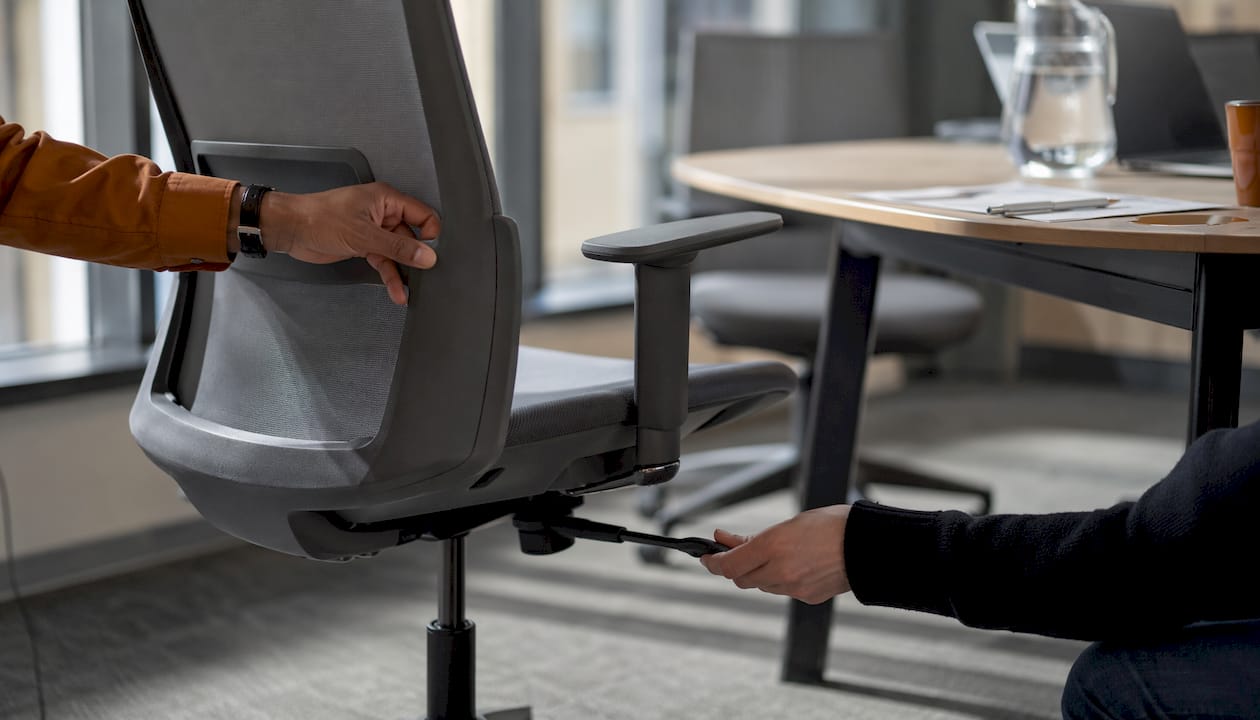
Hands adjusting ergonomic office chair

Height-adjustable desks bring a different benefit: they allow participants to shift between sitting and standing during longer sessions, which sustains energy and reduces the physical stiffness that accumulates in extended meetings. The Air Height Adjustable Slimline Desk is a practical choice for meeting rooms where cable management matters, while a properly configured height-adjustable desk setup across a meeting space gives teams the flexibility to reconfigure for different session types.

Layout matters as much as individual pieces. Long, formal conference tables tend to inhibit open discussion; they signal hierarchy and discourage the quieter voices in the room. Modular furniture that can be rearranged for a workshop, a small team huddle, or a formal presentation gives you one room that genuinely serves multiple purposes. For meeting room furniture suited to UK offices, Furnitureforbusiness offers a range built around exactly this kind of adaptability.

Technology integration is worth specifying at the procurement stage. Desks and tables with built-in cable ports, power access, and screen-height flexibility remove the friction that slows hybrid meetings before they have even started.

Features to prioritise when specifying meeting room furniture:

  • Adjustable seat height and lumbar support on all chairs
  • Castors or lightweight frames for easy reconfiguration
  • Built-in cable management on desks and tables
  • Durable, cleanable upholstery suited to shared use
  • Modular table systems that connect and separate without tools
  • Sufficient clearance for movement around the room

Pro Tip: Check that any chair or desk you specify meets the requirements of the Health and Safety (Display Screen Equipment) Regulations 1992, which apply to workstations used regularly by employees. Furnitureforbusiness products are designed with UK workplace standards in mind.


How to future-proof your meeting spaces for lasting productivity

Meeting rooms that work well today can become bottlenecks within two or three years if the furniture and layout are not designed with change in mind. Hybrid working has already shifted expectations; the next shift is already under way.

Build flexibility into the layout from the start. Furniture that can be reconfigured quickly, without specialist help, means a room can serve a formal client presentation in the morning and a creative workshop in the afternoon. Fixed installations lock you into a single use case.

  • Create transition zones outside meeting rooms. Soft seating areas adjacent to meeting spaces give participants somewhere to decompress between back-to-back sessions. This reduces the negative mood carryover that arrives when someone walks straight from a difficult call into the next meeting.
  • Minimise visual and acoustic distractions. Glazed partitions, hard floors, and open-plan adjacency all introduce noise. Specify acoustic panels, rugs, or soft furnishings where possible. Energy-efficient window treatments also help manage glare and temperature, both of which affect concentration.
  • Design for inclusion. Accessible furniture heights, clear sightlines to screens, and layouts that do not privilege one end of the table over another all contribute to more equal participation. This is not just good practice; it is increasingly expected by UK organisations under the Equality Act 2010.
  • Review regularly. Set a calendar reminder to reassess your meeting room setup annually. Technology changes, team sizes shift, and what worked for a ten-person team may not serve a twenty-person one.
  • Integrate adjustable lighting. Natural light supports alertness; harsh overhead fluorescents do the opposite. Dimmable LED systems with colour temperature control are now standard in well-specified UK offices.

A summary of practical future-proofing measures:

  • Specify modular, reconfigurable furniture over fixed installations
  • Add soft seating zones outside meeting rooms for between-session recovery
  • Specify acoustic treatment alongside furniture procurement
  • Confirm all furniture meets UK accessibility and DSE regulation requirements
  • Build technology integration (power, data, screen mounts) into the initial specification
  • Review room layouts annually against actual usage patterns

Key takeaways

Meetings deliver their best outcomes when preparation, participant discipline, and physical environment are all working together rather than any one in isolation.

Point Details
Optimal group size Keep decision-making meetings to 5–7 participants to maintain focus and accountability.
Agenda and preparation Share a time-boxed agenda well in advance so attendees arrive ready to contribute immediately.
Ergonomic furniture Adjustable seating and height-adjustable desks reduce fatigue and sustain active participation.
Future-proof layouts Modular, reconfigurable furniture and transition zones protect productivity as team needs evolve.
Follow-up accountability Assign named owners and deadlines to every action item, then distribute concise notes within 24 hours.

Upgrade your meeting rooms with Furnitureforbusiness

Furnitureforbusiness

Furnitureforbusiness supplies commercial-grade office chairs, height-adjustable desks, and meeting room furniture to UK businesses, with free delivery to the mainland. Whether you are refitting a single boardroom or specifying furniture across a multi-floor office, the range is built for durability, ergonomic compliance, and the flexibility that hybrid working demands. Bulk order pricing and easy returns make procurement straightforward for office managers and procurement teams working to a budget and a deadline.

    Leave a Reply

    Your email address will not be published. Required fields are marked *

    Subscribe
    Get the latest updates on new products and upcoming sales
    Follow Us
    Contact Us
    20six
    Unit 19 & 20,
    Henfield Business Park
    Shoreham Road
    Henfield
    BN5 9SL

    Phone: 0330 043 4114

    VAT no. GB 991 8681 60

    Company no. 07250570

    © 2026 By 20SIX (SOUTH EAST) LTD, T/A Furniture For Business