TL;DR:
- A telescopic beam desk is a modular office furniture piece with extendable frames that allow configuration changes without replacement. It offers long-term value through reconfigurability, ergonomic adjustability, and improved stability, especially in dynamic office environments. Proper specification of frame quality, cable management, and motor capacity enhances its benefits and durability over time.
A telescopic beam desk is defined as a modular office desk featuring extendable beams that slide to adjust the desk’s width, depth, or configuration without replacing the entire unit. The industry term for the broader category is “height-adjustable desk” or “sit-stand desk,” but the telescopic beam specifically refers to the structural frame component that enables this flexibility. For office managers and procurement teams specifying furniture for teams of 5 to 500 people, understanding this distinction matters. It separates a desk that adapts to your office from one that simply sits in it.
A telescopic beam desk uses a frame built around extendable metal tubes that nest inside one another, much like a camera tripod leg. When you adjust the beam, the inner tube slides out from the outer housing, changing the desk’s height or width. This mechanism is what gives the adjustable beam desk its defining characteristic: reconfiguration without disassembly.
The telescopic beam is not just a leg. It is the structural spine of the desk. In bench systems, a single beam can span multiple workstations, allowing the entire run to be extended or contracted as team sizes change. This is why modular furniture built around telescopic beams has become the preferred choice for offices undergoing frequent layout changes.
The key distinction from a standard fixed desk is that the telescopic system treats the desk as a component, not a permanent fixture. Procurement teams can specify one frame system and reconfigure it across multiple floor plans over the life of the furniture.
The core mechanism relies on two or three hollow steel tubes of decreasing diameter, each sliding inside the next. A motor or manual crank drives the movement, and a locking collar or electronic brake holds the position under load.

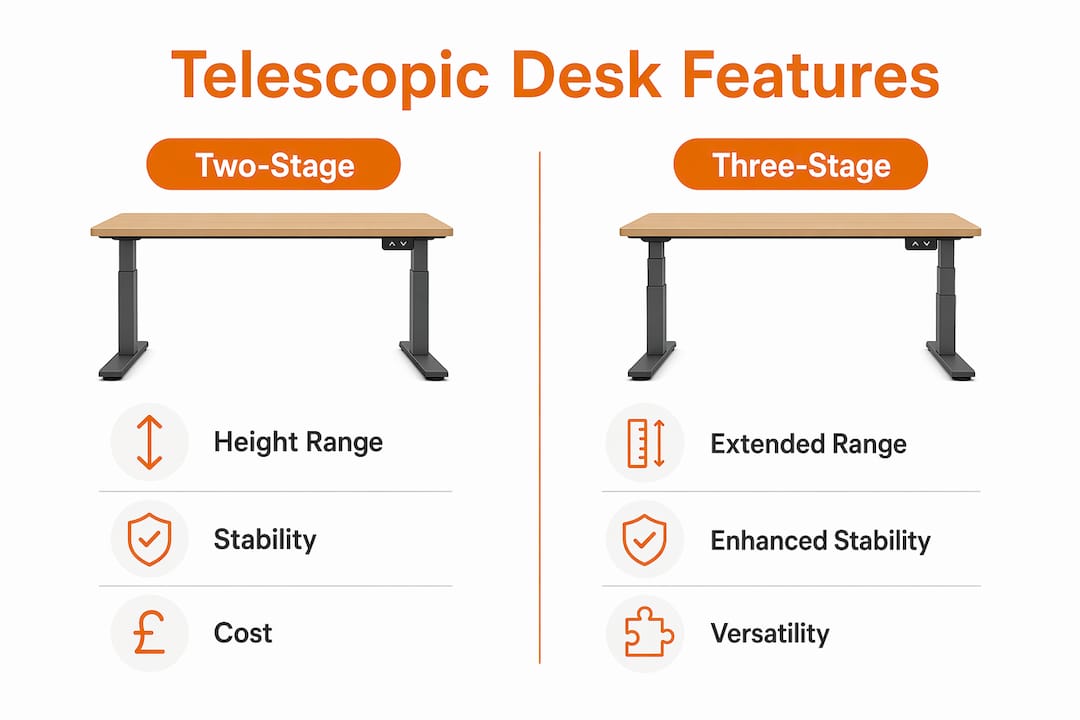
The number of telescopic stages directly determines the height range and stability of the desk. Two-stage legs offer a height range of 27–40 inches. They are lighter and less expensive, making them suitable for offices where all staff fall within a similar height range. Three-stage legs extend from 23–50 inches, supporting a wider variety of users and carrying heavier loads with greater stability. For commercial settings with diverse teams, three-stage systems are the more practical specification.
Three-stage systems also benefit from wider tube diameter bases and increased overlap between sections. That overlap is what resists lateral wobble at full extension, which matters when a desk carries two monitors, a docking station, and a desktop unit.
Motorised systems use an electric actuator housed within the beam itself. Integrated motor controllers within the beam frame eliminate the need for external mounts and allow wiring to run internally, cutting installation time and reducing under-desk clutter. Manual systems use a hand crank or gas-lift mechanism and cost less upfront, but they are slower to adjust and less likely to be used consistently throughout the working day.
Modern telescopic beam systems route cables through channels built into the beam housing. Integrated cable management designs cut installation time by up to 30% compared to retrofitted cable trays. Some bench systems use sliding tops and magnetic fixing methods to give clean access to power and data cables without dismantling the desk.
Pro Tip: Specify desks with internal cable channels from the outset. Retrofitting cable management to a telescopic bench system after installation costs significantly more in labour and rarely achieves the same result.
Telescopic beam desks separate themselves from standard office desks across four measurable dimensions: modularity, adjustability, stability, and cable integration.
The modular construction of a telescopic bench system means individual workstations can be added or removed from a run without replacing the entire frame. Modular telescopic systems allow office managers to treat desks as adjustable components, reconfiguring layouts as business needs evolve rather than commissioning new furniture. This is the single most undervalued feature in commercial procurement.
Height adjustability is the feature most buyers focus on, and rightly so. The ergonomic height range of a three-stage system accommodates seated users as short as 5ft and standing users over 6ft 4in. That range matters in open-plan offices where hot-desking is standard practice.
Telescoping section overlap length is the critical engineering factor for stability. Longer overlap between the inner and outer tubes produces greater stiffness and reduces wobble under heavy use. Procurement teams should request overlap specifications from suppliers, not just maximum load ratings.
Bench systems with sliding tops and magnetic cable fixing allow clean cable runs and easy access for IT teams. This reduces the time spent managing cables during desk moves and keeps the workspace visually tidy.
Pro Tip: Ask suppliers for the overlap-to-extension ratio on any telescopic leg you are evaluating. A longer overlap relative to total extension height is a reliable proxy for frame rigidity.
Here is a summary of how two-stage and three-stage systems compare across the criteria that matter most to procurement teams:
| Feature | Two-stage system | Three-stage system |
|---|---|---|
| Height range | 27–40 inches | 23–50 inches |
| Stability under load | Moderate | High |
| Load capacity | Lower | Higher |
| Cost | Lower | Higher |
| Best suited for | Uniform-height teams | Diverse or hot-desk teams |
The benefits of telescopic desks fall into three categories: health outcomes, layout flexibility, and cost efficiency over time.
The health case for height-adjustable desks is well established. Employees using sit-stand desks with height-adjustable features reported a 32% improvement in lower back pain and an 87% increase in energy levels over 12 weeks. Those figures represent a meaningful reduction in the musculoskeletal complaints that drive absenteeism and presenteeism in UK offices.
Height-adjustable telescopic desks reduce pressure on the lower back, neck, and hips by enabling movement variety throughout the day. Static desks, regardless of how well they are specified, cannot replicate this. Addressing office posture problems requires furniture that moves with the user, not furniture that fixes them in one position.
A telescopic bench system adapts to team growth without procurement intervention. Adding a workstation to an existing run takes minutes rather than days. For offices managing hybrid working patterns, where desk occupancy fluctuates week to week, this flexibility removes the need to over-specify furniture at fit-out stage.
Space efficiency is a direct financial benefit. A telescopic bench system uses less floor space per workstation than an equivalent number of individual fixed desks, because the shared beam eliminates duplicated frame components. For UK offices paying per square metre, that saving compounds quickly across a full floor.
Fixed desks become a liability when layouts change. Telescopic beam systems become an asset. The frame survives multiple reconfigurations, meaning the capital cost is spread across a longer useful life. Procurement teams who factor in reconfiguration costs alongside purchase price consistently find that telescopic systems deliver better value over a five-year horizon.
Selecting the right system requires evaluating five factors in order of importance.
Height range and stage count. Specify three-stage legs for any office with a diverse workforce or a hot-desking policy. Two-stage systems are adequate only where the user population is known and consistent.
Frame structural integrity. Prioritise overlap length and tube diameter over surface finishes. A desk that wobbles at full extension will be abandoned by users within weeks, regardless of how attractive the desktop is.
Motor type and load capacity. Dual-motor systems handle heavier loads and extend more smoothly than single-motor alternatives. Confirm the rated load capacity includes the weight of monitors, peripherals, and the desktop itself, not just the frame.
Cable integration. Specify desks with internal cable channels and integrated power modules where possible. The Air Height Adjustable Slimline Desk with Cable Ports from Furnitureforbusiness is one example of a product that combines telescopic height adjustment with built-in cable management in a single unit.
Installation and reconfiguration ease. Ask suppliers how long a single workstation takes to install and how the system is extended. A bench system that requires specialist tools for every reconfiguration negates much of the flexibility advantage.
Pro Tip: Request a physical sample or showroom visit before specifying a telescopic bench system for more than ten workstations. Wobble and motor noise are impossible to assess from a specification sheet.
Telescopic beam desks are the most adaptable office furniture investment available to procurement teams, combining ergonomic adjustability, modular reconfiguration, and long-term cost efficiency in a single frame system.
| Point | Details |
|---|---|
| Three-stage legs outperform two-stage | Three-stage systems cover 23–50 inches, supporting diverse users and heavier loads. |
| Overlap length determines stability | Longer telescoping section overlap reduces wobble and extends the desk’s working life. |
| Health benefits are measurable | Sit-stand use linked to 32% less back pain and 87% higher energy over 12 weeks. |
| Modularity reduces lifecycle cost | Telescopic bench systems reconfigure without replacement, spreading capital cost further. |
| Cable integration saves installation time | Internal cable channels cut installation time by up to 30% versus retrofitted solutions. |
The procurement conversation around height-adjustable desks almost always centres on the desktop finish and the price per unit. That is the wrong starting point. The frame is the investment. The desktop is a commodity.
After working with office managers across a range of UK fit-out projects, the pattern is consistent: teams that specified telescopic bench systems based on frame engineering, overlap length, and motor quality were still using the same furniture five years later. Teams that prioritised aesthetics and upfront cost were replacing desks within three years because the frames had developed wobble or the layout had changed and the desks could not adapt.
The other mistake I see regularly is underestimating the value of integrated cable management. An office with 40 workstations and no internal cable routing is an IT maintenance problem waiting to happen. Every desk move becomes a half-day job. Specifying height-adjustable desk setup with built-in cable management from day one is not a luxury. It is a time-saving decision that pays back within the first year.
The health argument for telescopic desks is also stronger than most procurement briefs acknowledge. A 32% reduction in back pain complaints across a team of 50 people is not a wellness initiative. It is a measurable reduction in sick days and a direct contribution to productivity. Pair the right desk with ergonomic seating and you have addressed the two primary drivers of musculoskeletal complaints in office environments.
My advice to any procurement team evaluating telescopic beam desks: treat the frame specification as seriously as you treat the lease on the building. Both are long-term commitments. Only one of them adapts to change.
— Furniture
Furnitureforbusiness supplies a range of height-adjustable office desks designed for commercial fit-outs across the UK, with free delivery to the UK mainland. The collection includes telescopic sit-stand desks with integrated cable ports, modular bench systems, and slimline options suited to open-plan environments.

Whether you are specifying desks for a team of ten or a floor of two hundred, Furnitureforbusiness offers bulk order pricing and a straightforward returns process. The range covers two-stage and three-stage telescopic systems, with options for built-in cable management and motorised adjustment. For teams planning a full office refurbishment, the office furniture buying guide covers selection criteria, durability benchmarks, and specification advice for commercial buyers.
A telescopic beam desk is a modular office desk built around an extendable metal beam that slides to adjust the desk’s height, width, or configuration. The telescopic mechanism allows reconfiguration without replacing the furniture unit.
Telescopic desks use two or three hollow steel tubes of decreasing diameter that slide inside one another. A motor or manual crank drives the movement, and a locking mechanism holds the position under load.
Two-stage telescopic legs adjust from 27–40 inches, while three-stage legs cover 23–50 inches. Three-stage systems accommodate a wider range of users and carry heavier loads with greater stability.
Telescopic beam desks deliver better value over a five-year horizon than fixed desks because they reconfigure without replacement and support measurable health benefits, including a 32% reduction in lower back pain among regular users.
Prioritise frame engineering, specifically the overlap length of telescoping sections, motor load capacity, and integrated cable management. Surface finishes and desktop materials are secondary to structural integrity.

Phone: 0330 043 4114
VAT no. GB 991 8681 60
Company no. 07250570