TL;DR:
- Reconfigurable furniture allows quick, tool-free adjustments for dynamic office layouts, supporting hybrid work environments.
- Most well-designed systems are also modular, enabling flexible configurations that suit various workspace needs.
Reconfigurable furniture is defined as any furniture system designed to be moved, adjusted, or reassembled quickly by users, without specialist tools or major renovation work. The industry also uses the term “adaptable furniture systems” to describe the same concept. Where traditional office furniture locks a space into a fixed layout, reconfigurable furniture treats the physical environment as something that should change as often as the business does. For UK procurement teams and office managers planning hybrid or growth-stage workspaces, this distinction carries real financial and operational weight.
Reconfigurable furniture and modular furniture are related but not identical concepts. Understanding the difference prevents costly procurement mistakes.

Modular furniture is composed of standardised, interchangeable units that connect to form larger systems. A sectional sofa, a wall-bed integrating a desk and shelving, or a bank of adjustable workstations all qualify as modular. Each unit is self-contained and scalable, meaning you can add or remove sections as headcount changes.
Reconfigurable furniture, by contrast, emphasises the ease and speed of functional rearrangement. The critical distinction is this: modular focuses on physical composition; reconfigurable focuses on how quickly a user can change the layout without calling in a contractor. A piece can be modular without being easily reconfigurable. A heavy, bolted panel system is modular in design but requires professionals to move. A lightweight nesting table on castors is reconfigurable by anyone in the room.
The practical overlap is significant. Most well-designed reconfigurable office furniture is also modular, because standardised components make rearrangement faster and more predictable. When evaluating options, look for both qualities together.
Key features that define genuinely reconfigurable furniture:
Pro Tip: When reviewing supplier specifications, ask specifically whether reconfiguration requires a facilities team or can be done by a single employee. That single question separates genuinely agile systems from furniture that merely looks flexible.
The category covers a wide range of products, each serving a distinct workspace function. Choosing the right type depends on what the space needs to do, and how often it needs to change.
Changes that traditionally take months can be completed in days using the right reconfigurable systems. That speed advantage is only possible when the furniture type matches the use case.
| Furniture type | Primary function | Key reconfigurable feature |
|---|---|---|
| Desks on castors | Individual or shared workstations | Roll into clusters or rows without lifting |
| Nesting tables | Meeting rooms, training spaces | Stack and store flat; deploy in minutes |
| Movable partitions | Zone creation, acoustic separation | Slide or fold to divide or open a space |
| Modular panel systems | Semi-permanent spatial division | Reconfigure wall layouts without demolition |
| Modular lounge seating | Collaboration and breakout zones | Add, remove, or reorder seat units freely |
Furniture systems that integrate power, data, and acoustics allow spatial divisions that genuinely mimic permanent walls. They avoid demolition costs, building permits, and re-certifications. For UK businesses operating in leased offices, this is particularly valuable because structural changes often require landlord approval.
Height-adjustable desks represent one of the most practical entry points into reconfigurable office furniture. They adapt to individual users throughout the day and can be repositioned within a floor plan without tools. Modular lounge seating works in a similar way for breakout areas, where the configuration might shift from a collaborative cluster in the morning to a presentation layout by afternoon. Current office design trends consistently point toward furniture that supports this kind of fluid, activity-based working.
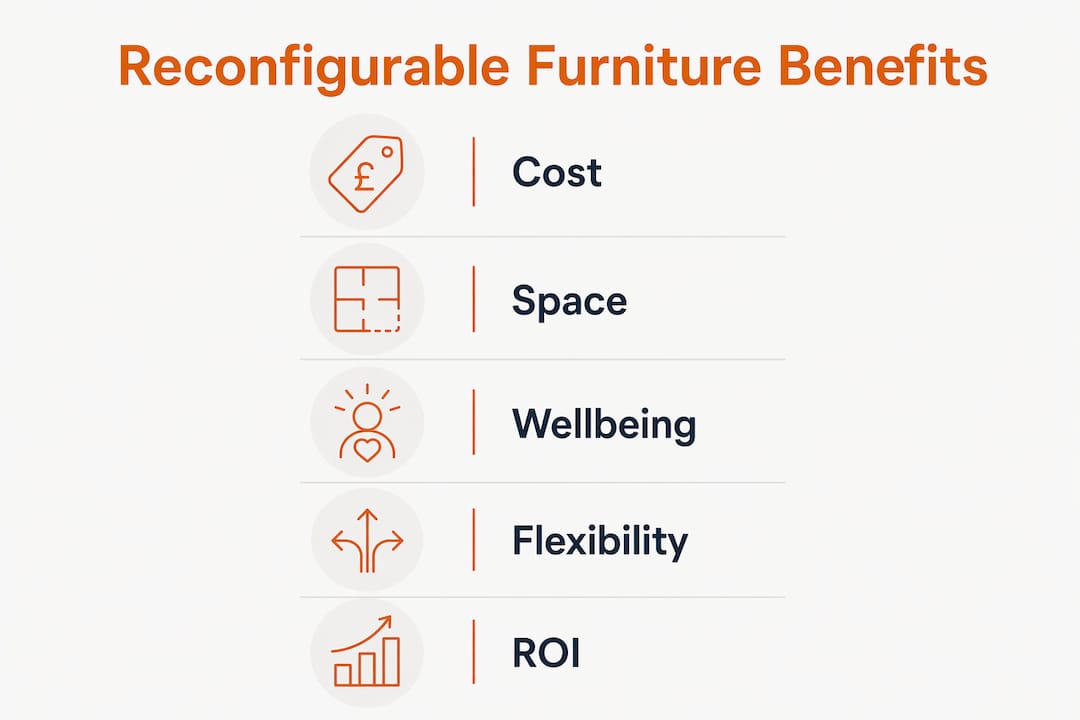
The business case for flexible furniture rests on four measurable benefits: cost reduction, space efficiency, employee wellbeing, and environmental impact.
Cost reduction is the most immediate advantage. The primary value for businesses is reducing ongoing “churn costs” related to moves, adds, and changes, and avoiding costly “rip-and-replace” renovations. Every time a team restructures or a department relocates within a building, fixed furniture generates labour, disposal, and replacement costs. Reconfigurable systems eliminate most of that spend.
Space efficiency becomes critical as hybrid working reduces average desk occupancy. A reconfigurable layout can shift from a full-team configuration on busy days to a smaller, more focused arrangement when half the team works remotely. This flexibility means businesses can make better use of the floor space they already pay for.
Employee wellbeing and collaboration also improve. Static furniture hinders workplace adaptability and employee productivity. When teams can arrange their own environment to suit a task, whether that is a focused solo project or a group workshop, engagement and output both benefit.
Sustainability is the fourth advantage, and one that procurement teams increasingly report to senior leadership. Modular furniture’s effective lifespan often exceeds that of fixed furniture because it adapts through multiple office moves or layout changes. Fixed pieces become obsolete quickly when space or needs change, generating avoidable waste.
Key advantages at a glance:
Pro Tip: When calculating the ROI of reconfigurable furniture, include the avoided cost of a single office reconfiguration project. Facilities managers often find that one avoided move pays for the furniture upgrade entirely.
Choosing reconfigurable furniture is only the first step. Getting full value from it requires a clear approach to selection, use, and upkeep.
Choose systems users can operate independently. A common procurement mistake is ignoring the labour cost of moves and changes. Furniture that requires a specialist to reconfigure defeats the purpose. Prioritise tool-free connection systems and components light enough for one person to move safely.
Map your change scenarios before you buy. Think about the three or four layout configurations your space will actually use. A training room that doubles as a boardroom needs nesting tables and stackable chairs. A collaborative zone that shifts to focused work needs movable screens and individual desks on castors. Buying without this mapping leads to furniture that is technically reconfigurable but never actually reconfigured.
Establish a simple maintenance routine. Check castors and glides every six months for wear. Tighten connection points on panel systems after each major reconfiguration. Clean upholstered surfaces on modular seating according to the manufacturer’s schedule. Small maintenance habits prevent the gradual degradation that makes reconfigurable furniture feel unreliable.
Plan for scalability from the outset. Buy into a system, not just individual pieces. When a supplier’s range uses standardised dimensions and connectors across its catalogue, you can add components years later without mismatches. This is how reconfigurable furniture functions as long-term infrastructure rather than a short-term fix.
Train your team. A brief induction showing staff how to reconfigure the space safely and correctly pays dividends immediately. Teams that understand the system use it. Teams that do not understand it leave the furniture in one configuration permanently, which eliminates the entire benefit.
Pro Tip: Create a simple one-page layout guide showing two or three approved configurations for each room. Pin it inside a cupboard or store it digitally. This removes the guesswork and encourages teams to actually use the flexibility they have.
Reconfigurable furniture is the most cost-effective way for UK businesses to future-proof office layouts without committing to expensive renovations or fixed infrastructure.
| Point | Details |
|---|---|
| Clear definition matters | Reconfigurable furniture prioritises ease of rearrangement; modular furniture prioritises physical composition. |
| Tool-free is non-negotiable | Systems requiring specialist labour to move undermine the core benefit and inflate ongoing costs. |
| Cost savings are measurable | Avoiding a single office reconfiguration project often covers the full cost of a flexible furniture upgrade. |
| Lifecycle advantage is real | Adaptable systems outlast fixed furniture because they evolve with the space rather than becoming obsolete. |
| Scalability requires planning | Buying into a standardised system from the outset allows components to be added years later without mismatches. |
The businesses that get the most from reconfigurable furniture are the ones that stop thinking about it as furniture at all. They treat it as workspace infrastructure, in the same category as IT cabling or HVAC. That shift in mindset changes every decision that follows.
What I see far too often is procurement teams selecting flexible furniture based on aesthetics or unit price, then wondering why the office layout never actually changes. The furniture sits in one configuration for two years because nobody was told it could move, or because moving it requires a facilities request that takes three weeks to process. The flexibility was purchased but never activated.
The other common mistake is buying reconfigurable furniture piecemeal. A few desks on castors here, a modular sofa there, but from different systems with incompatible dimensions. The result looks flexible but functions as a collection of fixed islands. True adaptability comes from buying within a coherent system where every component works with every other.
Collaboration furniture is where I see the clearest return. A meeting room that can shift from a boardroom layout to a workshop configuration in under ten minutes genuinely changes how teams work. That is not a marginal improvement. It is a different kind of office.
The businesses that will struggle most in the next five years are those locked into fixed layouts that cannot respond to headcount changes, hybrid patterns, or new ways of working. Furniture is not decoration. It is the physical expression of how a business operates.
— Furniture
Furnitureforbusiness supplies commercial office furniture to UK businesses, with free delivery to the UK mainland and bulk order pricing for teams of all sizes.
The range includes height-adjustable desks suited to reconfigurable workstation layouts, ergonomic office chairs that move with your team, and meeting room furniture built for spaces that need to serve multiple functions. Whether you are fitting out a new office or rethinking an existing layout for hybrid working, Furnitureforbusiness has the products and the expertise to help you build a workspace that adapts rather than constrains. Browse the full range at Furnitureforbusiness or contact the team for a bulk order quote.
Reconfigurable furniture is any furniture that can be quickly moved, adjusted, or reassembled by users without specialist tools or renovation work. It is designed to let a space change function rapidly, from a meeting room to a training space, for example.
Modular furniture and reconfigurable furniture overlap but are not identical. Modular furniture refers to standardised, interchangeable units; reconfigurable furniture refers to how easily those units can be rearranged. A piece can be modular but still require professionals to move.
The most common types include desks on castors, nesting tables, movable partitions, modular panel systems, and modular lounge seating. Each type serves a different workspace function, from individual workstations to collaborative breakout zones.
Reconfigurable furniture lets businesses adjust their floor plan daily to match actual occupancy. On high-attendance days, desks cluster together; on quieter days, the layout opens up for focus work or collaboration, without any renovation or specialist involvement.
Reconfigurable furniture typically outlasts fixed furniture in effective lifespan because it adapts through multiple layout changes and office moves rather than becoming obsolete when needs shift.

Phone: 0330 043 4114
VAT no. GB 991 8681 60
Company no. 07250570