TL;DR:
- Stackable meeting tables increase room flexibility by enabling quick reconfigurations for different team sizes and meeting types. They reduce space waste, lower reconfiguration costs, and allow for efficient room layouts without physical rebuilding, especially in high-cost urban areas. Proper workflow planning, including staff training and pairing with stackable chairs, ensures maximum operational and financial benefits from these modular furniture solutions.
Stackable meeting tables are furniture designed to maximise meeting room flexibility by allowing easy storage and fast reconfiguration of layouts to suit varying team sizes and meeting types. For office managers weighing up why stackable meeting tables deserve a place in their procurement plan, the answer sits at the intersection of space efficiency, cost savings, and daily operational ease. Fixed conference tables lock rooms into a single format. Stackable alternatives, including flip tables and nesting modular systems, turn one room into many. The evidence from suppliers like MEI YI and research published via Dezeen confirms the financial and operational case is strong.
Fixed conference tables are the single biggest cause of meeting room waste. Traditional fixed tables cause rooms to sit unused roughly 40% of the time because the layout cannot adapt to smaller groups or different meeting formats. That is a significant proportion of your real estate budget generating no return.
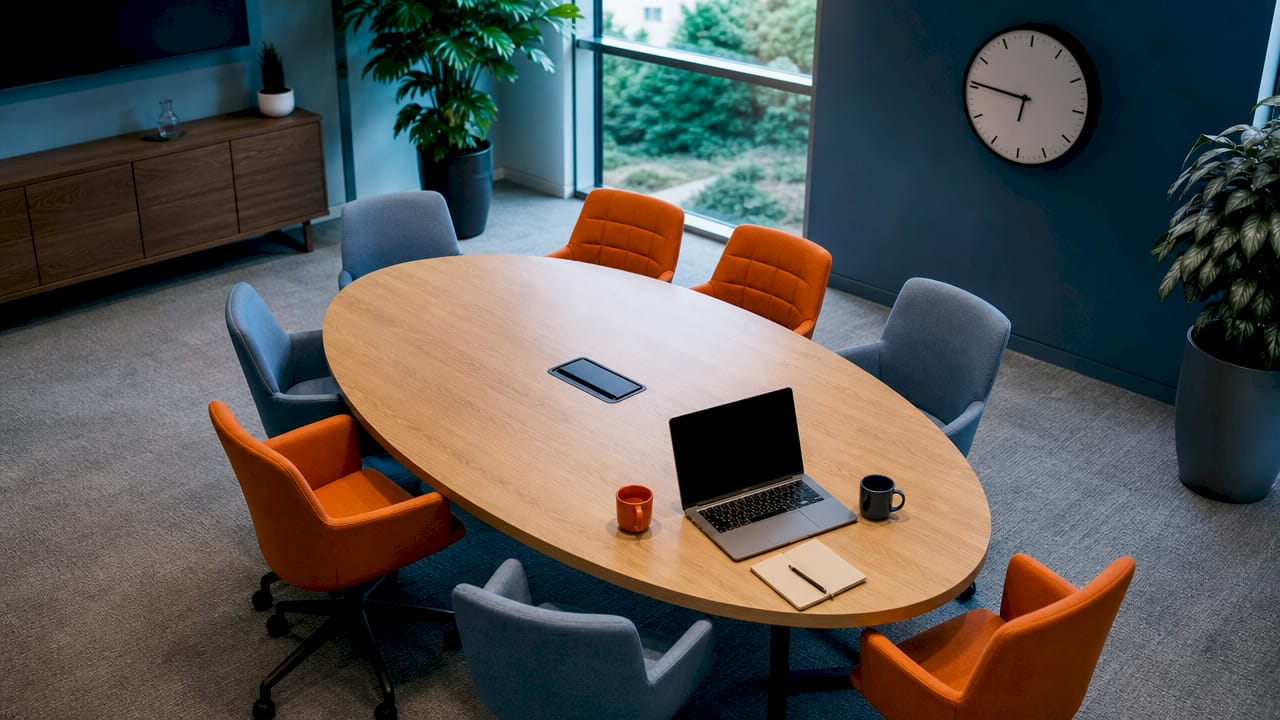
Stackable modular tables solve this directly. They reconfigure within minutes, accommodating everything from a one-to-one catch-up to a twenty-person all-hands session. A room that previously served only formal board meetings can shift to a training layout, a workshop cluster, or a presentation space before lunch.
Activity-based layout changes using flexible furniture can reduce overall office space requirements by 20–30% without reducing peak seating capacity. That figure matters because it means you can support the same number of staff in a smaller footprint, which directly reduces lease costs. Stackable tables enable spatial zoning too, separating collaborative areas from quiet work zones within the same room.
The benefits of stackable tables in this context are not theoretical. Pay.UK achieved similar or increased employee capacity using half the workspace through flexible room and furniture configurations. Stackable meeting tables were central to enabling overflow spaces and alternative presentation areas without expanding the building.
Pro Tip: Measure your storage area before selecting tables. A table that saves floor space during use but requires a large dedicated storage room defeats the purpose. Prioritise nesting designs that stack tightly against a wall or inside a cupboard.
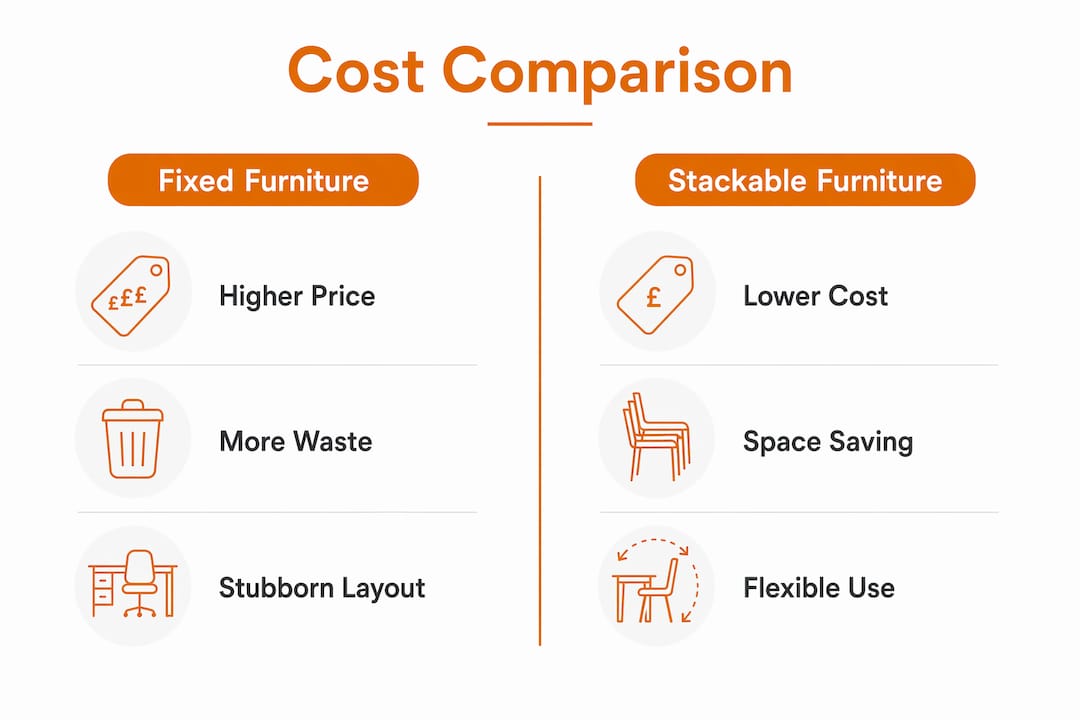
The cost argument for stackable meeting room solutions is more compelling than most office managers realise at the point of purchase. Replacing traditional meeting rooms with modular alternatives reduces initial costs by approximately 10%, rising to 60% in high-cost cities like London when reconfigurations are factored in. That uplift comes from avoiding the disruption and contractor fees associated with physically rebuilding a room.
The lifecycle picture is even sharper. Major reconfigurations with modular furniture realise savings exceeding 90%, sometimes reaching 150% in expensive urban markets. The reason is straightforward: a fixed room requires full reinstatement at lease end or during a refurbishment, while a modular setup simply gets moved or restacked.
| Cost factor | Fixed furniture | Stackable modular furniture |
|---|---|---|
| Initial purchase | Standard | Approximately 10% lower |
| Reconfiguration cost | High (contractor required) | Minimal (staff-led, minutes) |
| Reinstatement at lease end | Up to 3x higher | Significantly reduced |
| Lifecycle savings | Negligible | Up to 90–150% in high-cost cities |
Reinstatement costs for traditional fixed rooms run approximately three times higher than modular alternatives. For a business on a five-year lease in central London, that difference can represent a material budget line. Pairing stackable tables with stackable chairs is the step most managers overlook. Without portable seating, chairs left in place prevent efficient pack-up and the room effectively becomes fixed again.
Pro Tip: When calculating ROI on stackable furniture, include projected reconfiguration frequency over your lease term. Even two major layout changes per year shift the financial case decisively in favour of modular solutions.
Flip tables represent the most practical expression of stackable meeting table design. The mechanism combines a folding top with a nesting frame, meaning the table surface folds flat and the legs tuck inward so multiple units can be pushed together into a compact row. Flip-table mechanisms cut setup and pack-down times roughly in half compared to traditional folding tables. That saving compounds across every meeting day.
The operational detail that separates good flip tables from poor ones comes down to four features:
Typical flip tables for UK meeting rooms range from 1,200mm to 1,800mm in length and 600mm to 750mm in depth. These dimensions suit both training room rows and boardroom clusters. The modular nature of flip tables also means you can add units as headcount grows, which is a genuine advantage of modular meeting tables over fixed alternatives.
Applying the advantages of modular meeting tables requires planning before the furniture arrives. A room that is not designed around the reconfiguration workflow will revert to a fixed layout within weeks. The following steps prevent that outcome.
Pro Tip: Photograph each standard layout and post the images inside the storage cupboard door. Teams reset rooms correctly without needing to remember or ask, which removes the single biggest barrier to daily reconfiguration.
Designing meeting rooms for hybrid working requires this kind of deliberate planning. The furniture choice is only half the solution. The workflow around it determines whether the investment delivers or sits idle. For a practical framework on this, Furnitureforbusiness has published a hybrid meeting room guide covering layout strategies for UK offices.
Stackable meeting tables deliver measurable space, cost, and operational advantages over fixed furniture, but only when paired with the right seating and a clear reconfiguration workflow.
| Point | Details |
|---|---|
| Space utilisation | Fixed tables leave rooms unused roughly 40% of the time; stackable alternatives enable multiple layouts in one space. |
| Cost savings | Modular furniture reduces initial costs by approximately 10%, rising to 60%+ in cities like London when reconfigurations are included. |
| Lifecycle advantage | Major reconfigurations with modular systems save up to 90–150% compared to rebuilding fixed rooms. |
| Flip and nesting design | One-handed flip mechanisms and locking castors cut setup times in half and enable compact daily storage. |
| Workflow dependency | Stackable tables must be paired with stackable seating and a clear staff workflow to prevent rooms reverting to fixed use. |
Office managers often evaluate meeting room furniture on purchase price alone. That is the wrong frame. The real cost of a fixed conference table includes every reconfiguration it prevents, every room booking it wastes, and every reinstatement fee it generates at lease end. I have seen businesses in central London absorb reinstatement costs that exceeded the original fit-out budget because fixed furniture was treated as permanent.
Stackable modular tables change that equation entirely. The operational success of these systems depends on one thing above all else: whether the storage and handling workflow matches how staff actually move through the building. If tables require two people and three steps to stack, they will not get stacked. The room will drift back to a fixed layout, and the investment will underperform.
The furniture choice and the workflow design must happen together. Pair stackable tables with stackable chairs. Define your layouts. Train more than one person to reset the room. When those conditions are in place, the financial case, including lifecycle savings that can reach 150% in high-cost urban markets, becomes the most persuasive argument for any procurement decision.
— Furnitureforbusiness
Furnitureforbusiness supplies modular meeting room furniture to businesses across the UK, with free delivery to the mainland. The range includes stackable meeting tables designed for daily reconfiguration, with mobile frames, nesting mechanisms, and finishes suited to modern commercial interiors.
For office managers building a fully flexible meeting room, pairing stackable tables with the right seating is the critical next step. Furnitureforbusiness offers a range of stackable office chairs that complement modular table systems and complete the reconfiguration workflow. Browse the full meeting room collection to find options matched to your room dimensions, team size, and budget.
A stackable meeting table uses a flip or nesting mechanism that allows the surface to fold flat and the frame to tuck inward, so multiple units store compactly together. Locking castors and a one-handed fold action are the features that determine practical daily usability.
Activity-based layout changes using stackable furniture can reduce overall office space requirements by 20–30% without reducing peak seating capacity. The saving comes from enabling multiple room formats in a single footprint rather than dedicating separate rooms to each use.
Modular stackable furniture reduces initial costs by approximately 10% compared to fixed alternatives, rising to 60% in high-cost cities like London when reconfiguration expenses are included. Lifecycle savings can reach 90–150% over a standard lease term.
Stackable tables deliver full flexibility only when paired with stackable or easily portable chairs. Chairs left in place prevent efficient room pack-up and effectively fix the layout, negating the core benefit of the table system.
Flip-table mechanisms cut setup and pack-down times roughly in half compared to traditional folding tables. A single person can reconfigure a standard meeting room in under ten minutes when tables nest compactly and chairs stack efficiently.

Phone: 0330 043 4114
VAT no. GB 991 8681 60
Company no. 07250570