TL;DR:
- Mesh back technology uses open-weave fabric stretched across a frame to improve airflow and pressure distribution. It offers benefits like breathability, support adaptability, and easier maintenance, especially for long sitting sessions. Selecting adjustable lumbar support and high-quality materials ensures long-term comfort and durability in office environments.
Mesh back technology is defined as a chair backrest design that uses an open-weave fabric stretched across a rigid frame, engineered to allow continuous airflow between the sitter and the seat. This is the standard industry term used in ergonomic seating, distinct from wireless mesh networking, which involves routers and access points rather than furniture. The two share a name but nothing else. For procurement teams and office managers choosing seating for teams of five to five hundred, understanding mesh back technology is the starting point for any serious ergonomic buying decision.
Mesh back chairs deliver three core benefits: breathability, pressure distribution, and postural adaptability. Each matters more than it sounds on a specification sheet.
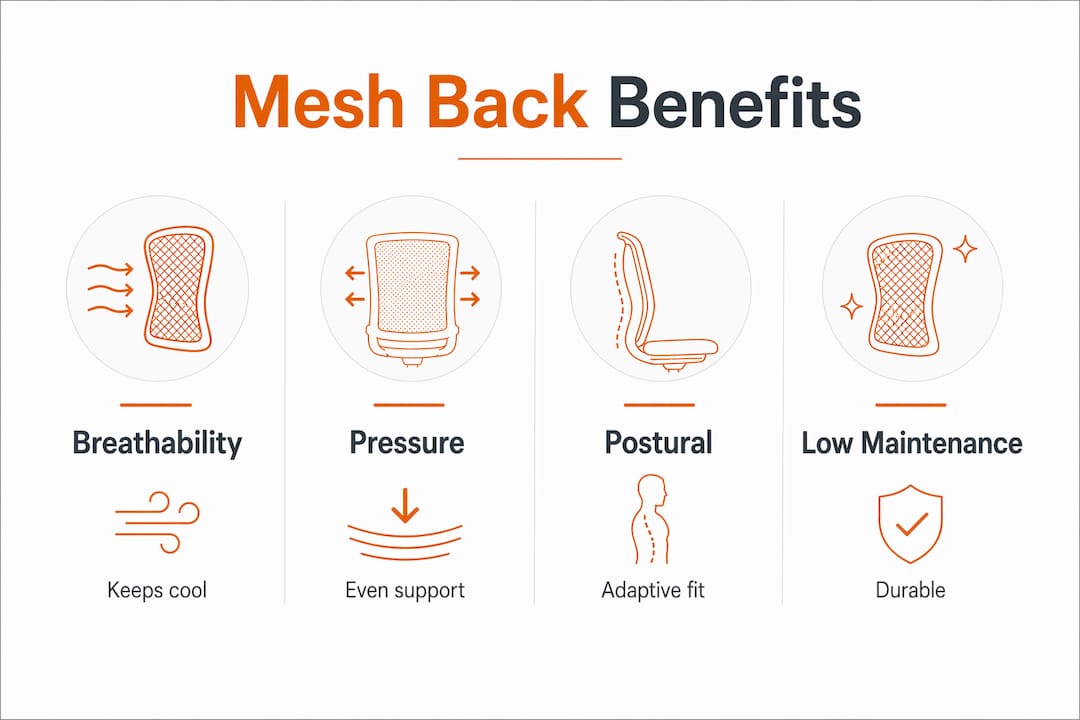
Breathability is the most immediate advantage. Mesh promotes breathability through convection. Air moves through the open weave continuously, which prevents the heat and moisture build-up that foam or leather backs trap against the spine. For staff sitting six to eight hours a day, that difference is felt by mid-afternoon.
Pressure distribution is less obvious but equally significant. A well-tensioned mesh backrest flexes with the body rather than pushing back against it. This distributes contact pressure across a wider surface area than a rigid foam panel, reducing localised fatigue in the lower and mid-back.

Postural adaptability means the mesh conforms to different body shapes without requiring manual adjustment. A foam back holds one fixed shape. Mesh moves with the sitter.
Key advantages at a glance:
Pro Tip: When comparing mesh chairs for bulk orders, ask suppliers for the mesh tension rating. A chair that feels supportive for a 70kg person may feel slack for a 100kg person. Tension matters as much as material.
Compared with traditional padded or leather backs, mesh backs run cooler and require less maintenance. Leather cracks over time and traps heat. Foam compresses and loses its shape. Mesh back design retains its structural properties significantly longer under daily commercial use, making it a sound investment for businesses replacing chairs at scale.
Lumbar support design is the main factor in perceived support for long-session users, not the mesh material alone. This is the single most misunderstood point in mesh chair procurement.
Mesh back chairs use three distinct lumbar support approaches:
| Lumbar type | How it works | Best suited to |
|---|---|---|
| Mesh-only tension | The mesh itself provides curve support through fabric tension | Users with mild lumbar needs and shorter sessions |
| Integrated lumbar pad | A fixed foam or plastic pad sits behind the mesh at lumbar height | Users needing consistent lower back contact |
| Adjustable lumbar support | A separate mechanism allows height and depth adjustment | Users with specific spinal requirements or varied body types |
The mesh-only approach works for lighter use. For staff sitting beyond four hours, an adjustable lumbar mechanism is the correct specification. Spinal alignment and comfort depend on the lumbar curve being supported at the correct height, which varies between individuals. A fixed pad placed at the wrong height is worse than no pad at all, because it pushes the spine out of its natural curve rather than supporting it.
Procurement teams should confirm whether lumbar support is mesh-based or a separate pad, as this directly affects pressure, airflow, and long-term user satisfaction. A mesh-only lumbar zone keeps airflow uninterrupted. A foam pad improves contact but reduces breathability at the lower back.
Pro Tip: For open-plan offices with mixed user heights, specify chairs with height-adjustable lumbar support as standard. The cost difference per unit is small. The reduction in musculoskeletal complaints is significant.
The Health and Safety Executive’s Display Screen Equipment regulations require employers to provide seating that supports the lower back. An adjustable lumbar mechanism is the most reliable way to meet that requirement across a diverse workforce.
Mesh fabric in office chairs is not a single material. The construction varies considerably, and those differences affect durability, breathability, and support.
Weave density also matters. A tighter weave provides more structural support but reduces airflow. A looser weave maximises breathability but may offer less resistance for heavier users. The best commercial chairs balance these properties by varying weave density across zones, firmer at the lumbar, more open at the upper back.
Mesh-only backrests keep the entire back surface breathable. Mesh combined with a foam lumbar pad or upholstered frame sections reduces airflow at those contact points but can improve perceived support. Neither construction is universally superior. The right choice depends on user profile and session length.
Selecting the correct mesh back chair requires more than comparing mesh types. The following criteria apply directly to commercial buying decisions.
Assess adjustability first. Seat height, armrest height and width, backrest recline, and lumbar support position should all be independently adjustable. A chair that fits one body type well but not others creates problems in shared workspaces.
Match the chair to session length. For call centre or data entry roles where staff sit for six or more hours, prioritise adjustable lumbar support and high-tension mesh. For meeting rooms or hot-desking areas with shorter sessions, a lighter mesh chair with fixed lumbar is adequate.
Evaluate mesh quality directly. Sit in the chair and press your hand against the backrest. The mesh should resist without feeling rigid. If it deflects more than a centimetre under light pressure, it will not provide adequate support under body weight over time.
Check the frame construction. The mesh is only as good as the frame holding it. A polypropylene frame with poor joint quality will flex and distort, reducing mesh tension over months of use. Look for reinforced nylon or aluminium frames in commercial-grade chairs.
Confirm weight ratings. Commercial chairs should carry a minimum weight rating of 110kg. Chairs specified below this threshold will fail prematurely in mixed-weight workforces.
Review warranty terms. A five-year warranty on the frame and mechanism is the minimum acceptable for commercial use. Mesh fabric warranties vary; confirm whether the mesh itself is covered or only the frame.
Request samples before bulk orders. Mesh tension and comfort are subjective. A sample programme allows representative users to test chairs before a full order is committed. This step prevents costly returns and staff dissatisfaction.
For a broader view of ergonomic seating options, the ergonomic chairs guide from Furnitureforbusiness covers the top-rated options for 2026 across multiple seating categories.
Mesh back chairs are low-maintenance compared with upholstered alternatives, but they do require regular attention to retain their ergonomic properties.
Pro Tip: Label chairs with their installation date. Mesh back chairs in commercial environments typically reach the end of their useful ergonomic life after five to seven years of daily use, regardless of how they look. Replacing them on a schedule prevents gradual comfort decline that staff rarely report but always notice.
Proper care of mesh chairs maintains both the ergonomic function and the professional appearance of the workspace, which matters in client-facing environments.
Mesh back technology delivers genuine ergonomic value only when the mesh quality, lumbar support design, and adjustability are specified together rather than treating breathability as the sole criterion.
| Point | Details |
|---|---|
| Core definition | Mesh back technology uses open-weave fabric in chair backrests to improve airflow and distribute pressure. |
| Lumbar support is critical | Mesh breathability alone does not provide adequate spinal support for sessions exceeding four hours. |
| Material quality varies | Polyester, nylon, and Pellicle mesh differ significantly in tension, durability, and breathability. |
| Buying criteria | Adjustability, frame quality, weight rating, and warranty matter as much as mesh type in commercial procurement. |
| Maintenance extends lifespan | Monthly vacuuming, quarterly mechanism checks, and annual tension inspection keep chairs performing as specified. |
Procurement teams frequently over-index on mesh as a feature and under-specify lumbar support. I have seen offices where every chair has a premium mesh back and half the staff are using rolled-up jackets as lumbar pads. The mesh looks good in a specification document. The lumbar support is what people actually feel.
The other pattern I see repeatedly is buying on price per unit rather than cost over time. A cheaper mesh chair with a polyester weave and a fixed lumbar pad will need replacing in three years under daily commercial use. A better-specified chair with a nylon or Pellicle mesh and an adjustable lumbar mechanism will last five to seven years and generate fewer complaints. The maths favours the higher initial spend in almost every scenario I have encountered.
Airflow benefits are real but context-dependent. In a well-ventilated modern office, the breathability advantage of mesh over foam is noticeable but not dramatic. In a warm, poorly ventilated environment, it is the difference between a productive afternoon and a miserable one. If your office runs warm, mesh back chairs are not a preference. They are a practical necessity.
My advice to any procurement team: test the lumbar support before you test the mesh. Sit in the chair for twenty minutes, not twenty seconds. The mesh will feel fine immediately. The lumbar support will tell you everything you need to know about whether the chair will still feel acceptable at hour six.
— Furnitureforbusiness
Furnitureforbusiness supplies a full range of ergonomic office chairs suited to commercial workplaces across the UK, with free delivery to the UK mainland. The collection includes mesh back chairs with adjustable lumbar support, height-adjustable armrests, and commercial-grade frames rated for daily professional use.
Whether you are fitting out a single team or refurbishing an entire floor, bulk order pricing and easy returns make it straightforward to specify the right chair at scale. Pair your seating with height-adjustable desks and office accessories to build a complete ergonomic workstation. Browse the full range and request samples before committing to a full order.
Mesh back technology refers to chair backrests constructed from an open-weave fabric stretched across a rigid frame, designed to improve airflow and distribute pressure across the sitter’s back. It is the standard construction in ergonomic office seating and is distinct from wireless mesh networking technology.
A mesh back chair is ergonomic when it combines breathable mesh with adequate lumbar support and full adjustability. Mesh alone does not guarantee spinal alignment; the lumbar support design is the primary factor in long-session comfort.
The open weave allows air to circulate continuously between the sitter’s back and the chair, preventing heat and moisture build-up. The fabric tension distributes body weight across the backrest surface rather than concentrating pressure at fixed contact points.
Mesh back chairs outperform foam backs on breathability, long-term shape retention, and ease of cleaning. Foam backs offer more initial cushioning but compress over time and trap heat, making them less suitable for extended daily use in professional environments.
In commercial environments with daily use, a well-specified mesh back chair with a nylon or reinforced polyester weave typically lasts five to seven years before mesh tension and mechanism performance decline noticeably. Annual tension checks and regular cleaning extend that lifespan.

Phone: 0330 043 4114
VAT no. GB 991 8681 60
Company no. 07250570