TL;DR:
- A successful workspace transformation involves thorough planning, phased implementation, and proactive change management. It aims to enhance productivity and employee well-being while avoiding costly failures through data-driven decisions and continuous post-move evaluation. Emphasizing culture and flexible furniture ensures the office adapts to evolving work norms and fosters a collaborative environment.
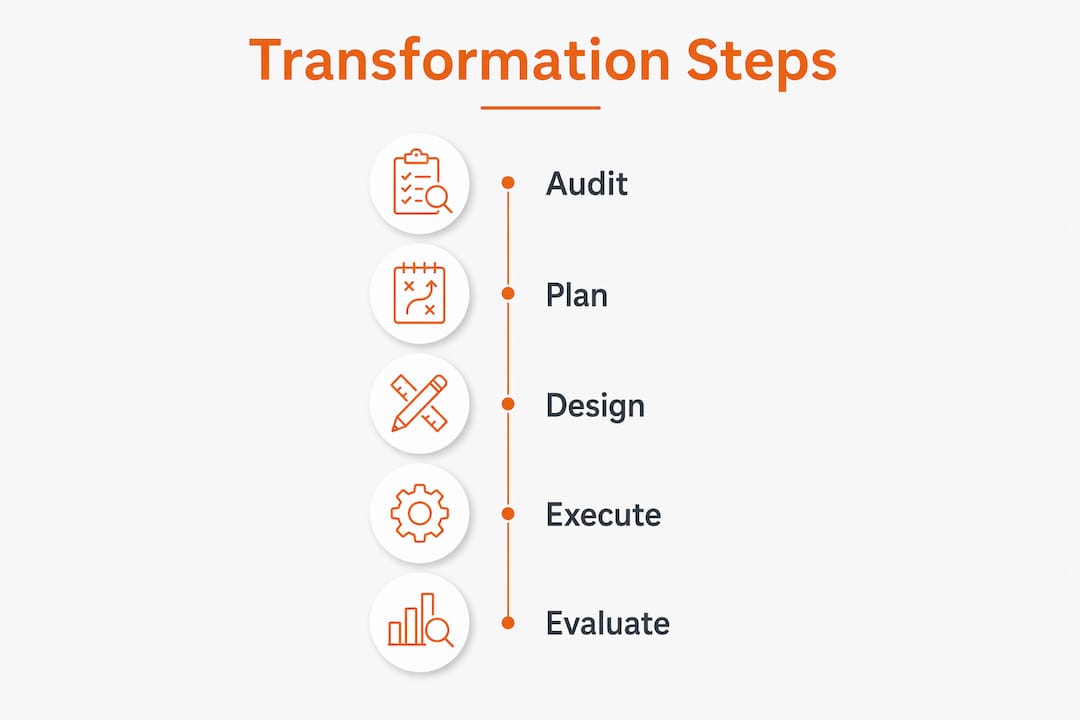
The workspace transformation process is a systematic approach to redesigning office environments that improves spatial efficiency, employee experience, and operational outcomes. Done well, it delivers measurable gains in productivity, well-being, and space utilisation. Done poorly, it costs far more than the refurbishment budget. This guide gives business leaders and office managers a structured, practical framework covering prerequisites, phased execution, change management, and post-move evaluation, with specific tools and strategies drawn from current 2026 practice.

Office redesign is the industry term for what many organisations call a workspace transformation. The two terms describe the same structured discipline: auditing how space is currently used, defining how it should perform, and executing the physical and cultural changes needed to close that gap. The process spans space planning, furniture specification, phased construction, and people management. Skipping any of these stages is the most common reason transformations run over budget or fail to change how people actually work.
Sound planning separates a successful office redesign from an expensive disruption. Before a single desk moves, you need four things in place: occupancy data, stakeholder input, regulatory clearance, and a realistic budget.
Occupancy data tells you which spaces are genuinely used and which are wasted. Badge data, desk booking records, and sensor counts all work. 92% of organisations are now exploring AI tools to model occupancy patterns and identify underused zones. That figure reflects how central data has become to credible space planning, not just intuition.
Stakeholder interviews and workshops surface requirements that no floor plan reveals. Talk to team leads, facilities staff, IT, and HR. Ask what frustrates people about the current layout, what collaboration looks like in practice, and what a good day at the office feels like. These conversations prevent costly redesigns later.
| Planning Step | What to Confirm |
|---|---|
| Occupancy audit | Desk and room utilisation rates by day and time |
| Stakeholder workshops | Team-specific needs, collaboration patterns, pain points |
| Regulatory checks | Building consent, fire egress, DDA compliance under UK law |
| Budget and timeline | Realistic cost per workstation, phasing schedule |
Regulatory checks matter more than most leaders expect. UK building regulations, fire safety requirements, and the Equality Act 2010 all apply to commercial fit-outs. Confirm compliance with your building manager and a qualified fit-out contractor before finalising any layout.
Pro Tip: Use a space planning guide to benchmark your utilisation rates against sector norms before briefing a designer. It prevents over-specifying space you do not actually need.
A typical office refurbishment takes between 8 and 16 weeks depending on scope. Build that range into your project plan from day one, and add contingency for supply chain delays on furniture.
Phased execution reduces risk and keeps the business running. The principle is straightforward: test before you commit, sequence by disruption level, and keep displaced teams productive throughout.
Pro Tip: When specifying furniture for pilot zones, choose pieces from your intended final specification. This gives you real-world feedback on comfort, durability, and layout fit before bulk ordering.
The concept of ‘workspitality’, which blends workplace functionality with hospitality comfort, is increasingly relevant here. Pilot zones that feel welcoming rather than utilitarian generate better feedback and higher adoption rates from the start.
Technical execution without people management produces offices that look transformed but work no differently. Integrating change management from day one is not optional. Bolting it on after construction is complete leads to poor adoption despite a technically successful fit-out.
The most effective change management strategies for office transformations share three characteristics:
“Most failures in transformation come from viewing it solely as construction rather than a critical change management exercise involving staff buy-in and cultural alignment.” — Workplace Change Management guide
Resistance to change is normal and predictable. The most common objections are loss of a personal desk, noise concerns in open-plan areas, and uncertainty about hybrid working norms. Address each directly in your communications before people raise them. Anticipating resistance is more effective than responding to it.
Post-occupancy evaluation is where most organisations underinvest. The physical handover is not the end of the transformation. It is the beginning of the optimisation phase.
80% of operational issues surface within the first two weeks post-move. These include acoustic problems, booking system errors, and power outlet shortfalls. Fixing them quickly is critical. Leaving them unresolved signals to staff that their feedback does not matter.
A two-week snagging walkthrough with your fit-out contractor and facilities team catches physical defects. A 60-day review captures real-world usage patterns that no design process can fully predict. Post-move check-ins at 2–4 weeks after each phase are the recognised best practice for managing this effectively.
| Metric | What It Tells You |
|---|---|
| Desk booking utilisation rate | Whether the ratio of desks to staff is correctly calibrated |
| Meeting room occupancy vs. bookings | Whether no-show rates justify AI scheduling investment |
| Employee satisfaction score | Whether the transformation improved perceived well-being |
| Acoustic complaint frequency | Whether zoning and sound absorption are working |
Iterative layout adjustments based on real usage data are far more effective than trying to perfect the design before handover. Modular furniture makes this iteration practical. Fixed installations make it prohibitively expensive.
The office fit-out workflow does not end at handover. Build a six-month review into your project plan and assign a named owner for post-occupancy improvement. Without accountability, issues accumulate and the transformation loses momentum.
A successful workspace transformation requires integrated planning, phased execution, and people-centred change management working in parallel from the outset.
| Point | Details |
|---|---|
| Start with data, not design | Conduct occupancy audits and stakeholder workshops before briefing any designer or contractor. |
| Run a pilot zone first | Test your design assumptions for 4–6 weeks in one area before committing to a full rollout. |
| Integrate change management early | Bolting on people management after construction leads to poor adoption regardless of design quality. |
| Fix issues within two weeks | 80% of operational problems surface in the first fortnight; resolve them fast to maintain staff confidence. |
| Specify modular furniture | Movable, reconfigurable pieces future-proof your layout against hybrid working changes and team growth. |
The most common mistake I see in office transformation projects is treating the floor plan as the deliverable. It is not. The deliverable is a change in how people work, collaborate, and feel about coming into the office. The floor plan is just the mechanism.
Furniture layout is a cultural tool. Where you place collaborative zones relative to quiet focus areas signals what the organisation values. A layout that forces everyone into open-plan seating without acoustic refuge tells staff that their concentration is less important than visibility. That message lands, whether you intended it or not.
The organisations that get this right treat every furniture decision as a statement about working norms. Ergonomic chairs at every workstation say that physical wellbeing is non-negotiable. Height-adjustable desks say that people are trusted to manage their own posture and energy. Soft seating in informal meeting areas says that not every conversation needs a boardroom table.
The other thing I would push back on is the idea that a transformation has a finish line. The best-performing offices I have seen are the ones where the facilities team treats the layout as a living document. They move things, test configurations, and act on feedback. That mindset requires modular furniture and a culture of iteration. It also requires leadership that is visibly invested in the outcome, not just the budget sign-off.
— Furniture
Furnitureforbusiness supplies commercial office furniture to UK businesses undergoing refurbishment and fit-outs, from teams of five to organisations of five hundred. Whether you are specifying ergonomic office chairs for a new open-plan floor, sourcing height-adjustable desks for a hybrid-ready layout, or fitting out a meeting suite with conference room essentials, Furnitureforbusiness offers bulk order pricing, free delivery to the UK mainland, and a product range built for commercial durability. The office furniture buying guide is a practical starting point for any procurement team working through a transformation brief. For tailored advice on specification and volume orders, the Furnitureforbusiness team is available to support your project directly.
The workspace transformation process is a structured approach to redesigning office environments, covering space auditing, design, phased construction, furniture specification, and change management. The goal is to improve spatial efficiency, employee well-being, and operational performance.
A typical office reorganisation takes between 8 and 16 weeks depending on scope. Post-move check-ins are recommended at 2–4 weeks after each phase to catch and resolve operational issues quickly.
Most failures occur when transformation is treated as a construction project rather than a change management exercise. Poor staff engagement, late communication, and no post-move evaluation are the leading causes of underperformance.
Modular and movable furniture is the recommended choice for hybrid offices. Fixed installations limit your ability to reconfigure layouts as team sizes and working patterns change. Height-adjustable desks and reconfigurable storage units offer the most flexibility.
Track desk and room booking utilisation rates, employee satisfaction scores from pulse surveys, and acoustic complaint frequency. A 60-day post-occupancy review captures real-world usage data that design-phase assumptions cannot predict.

Phone: 0330 043 4114
VAT no. GB 991 8681 60
Company no. 07250570