TL;DR:
- Contract seating is engineered for demanding commercial environments, with certification to strict safety standards like EN 16139 and Crib 5. It offers a service life of up to 15 years, reducing replacement costs and ensuring legal compliance, unlike domestic furniture. Proper specification of contract seating safeguards operational continuity, safety, and long-term value for businesses.
Contract seating is commercial-grade furniture engineered specifically for multi-user environments where chairs face intense, repeated daily use across years of service. Unlike residential furniture, contract seating must meet strict safety and performance standards including EN 16139 and Crib 5 fire compliance before it can legally and safely be specified for offices, hospitality venues, or public spaces. The distinction matters enormously for procurement teams and office managers: specifying the wrong category of furniture in a commercial setting carries real legal, financial, and operational consequences. This guide explains the contract seating definition, what separates it from domestic alternatives, and how to select the right options for your workspace.
Contract seating is defined as seating manufactured to withstand the demands of commercial environments, tested and certified to perform through thousands of use cycles without degradation. The term “contract” refers to the contractual specification process used by architects, interior designers, and procurement teams when fitting out commercial projects. It is the recognised industry term, and understanding it properly is the first step to making sound purchasing decisions.

The most visible difference between contract and domestic furniture is structural. Contract seating uses high-density foam, reinforced frames, and suspension systems designed to resist sagging through continuous use. A domestic sofa or chair is typically engineered for a household of two to four people using it intermittently. A contract chair in a busy office or hotel lobby may be occupied for eight or more hours a day by a rotating cast of users.
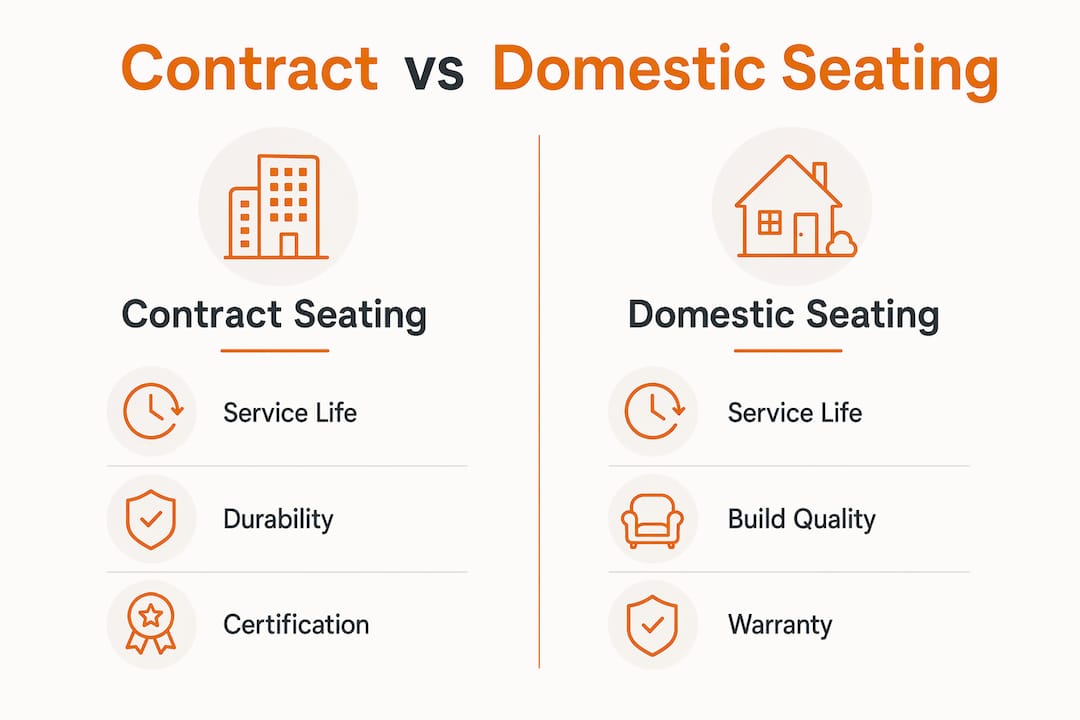
Service life tells the story clearly. Contract furniture provides a service life of 8 to 15 years, compared to just 3 to 5 years for residential equivalents. For a procurement team managing a 200-person office refurbishment, that gap translates directly into replacement cycles, budget forecasting, and disruption to operations.
Compliance is the other critical dividing line. Contract seating must satisfy EN 16139 certification, the European standard that tests structural strength, safety, and performance for intensive-use seating through thousands of compression and impact cycles. In the UK, upholstered contract seating for hospitality and public spaces must also meet Crib 5 fire resistance standards. Domestic furniture carries no such obligations, which is precisely why placing it in a commercial setting creates liability.
Pro Tip: When reviewing product specifications, look for explicit EN 16139 certification rather than vague claims of “commercial quality.” Certification levels within the standard vary, so match the level to your specific use case.
| Feature | Contract seating | Domestic seating |
|---|---|---|
| Service life | 8 to 15 years | 3 to 5 years |
| Foam density | High-density, sag-resistant | Softer, comfort-focused |
| Fire compliance | Crib 5 (where required) | Domestic fire standards only |
| Structural testing | EN 16139 certified | No commercial standard |
| Frame construction | Reinforced joints, robust frames | Standard household construction |
The case for contract seating goes well beyond durability. Specifying certified commercial furniture protects your business legally and financially in ways that are easy to overlook until something goes wrong.
Using non-certified domestic furniture in a commercial space risks invalidating your insurance and creating safety hazards for employees and visitors. If a chair fails and causes injury, and it transpires the furniture was not rated for commercial use, your liability position is significantly weakened. This is not a theoretical risk. It is a documented reason why insurers and health and safety auditors specifically ask about furniture certification during assessments.
The financial logic of contract seating becomes clear when you calculate total cost of ownership rather than purchase price alone. A domestic chair at £80 replaced every four years costs more over a decade than a certified contract chair at £200 lasting twelve years. Add in the hidden costs of procurement time, delivery disruption, and disposal, and the gap widens further. Certified contract seating reduces maintenance costs and premature replacements, delivering measurably better long-term value.
“The real cost of cheap seating is not the purchase price. It is the replacement cycle, the downtime, and the risk you carry every day the wrong furniture is in your building.”
There are four strategic reasons to specify contract seating from the outset:
Selecting contract seating solutions for a commercial project requires matching specific product features to the functional demands of each space. The most common procurement mistake is choosing seating based on appearance alone, then discovering it fails to perform in practice. Function must lead the specification, with aesthetics following once performance criteria are confirmed.
Start by mapping each area of your workspace to its primary use pattern. A meeting room used for two-hour sessions has different requirements from a contact centre where staff sit for six to eight hours continuously. A reception lounge needs seating that looks welcoming and cleans easily. A staff canteen needs stackable chairs that can be rearranged quickly and wiped down between uses.
Key features to evaluate by setting:
Pro Tip: Ask suppliers for the Martindale abrasion rating on any upholstered contract seating. For high-traffic areas, specify a minimum of 40,000 rubs. For standard office use, 25,000 to 30,000 is acceptable.
Project timeline coordination is another factor procurement teams frequently underestimate. Contract seating from specialist manufacturers often carries lead times of four to twelve weeks. Phased office refurbishments require deliveries timed to site readiness, and a mismatch between furniture arrival and installation readiness creates storage problems and damage risk. Build lead times into your project plan from the first specification meeting, not as an afterthought.
Specifying coordinated furniture packages rather than sourcing individual pieces from unrelated ranges produces a more cohesive operational and visual result. This matters for brand perception in client-facing spaces and for the practical ease of future replacements.
Contract seating covers a broad range of categories, each suited to specific commercial applications. Understanding the main types helps procurement teams build accurate specifications rather than defaulting to generic “office chair” searches.
Contract seating includes fixed benches, modular lounge seating, task and operator chairs, and visitor seating options, with bespoke banquette seating commonly specified for hospitality and public spaces. The table below maps the primary categories to their typical applications and key specification criteria.
| Seating type | Typical application | Key specification criteria |
|---|---|---|
| Task and operator chairs | Open-plan offices, contact centres | EN 16139 certified, full ergonomic adjustment, 8-hour use rating |
| Visitor and side chairs | Reception areas, meeting rooms | Stackable, easy-clean upholstery, lightweight frame |
| Modular lounge seating | Breakout zones, reception lounges | High Martindale rating, reconfigurable modules, Crib 5 compliance |
| Fixed and banquette seating | Hospitality, canteens, public spaces | Fixed frame, Crib 5 upholstery, high abrasion resistance |
| Executive and boardroom chairs | Boardrooms, private offices | Premium materials, ergonomic support, brand-appropriate aesthetics |
Task chairs represent the highest-volume purchase for most office fit-outs. The ergonomic features required for sustained daily use include adjustable lumbar support, seat depth adjustment, and armrests that move independently of the seat. Chairs without these adjustments fail to accommodate the range of body types in a typical workforce, increasing the risk of discomfort and musculoskeletal complaints over time.
Strong frame construction, reinforced joints, and abrasion-resistant upholstery are the three determinants of contract seating longevity that matter most regardless of category. These are the features to verify in product data sheets before committing to a bulk order.
For visitor and side chairs, modular lounge seating offers the flexibility to reconfigure breakout spaces as your team’s working patterns evolve. This is particularly relevant for businesses managing hybrid working arrangements where space use shifts week to week.
Contract seating is the only furniture category that combines certified durability, legal compliance, and genuine total cost of ownership advantages for commercial environments.
| Point | Details |
|---|---|
| Contract seating definition | Commercial-grade seating engineered for intensive multi-user environments, certified to EN 16139 and Crib 5 standards. |
| Service life advantage | Contract seating lasts 8 to 15 years versus 3 to 5 years for domestic alternatives, reducing replacement costs significantly. |
| Legal and insurance protection | Non-certified domestic furniture in commercial spaces risks invalidating insurance and breaching UK health and safety obligations. |
| Function before aesthetics | Specify seating features to match each space’s use pattern before considering visual design or colour. |
| Total cost of ownership | Higher upfront cost is offset by longer service life, lower maintenance, and reduced procurement disruption over time. |
From where we stand at Furnitureforbusiness, the most consistent mistake we see in commercial furniture procurement is treating contract seating as a commodity purchase. Teams focus on unit price, pick something that looks right in a product image, and discover six months later that the foam has compressed, the upholstery is pilling, or the chair mechanism has failed under daily use.
The uncomfortable truth is that evaluating seating on surface comfort alone is insufficient. A chair that feels pleasant in a showroom for five minutes tells you nothing about how it performs after 2,000 hours of use. Certification exists precisely because subjective assessment cannot predict long-term performance.
We also see procurement and design teams working in silos, with designers specifying aesthetically driven choices and procurement teams sourcing on price, neither group fully owning the performance outcome. The businesses that get this right bring both functions into the specification process early, agree on non-negotiable performance criteria first, and then find the best product within those constraints.
Contract seating is not a cost centre. It is an investment in your people’s daily experience and your organisation’s operational continuity. Specify it accordingly.
— Furniture
Furnitureforbusiness supplies a full range of contract-compliant seating for UK offices, meeting rooms, reception areas, and hospitality spaces, with free delivery to the UK mainland. Every product in the range is selected for commercial durability, ergonomic performance, and compliance with relevant UK and European standards.
Whether you are fitting out a single meeting room or sourcing seating for a 300-person office, the office chairs range covers task chairs, executive seating, visitor chairs, and heavy-duty operator options. For bulk orders, Furnitureforbusiness offers competitive pricing and phased delivery to align with your project timeline. Browse the full collection and request a quote for your specific requirements at Furnitureforbusiness.
Contract seating refers to chairs and benches manufactured specifically for commercial environments, certified to meet standards such as EN 16139 and Crib 5. The term “contract” originates from the specification and procurement contracts used in commercial fit-out projects.
UK health and safety legislation requires employers to provide safe, suitable furniture for the workplace. While no single law mandates contract-grade certification by name, using non-certified domestic furniture in a commercial setting can breach health and safety obligations and invalidate public liability insurance.
Contract seating typically provides a service life of 8 to 15 years under commercial use conditions, compared to 3 to 5 years for domestic furniture. Longevity depends on the quality of frame construction, foam density, and upholstery abrasion resistance.
EN 16139 is the European standard for non-domestic seating, testing structural strength and safety through thousands of compression and impact cycles. Seating certified to this standard has been independently verified to withstand intensive commercial use without premature failure.
Office chairs is a broad product category that includes both domestic and contract-grade options. Contract seating is the subset of office chairs and other commercial seating that meets certified durability and safety standards for intensive, multi-user commercial environments.

Phone: 0330 043 4114
VAT no. GB 991 8681 60
Company no. 07250570