TL;DR:
- Standardising office furniture ensures ergonomic compliance, enhances health safety, and simplifies procurement across multiple sites. Establishing a written specification aligned with British Standards and DSE regulations supports operational efficiency and comprehensive risk management. Regular reviews and employee training are essential components of a successful, resilient office furniture standardisation strategy.
Office furniture standardisation is the practice of establishing consistent ergonomic, design, and quality parameters across all workspaces in an organisation to protect employee health, simplify procurement, and satisfy UK legal obligations. For UK employers, this is not a cosmetic exercise. The Health and Safety Executive (HSE) enforces the Display Screen Equipment (DSE) Regulations 1992, which require employers to assess and reduce workstation risks, including furniture adjustability requirements such as adjustable chair height, backrest, and arm height. Standardising office furniture is the most direct way to meet those obligations at scale, whether you manage one office or twenty.
The DSE Regulations 1992 place a clear duty on UK employers to assess every workstation used by habitual display screen users and reduce identified risks. Chairs must offer adjustable seat height, backrest height, and tilt. Desks must be positioned to support neutral posture. Buying furniture that meets these criteria once is straightforward. Maintaining compliance across a growing or changing workforce is where standardisation becomes the practical solution rather than an optional preference.
Musculoskeletal disorders are the most common work-related health complaint in the UK, and poorly configured workstations are a primary cause. When every employee sits in a different chair with different adjustment ranges, conducting consistent DSE assessments becomes almost impossible. A standardised chair specification means your assessors know exactly which adjustments are available and can train users accordingly.
Hybrid working has added a further layer of complexity. DSE duties extend to home workstations, meaning employers must assess and, where necessary, supply equipment that matches office ergonomic standards at employees’ homes. Without a defined furniture baseline, this becomes an unmanageable patchwork of ad hoc solutions.
Key legal and health reasons to standardise include:
Pro Tip: Document your furniture specification as part of your DSE risk assessment policy. When HSE or an insurer asks for evidence of compliance, a written standard is far stronger than a verbal assurance.
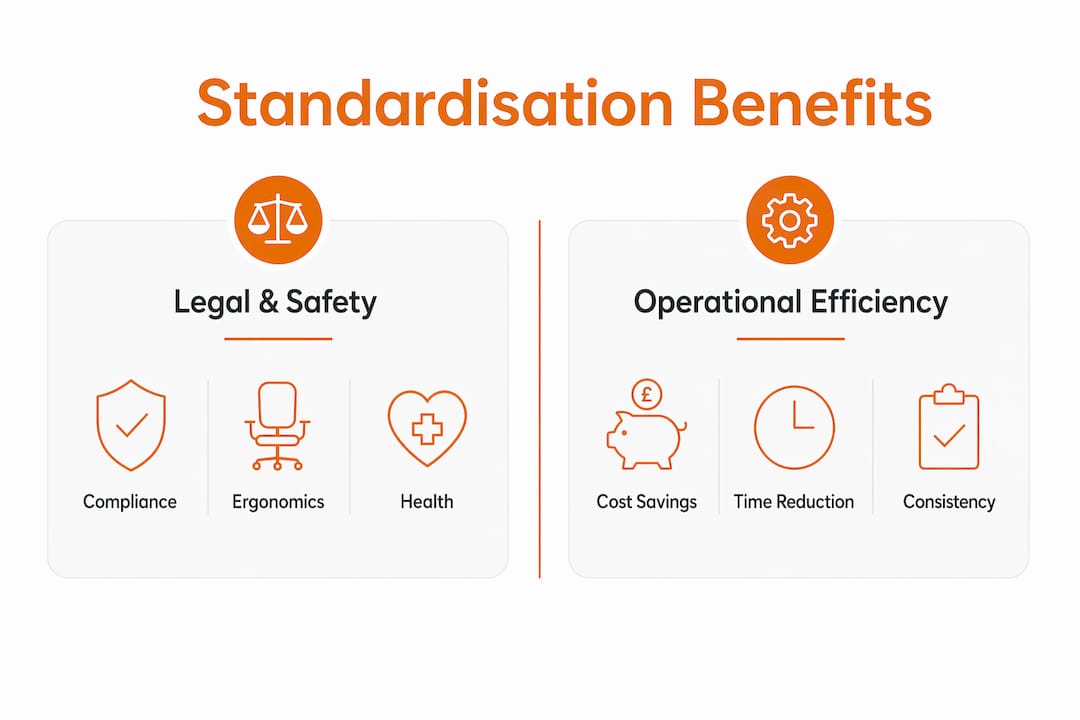
Procurement is where the financial case for standardising office furniture becomes undeniable. When every floor, department, or site orders from the same approved specification, you consolidate purchasing volume, negotiate better unit pricing, and eliminate the administrative overhead of evaluating dozens of different products. Standard desk sizes also reduce reconfiguration friction: when a team expands or moves floors, new desks slot into existing layouts without a full redesign.
The operational benefits extend well beyond procurement. Consider these practical gains in sequence:
The table below illustrates how a standardised approach compares to an ad hoc procurement model across common operational metrics.
| Metric | Ad hoc procurement | Standardised approach |
|---|---|---|
| Procurement time per order | High: repeated evaluation cycles | Low: approved spec, direct order |
| Reconfiguration cost | High: bespoke fitting often required | Low: standard dimensions slot in |
| DSE compliance consistency | Variable: different adjustment ranges | Consistent: known specification |
| Replacement parts availability | Unreliable: multiple suppliers | Reliable: single approved range |
| Brand coherence across sites | Low: visual inconsistency | High: uniform design language |

Pro Tip: When specifying furniture for a multi-site estate, build a short approved product family rather than a single SKU. This gives procurement teams flexibility while maintaining the ergonomic and design baseline you need.
British Standards are the quality and safety benchmarks that give your furniture specification legal and commercial credibility. The most significant for UK office environments is BS 5852 Crib 5, the fire safety standard for contract upholstery. Crib 5 certification means the upholstery has been tested against a sustained ignition source equivalent to a burning wooden crib, the baseline required for contract furniture in commercial premises.
When specifying upholstered seating, the distinction between inherent and topical fire resistance matters considerably. Inherent resistance is woven into the fabric at manufacture and does not degrade with cleaning or wear. Topical treatment is applied as a finish and can diminish over time. For a standardised office furniture programme, specifying inherent Crib 5 compliance removes the need for periodic re-treatment and provides a consistent, auditable standard across the entire estate.
The role of BS EN standards in office furniture extends beyond fire safety. BS EN 1335 covers office seating dimensions and adjustment ranges, while BS EN 527 addresses office desks. Specifying furniture to these standards gives you confidence that products from different suppliers within your approved range will meet the same performance baseline.
Key advantages of embedding British Standards in your furniture specification:
Global baseline plus local adaptation is the approach that outperforms identical SKU everywhere in multi-site office programmes. The principle is straightforward: define mandatory performance criteria centrally, then allow controlled local variation within those boundaries. Confusing visual uniformity with functional uniformity is one of the most common causes of programme failure, because it leads organisations to enforce identical products in locations where supply chains, building regulations, or cultural norms make that impractical.
A practical multi-site standardisation framework distinguishes between two categories of criteria. Mandatory criteria include ergonomic performance (adjustment ranges, seat dimensions), fire safety certification (Crib 5 or equivalent), and structural durability standards. Adaptive variables include colour, fabric choice within a compliant range, and local supplier selection from an approved product family.
Practical steps for multi-site programmes:
The result is a programme that holds its ergonomic and safety baseline across every site while giving regional teams the flexibility to source efficiently and respond to local constraints.
Effective office furniture standardisation starts with a written specification, not a product catalogue. The specification should define ergonomic requirements (seat height range, backrest adjustability, desk height), fire safety certification (BS 5852 Crib 5 for upholstery), structural standards (BS EN 1335 for chairs, BS EN 527 for desks), and aesthetic parameters (colour palette, material family). This document becomes the reference point for procurement, supplier evaluation, and DSE compliance audits.
Follow these steps to implement standardisation effectively:
Pro Tip: Embed your furniture specification into your supplier contracts as a schedule. This prevents last-minute substitutions and gives you a contractual basis for rejecting non-compliant deliveries.
Standardising office furniture delivers legal compliance, procurement efficiency, and ergonomic consistency simultaneously, making it one of the highest-return decisions an office manager can make.
| Point | Details |
|---|---|
| Legal compliance is the baseline | DSE Regulations 1992 require adjustable, ergonomic workstations; standardisation makes compliance auditable and consistent. |
| British Standards add credibility | BS 5852 Crib 5 and BS EN 1335 give specifications legal weight and simplify supplier evaluation. |
| Operational savings compound | Standard desk sizes and approved product families cut procurement time, reconfiguration costs, and replacement complexity. |
| Hybrid work demands a defined baseline | DSE duties extend to home workstations; a written furniture standard is the only scalable solution. |
| Training completes the picture | Purchasing compliant furniture without user training leaves DSE obligations unmet regardless of the specification. |
Most organisations treat furniture standardisation as a procurement convenience. After working with UK businesses across a range of office sizes and sectors, I would argue it is one of the few workplace decisions that simultaneously reduces legal risk, cuts operational cost, and improves employee health. Those three outcomes rarely come from the same initiative.
The pitfall I see most often is organisations that buy the right furniture and then do nothing with it. An ergonomic chair that nobody knows how to adjust is functionally identical to a non-compliant one. The chair adjustment failure point is the most common reason a well-intentioned standardisation programme still produces DSE complaints. Training is not optional; it is the last mile of the specification.
I would also push back on the instinct to enforce identical products everywhere. A standards document with mandatory performance criteria and permitted local variables is more resilient than a single approved SKU. It survives supply chain disruptions, accommodates regional building regulations, and gives procurement teams room to work without compromising the ergonomic or safety baseline you have set. Flexibility within a defined framework is not a compromise. It is good programme design.
The businesses that get the most from standardisation are those that treat the written specification as a living document, reviewed regularly and updated as standards evolve and the workforce changes. That discipline is what separates a genuine programme from a one-off procurement exercise.
— Furniture
Furnitureforbusiness supplies ergonomic office chairs and height-adjustable desks that meet BS EN 1335, BS EN 527, and BS 5852 Crib 5 requirements, giving UK businesses a compliant foundation for any standardisation programme. Whether you are fitting out a single floor or rolling out across multiple sites, the range includes bulk order pricing, specification support, and free delivery to the UK mainland. The team can help you build an approved product family that satisfies your DSE obligations and holds its standard across hybrid and office environments. Explore the full range and request a bulk order quote at furnitureforbusiness.co.uk.
Standardising office furniture means defining consistent ergonomic, design, and quality parameters across all workspaces in an organisation. The goal is to meet DSE Regulations 1992, simplify procurement, and create a predictable, auditable environment for employee health and safety.
The DSE Regulations 1992 require employers to provide adjustable, ergonomically appropriate workstations for habitual display screen users. Standardisation is the most practical way to meet and evidence that obligation consistently across a workforce.
BS 5852 Crib 5 is the UK fire safety standard for contract upholstery, requiring fabric to resist a sustained ignition source. Specifying Crib 5 compliant seating satisfies fire risk assessment requirements under the Regulatory Reform (Fire Safety) Order 2005 and provides auditable evidence of compliance.
DSE obligations extend to home workstations, so employers must assess and, where necessary, supply furniture that meets the same ergonomic standard as the office. A written home worker equipment baseline, combined with a remote assessment process, is the practical solution.
A review every two years is a reasonable baseline, aligned with DSE assessment cycles. Reviews should also be triggered by significant office changes, new British Standards publications, or workforce shifts such as a move to hybrid working.

Phone: 0330 043 4114
VAT no. GB 991 8681 60
Company no. 07250570