TL;DR:
- Hot desking involves employees sharing unassigned workspaces to reduce costs and enhance flexibility when managed properly. Misunderstandings often stem from poor implementation, leading to issues like desk shortages, clutter, and low compliance. Successful hot desking relies on clear policies, proper storage, accurate data, and managerial support to foster a flexible, sustainable workspace.
Hot desking is one of the most misunderstood concepts in modern office management. Mention it to a team and you’ll likely hear groans about lost seats, cluttered desks, and unpredictable mornings. But that reputation is almost entirely the result of poor implementation, not the concept itself. What is hot desking, really? It’s a structured approach to shared workspaces that, when managed properly, cuts real estate costs, supports hybrid working patterns, and gives employees genuine flexibility. This guide explains exactly how it works, where it differs from similar models, and how to roll it out without the chaos.
| Point | Details |
|---|---|
| Hot desking defined | Employees share a pool of unassigned desks, selecting one on arrival or via advance booking. |
| Two main models | First-come, first-served offers spontaneity; reservation-based hoteling offers predictability. |
| Cost savings are significant | Right-sizing desk count to actual attendance eliminates the overhead of empty, unused workstations. |
| Policy and storage are non-negotiable | Clear desk rules and personal storage solutions determine whether hot desking succeeds or fails. |
| Technology ties it together | Desk booking software with check-in enforcement is now standard for well-run hot desking setups. |
Hot desking is a workplace model where employees have no permanently assigned desk. Instead, they draw from a shared pool of workstations, choosing whichever is free when they arrive. The practical rule is simple: the desk belongs to whoever needs it that day, and every user clears it before they leave.
The term has an interesting origin. It derives from the naval practice of “hot racking,” where sailors on rotating shifts shared the same bunk, with one sailor’s bunk still warm when the next person climbed in. The office equivalent is the same logic applied to workstations rather than sleeping quarters.
In day-to-day operation, hot desking works like this:
The industry also uses the related term desk hoteling, which refers specifically to reservation-based desk sharing. The defining difference is booking: hot desking is traditionally first-come, first-served, while hoteling requires employees to reserve a desk in advance. In 2026, many organisations blend both approaches, using booking software with check-in enforcement to manage shared workstations more precisely.
Pro Tip: If you are introducing hot desking for the first time, start with a pilot of one team or one floor. You will surface operational issues, from locker shortages to peak-day bottlenecks, without disrupting the whole business.
The most compelling case for hot desking is financial. Consider a team of 100 people operating a hybrid model, with only 55 in the office on any given day. Right-sizing your desk count to reflect actual attendance means you are not paying rent, rates, and maintenance costs for 45 empty desks sitting idle. Across a Central London or Manchester city centre office, that adds up to a significant annual saving.

The market has moved firmly in this direction. Assigned seating dropped from 83% to 55% of office layouts in 2024, reflecting a widespread shift towards flexible seating models including hot desking. This is not a fringe experiment. It is the new mainstream.
Beyond cost, the benefits extend into culture and collaboration:
Understanding hybrid team workspace design is closely linked to getting hot desking right, since the two models depend on each other to function well.
Hot desking fails for predictable reasons, and almost none of them are inherent to the concept. They are operational failures. Knowing what goes wrong makes them avoidable.
The most common issues are:
Desk shortages on peak days. If your whole team decides to come in on Tuesday and Wednesday, a first-come setup creates a scramble. Employees who arrive slightly late find no available desks and feel frustrated before the working day has even started.
Phantom bookings. When reservation systems are used without check-in enforcement, employees book desks they never occupy. Without desk check-in and clear desk rules, utilisation data becomes unreliable and capacity planning breaks down.
Personal belongings creep. People naturally want to make a workspace their own. Without a clear desk policy and proper storage provision, shared desks accumulate personal items, which defeats the purpose and creates a poor experience for the next user.
Confidentiality concerns. Teams handling sensitive data need to think carefully about where they sit. Open hot desking layouts can make screen privacy harder to manage, so screens and positioning matter.
Lack of compliance. Success depends as much on communication and policy enforcement as on physical layout. Managers who do not monitor or address non-compliance quickly undermine the whole system.
Addressing these issues requires a clear policy document, communicated before launch, not after the first complaint. Personal storage solutions such as lockers, under-desk pedestals, and portable storage caddies are not optional extras. They are foundational. Without somewhere to put personal belongings, a clean desk policy is unenforceable.
Pro Tip: Use your desk booking data to identify peak attendance days across three to four weeks before setting your desk-to-employee ratio. Aiming for a ratio of roughly 0.7 desks per person is a reasonable starting point for most hybrid teams, but your own data will tell you more.
The distinction between hot desking and desk hoteling matters when you are choosing which model fits your organisation. Both involve shared, unassigned workstations. The difference is in how access is managed.
Hot desking traditionally operates on a first-come, first-served basis, offering maximum spontaneity but less certainty. Hoteling requires advance reservations, giving employees the confidence that a workspace will be waiting for them when they arrive.
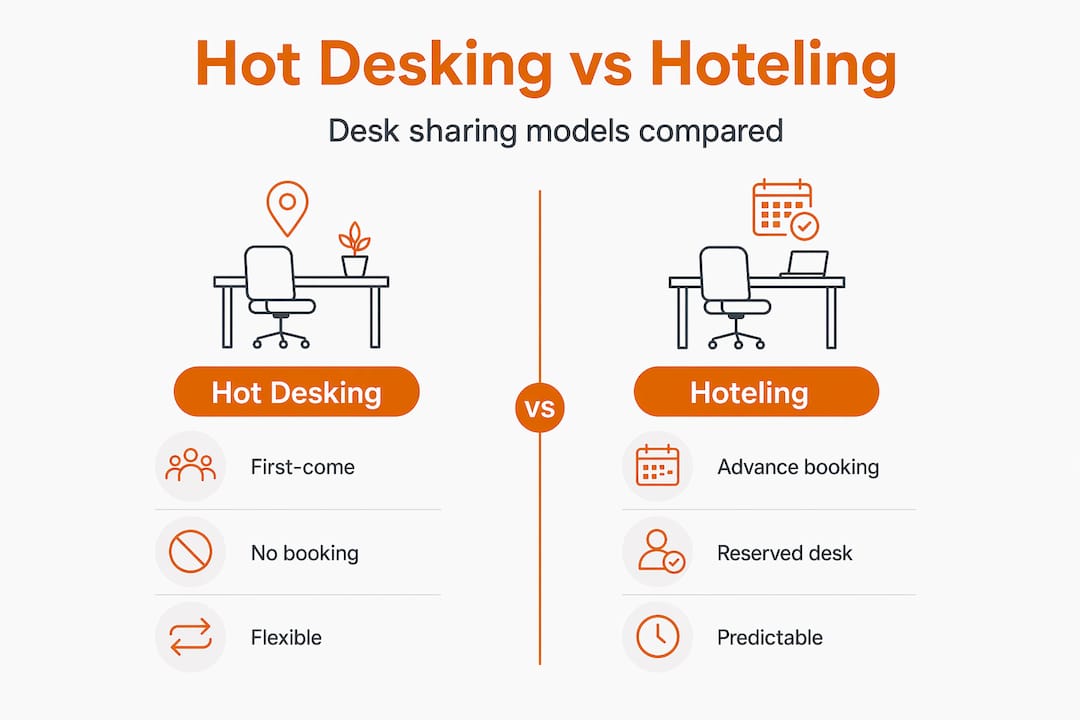
The table below summarises the key trade-offs:
| Feature | Hot desking | Hoteling |
|---|---|---|
| Booking method | First-come, first-served | Advance reservation |
| Employee certainty | Lower | Higher |
| Flexibility | High | Moderate |
| Admin overhead | Lower | Moderate to high |
| Best suited to | Smaller teams, high trust cultures | Larger organisations, compliance-heavy environments |
| Risk | Desk shortages on busy days | Phantom bookings without check-in enforcement |
Neither model is universally better. Organisations with strong attendance patterns and a culture of planning tend to benefit from hoteling. Teams that value flexibility and have relatively predictable occupancy levels often work well with pure hot desking. Many workplaces now operate a hybrid of both, which is arguably where the industry is heading in 2026.
Thinking about flexible workspace solutions alongside your model choice makes the implementation far more coherent, since the furniture needs to support whichever operational approach you select.
Getting hot desking right comes down to preparation, consistency, and ongoing management. Here is what the organisations that do it well have in common.
Start with policy, not technology. Before buying software or rearranging furniture, write a clear desk-sharing policy. It should cover who is covered, how desks are allocated, what clean desk standards look like, and what happens when the rules are not followed. Circulate it before the change goes live.
Match your desk count to real attendance data. Do not guess. Pull badge data, calendar data, or conduct a simple headcount survey over a few weeks. Your desk-to-employee ratio should reflect actual behaviour, not aspirational targets.
Provide proper personal storage. Lockers and storage caddies are the physical backbone of a working hot desking setup. Every employee needs somewhere to store personal items securely when they are not in the office.
Choose the right booking model. Not every team suits first-come. If you have employees who travel to the office from a distance or who need to coordinate sitting near specific colleagues, a reservation option removes friction and builds trust in the system.
Enforce check-in consistently. The biggest operational failure in hot desking is tolerating ghost bookings or desks that are not cleared at the end of the day. Desk check-in enforcement keeps utilisation data accurate and prevents the resentment that builds when some employees follow the rules and others do not.
Review utilisation data monthly. Hot desking gives you access to occupancy data that fixed seating never provided. Use it. If certain zones are chronically underused, reconfigure them. If certain days are consistently over capacity, adjust your attendance policy or add temporary flex capacity.
Pro Tip: Train managers before you train employees. If a team leader does not understand or respect the clean desk policy, their team will not either. Manager buy-in is the single fastest lever for adoption.
In my experience working with businesses across the UK, the gap between hot desking that works and hot desking that doesn’t comes down to one thing: whether leadership treats it as a policy change or just a furniture rearrangement.
I’ve seen organisations invest in booking software, buy new desks, and then watch the whole thing unravel within six months because nobody enforced the clean desk rule, lockers were never installed, and managers quietly kept their own permanent spots. The message that sends to employees is corrosive.
What I’ve found actually works is incremental rollout with genuine feedback loops. Start with one team. Get it right for them. Let their experience become the internal case study that builds confidence across the rest of the business. The teams that resist hardest at the start often become the strongest advocates once they see the system working cleanly.
The furniture matters more than most businesses realise, too. Ergonomics cannot be an afterthought in a shared workspace. If employees are fighting with poorly adjusted chairs or desks that do not accommodate different heights and working styles, they will find reasons to resist the whole programme. Proper height-adjustable desks and genuinely comfortable seating are not perks in a hot desking environment. They are prerequisites.
The broader truth is that hot desking, done well, is one of the most effective tools a business has for adapting its workspace to the reality of how people actually work today. But it demands respect. You cannot install it and ignore it.
— Furnitureforbusiness
If you are planning a hot desking rollout or refurbishing an existing flexible workspace, the furniture you choose will shape whether the policy sticks or falls apart. Furnitureforbusiness supplies durable, design-led commercial office furniture to UK businesses, with free delivery to the mainland.
Browse the full range of office desks built for shared use, including height-adjustable options that work for any user. Pair them with ergonomic office chairs designed for all-day comfort across multiple users, and explore office storage solutions including lockers and personal storage units that make a clean desk policy achievable. Whether you are outfitting five desks or five hundred, Furnitureforbusiness has bulk pricing and easy returns to simplify the procurement process.
Hot desking means employees have no permanently assigned desk and instead choose from a shared pool of workstations each day, either on a first-come basis or through a booking system. Every user is expected to clear the desk when they leave.
Hot desking is first-come, first-served, while hoteling requires employees to reserve a desk in advance. Hoteling offers greater certainty for employees; hot desking offers more spontaneous flexibility.
Height-adjustable desks and ergonomic chairs that accommodate a range of users are ideal for hot desking environments, alongside personal lockers or storage caddies to support a clean desk policy.
The most common issues are desk shortages on peak attendance days, phantom bookings that go unchecked, and the absence of personal storage, which leads to clutter and inconsistent compliance with clean desk policies.
A ratio of around 0.7 desks per employee is a common starting point for hybrid teams, but the right number depends on your actual attendance patterns. Tracking office occupancy data over several weeks before setting your desk count gives you far more accurate results.
Phone: 0330 043 4114
VAT no. GB 991 8681 60
Company no. 07250570