TL;DR:
- A workspace wellness checklist evaluates ergonomics, safety, environment, and habits to improve employee health. It requires assigning each flagged item to a responsible person with a deadline to ensure active management. Limiting changes to one physical and one behavioral habit at a time prevents wellness fatigue and fosters lasting improvements.
A workspace wellness checklist is a structured assessment tool that evaluates physical, environmental, and behavioural conditions at work to protect employee health and legal compliance. UK employers have a duty of care under the Workplace (Health, Safety and Welfare) Regulations 1992 and the Management of Health and Safety at Work Regulations 1999 to maintain safe, healthy working conditions. A well-built office health checklist reduces musculoskeletal disorders, supports Display Screen Equipment (DSE) compliance, and gives office managers a repeatable framework for continuous improvement. Furnitureforbusiness supplies the ergonomic furniture that underpins many of these checks, from adjustable seating to height-adjustable desks.
A complete work environment assessment spans five domains: ergonomics, safety compliance, environmental quality, behavioural habits, and mental health support. Each domain contains specific, measurable items that a manager or safety champion can verify in a structured walk-round. Skipping any domain leaves gaps that accumulate into injury claims, absenteeism, or regulatory non-compliance. The checklist format works best as a yes/no or pass/fail tool, reviewed at least annually and updated after any significant change to the office layout or workforce.
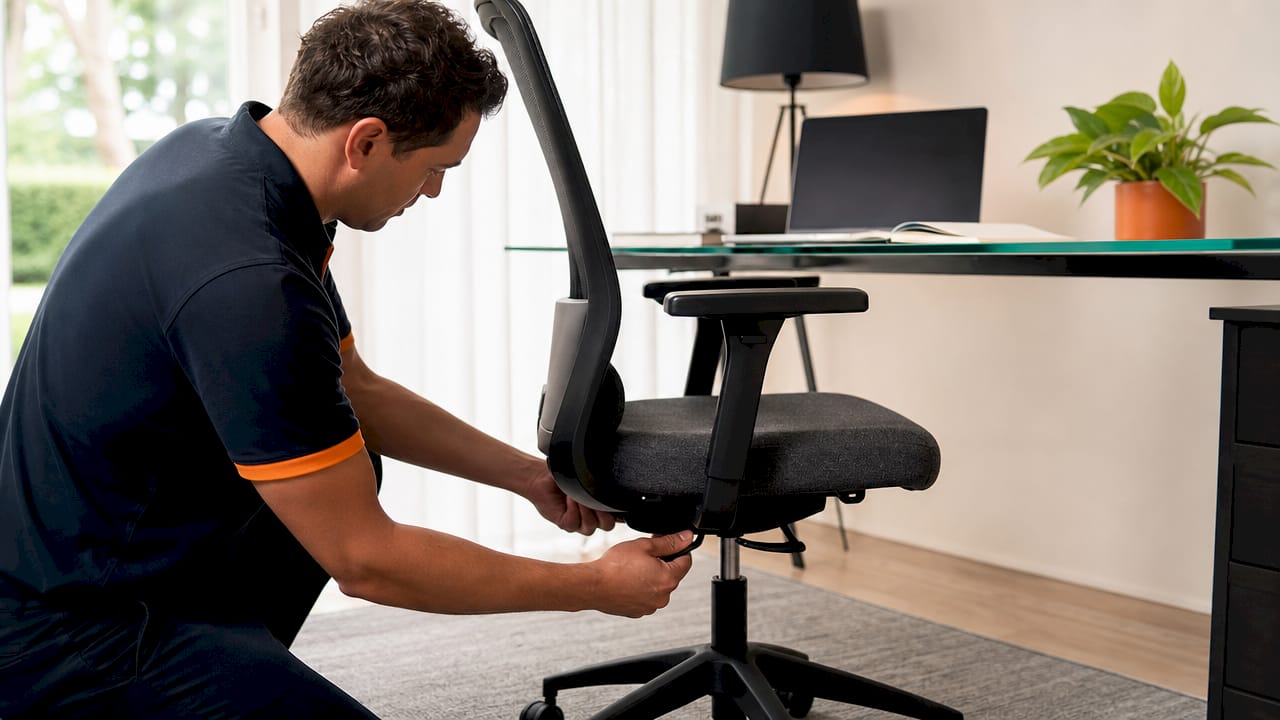
Ergonomic workstation assessments require evaluating five key zones: the chair, monitor, keyboard and mouse, lighting and glare, and work habits including posture and break frequency. Each zone should produce a quick yes/no answer per employee, with a separate column for reported symptoms. This format makes it easy to spot patterns across a team and prioritise fixes.
| Zone | Checklist item | Pass/Fail |
|---|---|---|
| Chair | Seat height allows feet flat on floor, knees at 90° | Pass / Fail |
| Monitor | Top of screen at or just below eye level, arm’s length away | Pass / Fail |
| Keyboard/mouse | Wrists neutral, elbows at 90°, mouse within easy reach | Pass / Fail |
| Lighting | No glare on screen, task lighting available, blinds functional | Pass / Fail |
| Work habits | Breaks taken every 20–30 minutes, posture checked regularly | Pass / Fail |
Micro-posture adjustments such as mouse angle and periodic eye breaks prevent chronic strain more effectively than ergonomic furniture alone. The 20-20-20 rule (every 20 minutes, look at something 20 feet away for 20 seconds) reduces digital eye strain and is a simple behavioural item to add to any checklist. Pair it with the workspace setup guide from Furnitureforbusiness for monitor and keyboard placement specifics.
Pro Tip: Management must explicitly authorise micro-breaks every 20–30 minutes in writing. Employees avoid breaks if permission is not documented, which increases the risk of strain injuries.
UK office safety compliance in 2026 requires an annual formal risk assessment plus monthly safety walk-rounds, covering fire safety, electrical safety (PAT testing), and DSE workstation compliance. Annual audits inspect 18 key safety points, including documentation review and a physical walk-around. Monthly walk-rounds, led by a named safety champion, catch emerging hazards between full reviews.
Risk assessments must be specific to the actual office, workers, and tasks. Generic templates downloaded from the internet are frequently non-compliant under the Management of Health and Safety at Work Regulations 1999. Every assessment must be reviewed after incidents, significant changes, or at least annually.
Key compliance items to include in your office health checklist:
Effective compliance requires linking each checklist outcome to a named responsible person with a deadline. A checklist that flags a broken chair but assigns no owner and no date is passive paperwork. Converting it into an active safety management tool means every flagged item has a named person accountable for resolution within an agreed timeframe.
Behavioural and environmental practices are the most overlooked section of any employee wellness programme. Clutter increases cognitive load and visual distraction, raising stress levels before the working day has properly begun. A five-minute end-of-day desk tidy is a checklist item that costs nothing and improves next-day focus measurably.
Wellness is about preventing chronic stress, not constant cheerfulness. Reducing visual distractions and decluttering directly improve mental focus. The simplest changes, done consistently, outperform elaborate wellness programmes that staff abandon after a fortnight.
Proximity to natural elements supports mental recovery without depleting cognitive resources. A view of greenery or a desk plant is not decoration. Micro-breaks of around 40 seconds spent looking at a plant or out of a window restore attention more effectively than scrolling a phone.
Wellness initiatives succeed when limited to one physical and one behavioural change at a time. Introducing too many changes simultaneously creates wellness fatigue, where staff disengage from the programme entirely. A phased approach, adding one new habit per month, produces far better long-term adoption.
Behavioural checklist items to include:
Pro Tip: A “focus activator” is any consistent physical cue that signals to the brain it is time for concentrated work. It could be a specific desk lamp switched on, a particular notebook opened, or headphones put on. Consistency builds the habit faster than willpower alone.
Workspace design is a direct mental health intervention, not an aesthetic choice. Quiet zones for focussed work and accessible social breakout spaces serve different cognitive needs. An office that provides only open-plan desks forces staff to choose between distraction and isolation. Both outcomes damage wellbeing and productivity.
Social interaction at work is a primary mental health protector and builds trust within teams. Breakout areas with comfortable seating encourage informal conversation, which reduces the isolation that hybrid working can create. Furnitureforbusiness offers design soft seating suitable for these informal zones.
Environmental comfort items to include in your wellness checklist:
Ceiling height affects cognition in ways most office managers do not consider. Higher ceilings promote abstract thinking and creativity. Lower ceilings support detail-focused work. Where ceiling height is fixed, lighting colour temperature can partially replicate the effect: cooler, brighter light (5,000K+) promotes alertness, while warmer light (2,700K–3,000K) supports relaxation in breakout areas. Read more about office lighting and productivity for the full evidence base.
Pro Tip: Intentional design of social spaces fosters trust faster than team-building events. A well-placed sofa and a coffee point near a window creates daily informal interaction that no scheduled activity can replicate.
A workspace wellness checklist works only when each flagged item is assigned to a named owner with a deadline, converting it from a passive document into an active management tool.
| Point | Details |
|---|---|
| Ergonomic zones | Assess chair, monitor, keyboard, lighting, and work habits using a yes/no format per employee. |
| Safety compliance | Annual formal risk assessments plus monthly walk-rounds are required under UK law. |
| Behavioural habits | Limit new wellness changes to one physical and one behavioural item at a time to prevent fatigue. |
| Design for mental health | Provide both quiet zones and social breakout spaces to support focus and reduce isolation. |
| Named accountability | Assign every flagged checklist item to a responsible person with a clear deadline. |
The checklist itself is rarely the problem. The problem is what happens after the checklist is completed. Most offices I have seen file the completed form and return to business as usual until the next annual review. That is not a wellness programme. That is paperwork.
The offices where wellness genuinely improves share one habit: they assign every flagged item to a specific person with a specific date, and they review progress at the next team meeting. It sounds obvious. Very few teams actually do it.
The other pattern I have noticed is wellness fatigue. A new office manager arrives, launches a full wellness overhaul, and within six weeks staff are ignoring every initiative. The two-change rule (one physical, one behavioural change per cycle) is not a compromise. It is the only approach that produces lasting results. Phased implementation respects the fact that habits take time to form and that staff have jobs to do beyond attending wellness workshops.
For hybrid teams, the checklist must extend to home workstations. A hybrid workspace wellness approach that only covers the office leaves the majority of working hours unassessed. Home assessments require a separate form, a stipend policy for equipment, and a clear process for reporting issues. Without those three elements, the duty of care gap remains open.
— Furniture
Completing a wellness checklist identifies gaps. Closing those gaps requires the right equipment. Furnitureforbusiness supplies commercial-grade ergonomic furniture to UK businesses, with free delivery to the UK mainland.
For seating, the ergonomic office chairs range covers everything from heavy-duty task chairs to executive models with full lumbar and arm adjustment. For posture variation throughout the day, the Air Height Adjustable Desk allows staff to alternate between sitting and standing, directly addressing the musculoskeletal risks your checklist will flag. For storage and desk organisation, the office storage and office accessories ranges support the decluttering habits that reduce cognitive load and improve daily focus.
A workspace wellness checklist is a structured assessment tool covering ergonomics, safety compliance, environmental quality, and behavioural habits. It gives office managers a repeatable framework to identify and resolve health risks before they become injuries or legal issues.
UK law requires a formal risk assessment at least annually under the Management of Health and Safety at Work Regulations 1999. Monthly safety walk-rounds by a named safety champion are best practice between full reviews.
Yes. Home office workstations must be assessed separately, with a stipend policy to cover equipment costs. Leaving home workers out of the assessment creates a significant health and safety compliance gap for hybrid teams.
The 20-20-20 rule means every 20 minutes, looking at something 20 feet away for 20 seconds. It reduces digital eye strain and is a simple, documented behavioural item that belongs in every DSE compliance checklist.
Limit new initiatives to one physical and one behavioural change at a time. Phased implementation improves long-term adoption and prevents staff from disengaging when too many changes are introduced simultaneously.
Phone: 0330 043 4114
VAT no. GB 991 8681 60
Company no. 07250570