Most office desks have a work-surface width in a common range around 120 to 180 cm, a depth near 60 to 75 cm, and a fixed sitting height around 70 to 75 cm. The most commonly stocked width across UK suppliers sits at 120 to 140 cm, paired with a 70 cm depth. These figures line up with the common ranges reported across major desk dimension references, so if a quote lands outside them, ask why.
Pro Tip: Before you order a single desk, measure the clearance behind it. HSE guidance on display screen equipment exists precisely because a desk that fits the wall plan on paper often fails the chair pull-back test in real life.
Standard desk sizes cluster around 120 to 160 cm wide, 60 to 76 cm deep, and 71 to 76 cm tall, but clearance planning and height adjustability matter more to long-term satisfaction than the surface dimensions alone.
| Point | Details |
|---|---|
| Standard dimensions | Order to 120 to 140 cm wide, 60 to 70 cm deep, 71 to 76 cm tall for most single-user desks. |
| Chair clearance is non-negotiable | Leave at least 760 mm behind every desk to allow safe chair movement and circulation. |
| Match depth to monitors | Use 70 to 76 cm depth for dual-monitor setups; 60 cm suffices for single-screen roles. |
| Adjustability suits shared desks | Specify height-adjustable desks for hotdesking or mixed-height teams rather than fixed height. |
| Furnitureforbusiness stocks decision-ready SKUs | Standard and height-adjustable desks are available with bulk pricing and free UK mainland delivery. |
Desk sizing isn’t one number, it’s a spectrum that tracks the job the desk is doing. A receptionist’s console and a finance director’s workstation have almost nothing in common dimensionally, and treating them as interchangeable is how procurement budgets get wasted on the wrong SKUs.
Compact or small desks are narrower and shallower, suitable for reception points and small home-office areas where floor space is limited. You lose paperwork room and dual-monitor capacity, but you gain flexibility in tight layouts.
Standard single-user desks commonly measure around 120 to 140 cm in width by 60 to 70 cm in depth, frequently specified in UK offices. It’s wide enough for a monitor, keyboard, and a stack of files, without eating floor space you’ll want for storage or circulation.
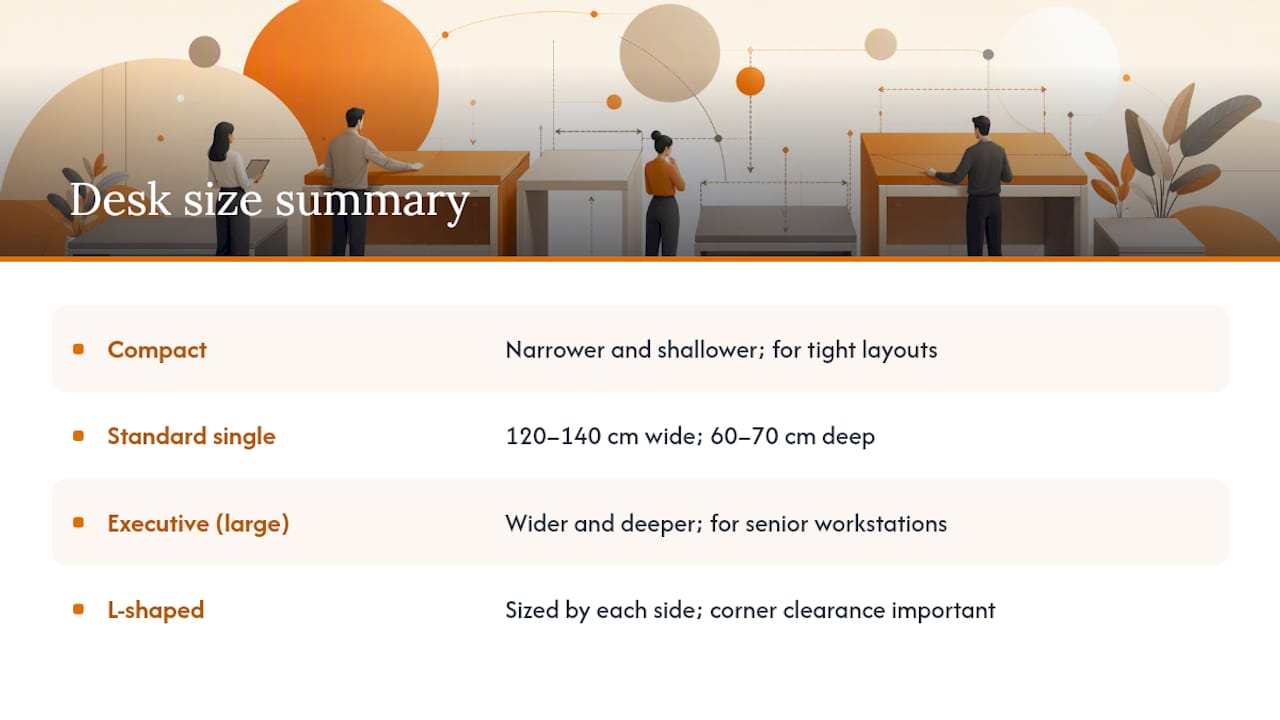
Large or executive desks are wider and deeper to accommodate multiple monitors or extra workspace. This is EffyDesk’s categorisation of desk sizing, and it holds up well against most industry stock lists. Reserve these for senior roles or specialist workstations where the extra surface genuinely earns its footprint.
L-shaped desks are sized by their individual sides, with corner clearance being a crucial factor in determining floor space usage.
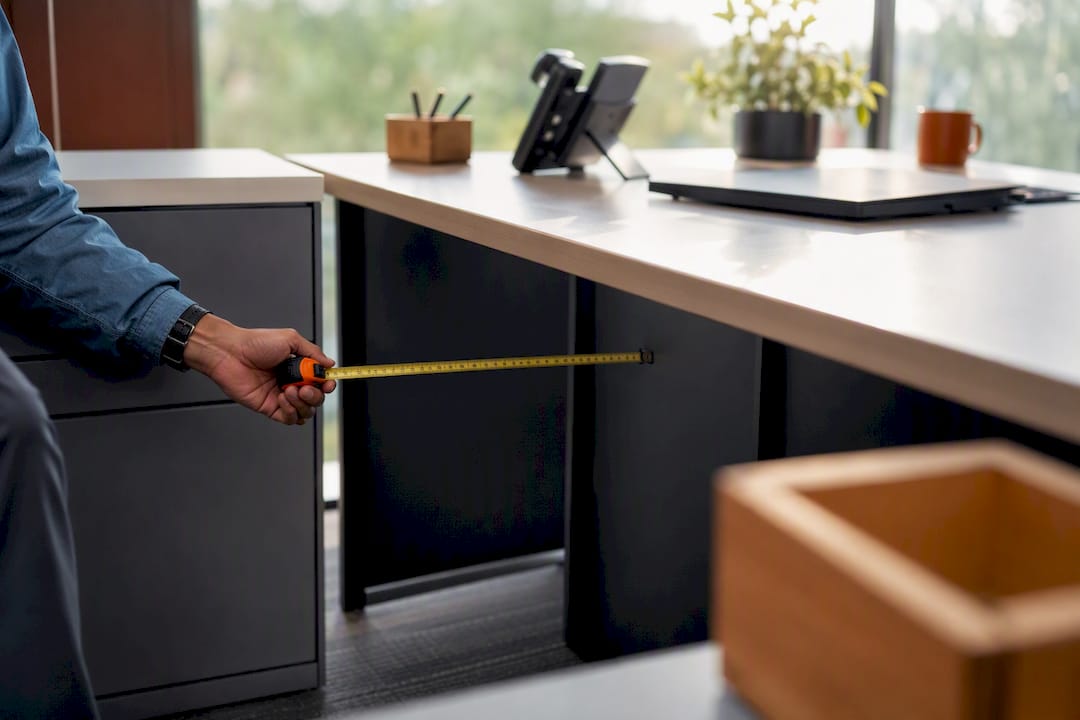
A fixed-height desk typically sits within a height range designed for average adult seated posture. It works well for teams of broadly similar height, but “average” is doing a lot of work in that sentence. Someone at 155 cm and someone at 190 cm can’t both sit comfortably at 74 cm without one of them compromising on chair height, footrests, or wrist angle.
Height-adjustable desks generally have a variable height range to accommodate different users, extending notably lower and higher than fixed desks. On shared desks, hotdesking setups, or offices with a genuinely mixed-height workforce, adjustability isn’t a luxury spec, it’s the only way to avoid fitting one group of people and failing another.
Getting the height right comes down to three checks:
Pro Tip: If you’re not confident about your workforce’s height spread, specify height-adjustable desks as the default rather than the exception. It’s cheaper to standardise on adjustability upfront than to retrofit complaints later.
Desk dimensions on a spec sheet mean nothing if the room can’t actually accommodate them once chairs, drawers, and walking routes are factored in. HSE’s room-space guidance is a useful sanity check here, because it frames clearance as a safety consideration, not just a comfort one.
The rules of thumb procurement teams should work to:
A worked example: a 140 × 70 cm desk with 760 mm of rear clearance and a 900 mm circulation aisle needs roughly 140 cm across by 233 cm deep (70 cm desk, plus 76 cm clearance, plus 90 cm aisle, allowing for rounding) before you’ve placed a single filing cabinet.
| Element | Space required |
|---|---|
| Desk depth | 70 cm |
| Chair clearance | 76 cm |
| Circulation aisle | 90 cm |
| Total depth per desk row | ~233 cm |
Multiply that depth allowance across every desk row on the floorplan, not just one desk, and you’ll usually find the real constraint is circulation space, not desk width.
The right desk size depends less on the room and more on what happens on the surface each day. Match the SKU to the task, not the other way round.
The pattern across all five: undersizing a desk saves floor space today and costs you in ergonomic complaints and re-purchases within a year. Oversizing wastes the same floor space you were trying to protect. The sweet spot is almost always the standard 120 to 160 cm band, adjusted narrowly for the task at hand.
Simplify the SKU list. Three sizes cover the overwhelming majority of UK office needs: 120 × 70 cm for standard workstations, 140 × 70 cm as the default single-user desk, and 160 × 80 cm for executive or three-monitor roles. Standardising on a small set of sizes reduces returns, speeds up fit-outs, and makes future re-layouts far less painful than a floor full of bespoke dimensions.
For mixed-height teams or hotdesking floors, height-adjustable desks should sit at the top of the spec list rather than the bottom. They cost more per unit but remove the guesswork of matching fixed heights to a workforce you can’t fully predict.
Businesses replacing an entire floor’s furniture tend to see the biggest wins not from choosing bigger desks, but from choosing fewer distinct sizes and getting the clearance planning right the first time.
Browse the full office desks range to compare stocked dimensions directly against the figures above before you finalise a floorplan.
Most desk-size guides treat the numbers as the whole answer. They aren’t. The width and depth ranges matter, but the decision that actually determines whether a fit-out succeeds is how many distinct sizes you allow onto the floor in the first place.
Offices that standardise on two or three SKUs almost always outperform offices that let every department pick its own dimensions “because it fits better.” The variance looks harmless at order stage and becomes a maintenance headache within eighteen months, once you’re trying to source a matching replacement for one odd-sized desk in a sea of standard ones.
The other place conventional advice underperforms is height. Guides quote the 71 to 76 cm fixed range as though it settles the matter, but that figure was never designed around a genuinely mixed-height workforce, it’s an average. If your team spans more than about 15 cm in height range, and most do, a fixed desk is quietly forcing someone into a compromised posture every single day.
Prioritise clearance planning and adjustability over chasing the biggest desk your budget allows. A well-spaced 140 × 70 cm desk with proper chair clearance beats a cramped 180 cm desk every time.
— Furniture
There are other routes to sorting out desk dimensions: generic size charts, a builder’s best guess, or ordering whatever looks right in a catalogue photo. None of them account for your actual floorplan or your actual team’s height spread. Furnitureforbusiness solves that gap directly, with a stocked range of standard SKUs (120 × 70 cm, 140 × 70 cm, and 160 × 80 cm) alongside height-adjustable options for teams with mixed body types or hotdesking floors, all delivered free to the UK mainland.

That means you’re not guessing at clearance or ergonomics after the desks arrive, you’re specifying against dimensions this article has already walked you through. Bulk order pricing applies whether you’re furnishing five desks or five hundred, and the returns process is straightforward if a size doesn’t work once it’s in the room. Browse the office desks category now, or check the height-adjustable desk range if your team’s height spread calls for it, and get a bulk quote before your next fit-out deadline.

Phone: 0330 043 4114
VAT no. GB 991 8681 60
Company no. 07250570