For general standing work, a moderate thickness of well-constructed cushioning suits most people; stable zones with trolleys or rolling loads need a firmer, lower-profile mat, while stationary, heavy-duty standing can justify a thicker mat. The number on the label matters less than what the mat is made from: construction and firmness decide how it actually feels underfoot, and HSE guidance still treats posture change, not mat thickness, as the primary fix for prolonged standing.
TL;DR:
- Cushioning material and deflection behavior are more important than thickness alone in predicting comfort and reducing discomfort during prolonged standing.
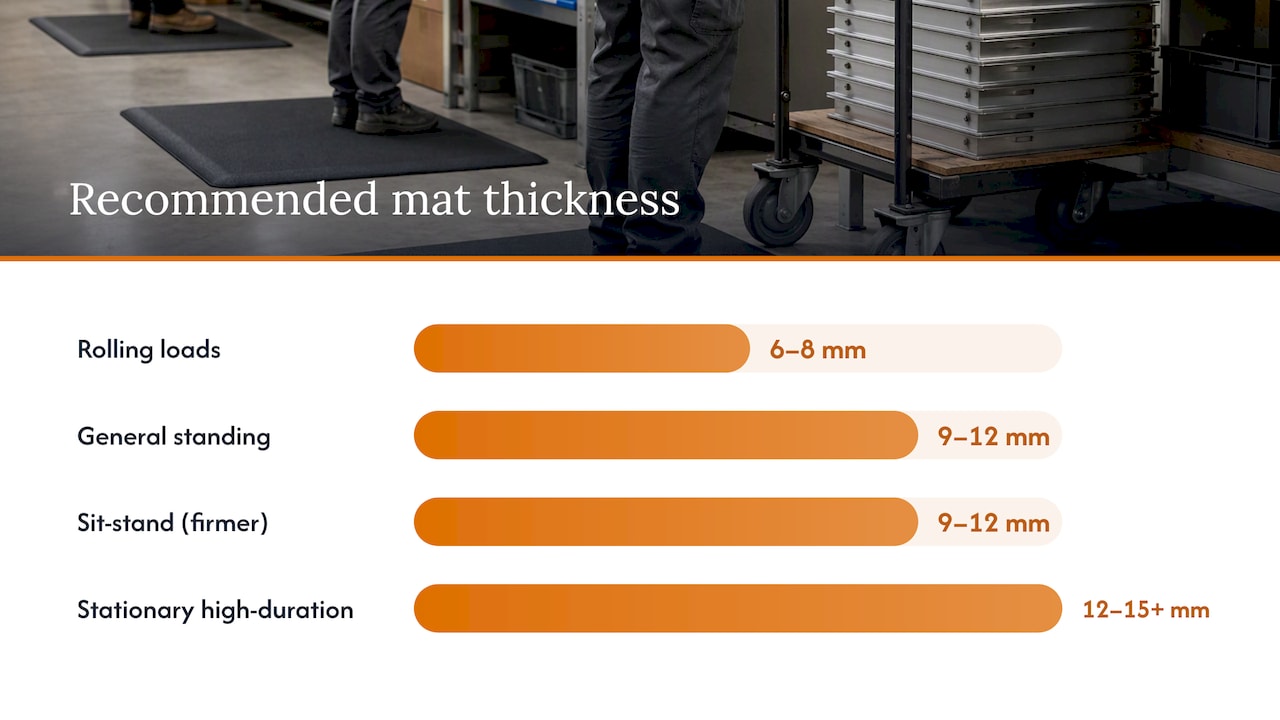
- Optimal mat thickness depends on use case, with 6-8 millimeters for rolling zones, 9-12 millimeters for general workstations, and 12-15 millimeters or more for high-duration standing.
- Mor e durable, closed-cell rubber mats offer longer lifespan and better chemical resistance but come at a higher initial cost, while foam and polyurethane options wear faster.
- Proper safety features like bevelled edges and transition strips are essential for thicker mats to prevent trip hazards in high-traffic or wet environments.
- Manufacturers’ deflection testing and Shore A hardness ratings provide better guidance on actual performance than nominal thickness alone.
Nominal thickness is simply the manufacturer’s stated height, typically within a range common to commercial anti-fatigue mats. It tells you how tall the mat is, not how it performs once someone stands on it for four hours.
What actually governs comfort is deflection: how far the surface compresses under load and how quickly it recovers. A peer-reviewed footfall deflection study measured this directly, testing multiple antifatigue surfaces under various loads and durations. The research found deflection depends heavily on load and duration, and correlates closely with Shore A hardness, the standard scale for rubber and foam firmness. At higher loads, deflection differences appeared between materials of similar thickness. That is the practical reason a 10 millimetre rubber mat and a 10 millimetre foam mat can feel completely different: one may compress and spring back quickly, the other may bottom out under sustained weight.
Comfort research backs this up from the user’s side. A NIOSH study on standing discomfort had participants stand for several hours on four commercial mats and a hard-surface control. Most mats reduced discomfort compared with the hard floor, but people’s subjective ratings did not reliably distinguish between the different mats. The more telling signal was behavioural: weight-shifting frequency varied between mats and correlated with reported discomfort, meaning a mat that keeps people shifting their weight less may be doing a better cushioning job even when the mat itself feels similar underfoot.
For buyers, this means:
Matching thickness to the task, rather than buying the thickest mat available, produces better results and avoids unnecessary cost. Four bands cover most commercial settings:
Stability considerations can shift a recommendation in either direction. Where castors, trolleys or pallet trucks cross the mat regularly, a thinner, firmer surface with a shallow bevel prevents the mat from becoming an obstacle. Where the floor is uneven or the task involves kneeling or crouching, a thicker mat with more give may be worth the trade-off in stability.
Industry listings commonly describe an “extra thick” workshop mat with an overall height of 12.7 millimetres, rated for anti-fatigue performance using ASTM D3574 deflection testing, illustrating how a mid-range nominal thickness can still carry a meaningful performance rating when the construction is tested properly rather than described by height alone.
Two mats can share a thickness measurement and behave nothing alike once installed, because the cell structure and base material do the real work.
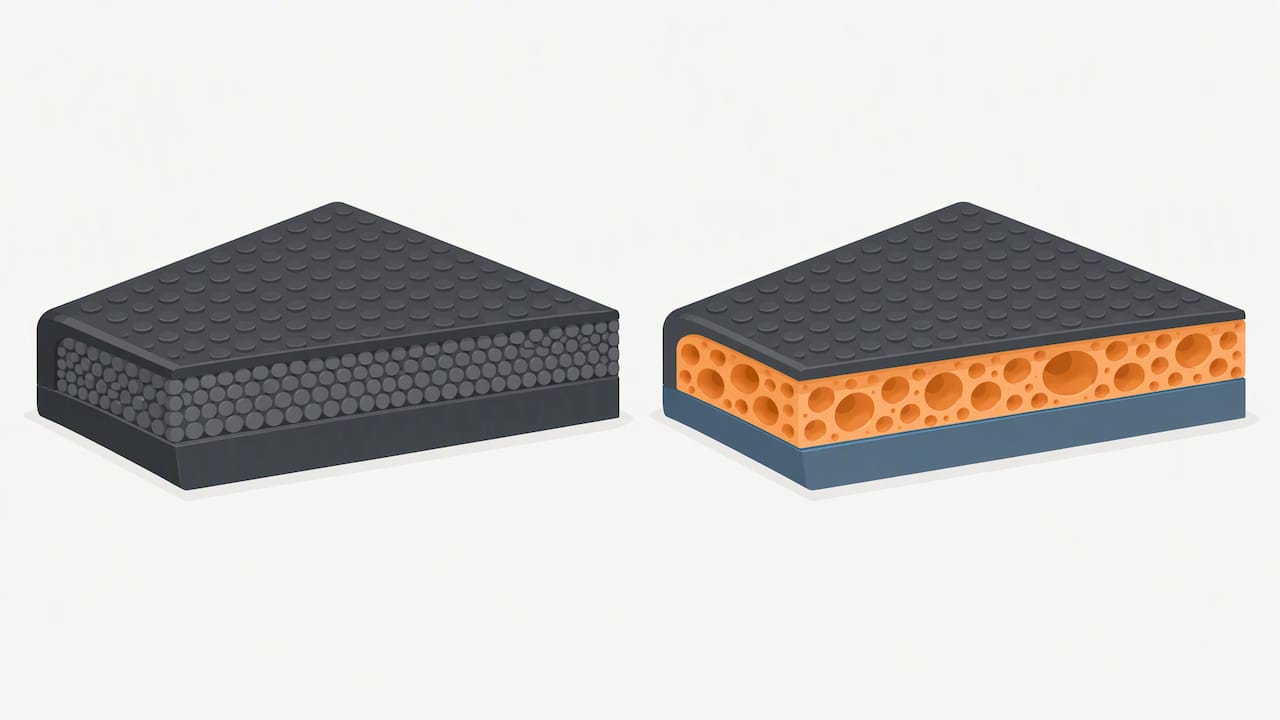
Closed-cell foams and rubbers resist moisture absorption, compress less permanently over time and tend to suit wet or chemical-exposed areas such as kitchens and wash-down zones. Open-cell foams often feel softer initially and provide good cushioning for dry, lower-traffic standing areas, but they can absorb spills and degrade faster under heavy daily use. Rubber mats generally offer the best combination of durability and chemical resistance, though they carry more weight and cost more than polyurethane alternatives, which are lighter and often more affordable but wear faster under sustained compression.
Surface texture matters as much as the core material. A smooth, closed surface is easier to wipe down and suits food preparation areas, while a textured or perforated top with drainage channels helps in wet workshop environments where liquid needs to run off rather than pool.
Pro Tip: Ask suppliers for the mat’s expected compression set rating rather than relying on thickness alone: it is a far better indicator of how long the cushioning will last under daily use.
Warranty length is often a useful proxy for build quality. Mats backed by longer warranties typically use denser, closed-cell constructions designed to resist permanent compression, while shorter warranty periods often signal lighter-duty foams intended for occasional rather than continuous standing.
A short, structured evaluation avoids the common mistake of buying on thickness alone. Before ordering, classify the task and test the shortlist against real conditions rather than a spec sheet.
When speaking to suppliers, a short list of direct questions gets past marketing copy:
A short pilot, typically two to four weeks, with two or three mat options in the actual work area, paired with informal staff feedback and a simple observation of how often people shift their weight or step off the mat, gives a far more reliable answer than any spec sheet.
Thickness choices are not purely about comfort: they affect walkway safety too. Mats above roughly 10 to 12 millimetres generally need a properly bevelled edge, and anything thicker crossing a busy walkway benefits from a transition strip or small ramp to prevent catching a toe or a trolley wheel.
For facilities teams managing multiple flooring transitions, guidance on flooring safety and transition strips is worth reviewing before specifying mats for busy corridors or mixed-use areas.
Thickness and material both drive price, and the cheapest option per mat is not always the cheapest option over its working life. Heavier, closed-cell rubber mats cost more upfront but resist permanent compression and chemical damage far better than lighter foams, which means fewer replacements over several years of daily use.
Maintenance habits affect lifespan as much as construction does. Regular cleaning with a mild detergent, avoiding harsh solvents on polyurethane surfaces, and periodically flipping or rotating mats in high-wear areas all help preserve the cushioning properties that make the mat worth buying in the first place.
A thinner, lower-cost mat is a reasonable choice for temporary installations, seasonal pop-up areas, or zones used only occasionally, where the shorter expected lifespan is not a real drawback. For a permanent production line or a till point used eight hours a day, the better-constructed mat tends to pay for itself in reduced replacement frequency alone.
We supply anti-fatigue matting alongside wider office and hospitality furniture ranges, with delivery available to the UK mainland and easy returns if a mat does not suit the space once it arrives. For procurement teams coordinating a fit-out, we recommend measuring the exact floor area and confirming delivery timing alongside desks, chairs and storage orders, so matting arrives ready to install rather than as an afterthought. Pricing arrangements may be available for multi-mat orders across production floors or multi-site kitchens, and our team can advise on sample requests before a larger commitment.
The instinct to buy the thickest mat available misreads the problem. HSE guidance is clear that prolonged standing is best managed through posture change, task rotation and better workstation design, with a mat as one supporting measure rather than the fix itself. A well-chosen mid-range mat, trialled with staff input before a full order, beats an oversized one bought on spec sheet alone.
— Furniture

Choosing the right thickness is easier once you can test a sample against your own floor and footwear rather than guessing from a product description. We offer anti-fatigue matting for multi-site businesses, with delivery available to the UK mainland, and easy returns if a sample does not suit your space. Our wider office accessories range covers the practical extras that come up during a fit-out alongside matting, and our team can talk through bundle pricing or sample requests before you commit to a full order. Browse our anti-fatigue mat range to compare constructions and request a sample for your site.
An anti-fatigue mat is a cushioned floor mat designed to reduce the discomfort of standing for long periods by encouraging small postural shifts and reducing pressure on the feet and legs. Research from NIOSH found that several commercial mats reduced discomfort compared with standing on a hard floor over a four-hour period.
Yoga mats are a different product from anti-fatigue mats and are typically much thinner, usually around 3 to 6 millimetres, to maintain stability and balance during movement. Anti-fatigue mats for standing work are considerably thicker, generally 9 to 19 millimetres, because their purpose is sustained cushioning rather than grip during dynamic poses.
Commercial anti-fatigue mats commonly come in nominal thicknesses of roughly 9 to 19 millimetres, with common floor sizes including standard workstation mats and longer runner mats for production lines. The right size depends on the work area’s footprint and how many people need to stand on it at once.
There is no single fixed maximum, but commercial mats rarely exceed around 19 millimetres nominal thickness, since greater thickness increases trip risk and can interfere with wheeled equipment and seating clearance. HSE guidance on work surfaces notes that excessive thickness can restrict workstation clearance, so thicker is not automatically better.

Phone: 0330 043 4114
VAT no. GB 991 8681 60
Company no. 07250570