The responsible person under UK fire law must show, on paper, that café seating won’t fuel a fire. For most cafés, that means sourcing upholstered furniture tested to BS 5852 Crib 5 and matched to BS 7176 medium hazard, then filing the finished-item certificate and permanent label with your fire risk assessment. Buy on price alone and skip the paperwork, and you’re the one holding the liability when an inspector or insurer asks for proof.
TL;DR:
- Fire compliance depends on obtaining finished-item certificates that specify testing of the entire upholstery composite, including fabric, foam, and interliners.
- UK furniture regulations are governed by both the 1988 Fire and Furnishings Regulations and the 2005 Fire Safety Order, with the latter requiring the responsible person to carry out and record fire risk assessments.
- Seating for cafes must meet Crib 5 (BS 5852) standards tested at the medium hazard level in accordance with BS 7176, especially when padding or fabric is added.
- Inspections prioritize proof tied to actual furniture, such as permanent labels and certificates matching the specific item, over fabric-only or indicative safety reports.
- Procurement should always involve requesting full finished-item certificates and permanent labels before purchase, ensuring they explicitly confirm compliance with BS 5852 Crib 5 and BS 7176 standards.
Two separate legal instruments govern this, and confusing them is the most common mistake procurement teams make.
The Furniture and Furnishings (Fire) (Safety) Regulations 1988 set the original testing and labelling framework for upholstered furniture sold in the UK, and the 2025 amendment to those regulations updated the scope and labelling rules for domestic upholstered furniture placed on the market. That amendment, published as statutory guidance in April 2025, focuses on domestic product marking rather than commercial contract seating specifically, but it confirms the direction of travel: tighter labelling expectations, not looser ones.
The operational duty that actually gets enforced in your café sits elsewhere. The Regulatory Reform (Fire Safety) Order 2005 requires the “responsible person” (usually the owner or operator) to carry out a suitable and sufficient fire risk assessment, record it, and act on the findings. This is the document a fire officer or Trading Standards inspector will ask to see first.
Between the two:
Government consultation has floated further reform of the furniture regulations, but nothing currently removes the practical need to specify contract-grade seating for hospitality venues. Treat that as guidance to watch, not a reason to relax specification now.
Ignition Source 5, known universally in the trade as Crib 5, is the toughest domestic ignition test in the BS 5852 series. It doesn’t just check whether a fabric resists a match. It tests the entire upholstery composite together, cover fabric, foam, and any interliner, because a fire-resistant cover over the wrong foam can still burn through fast.
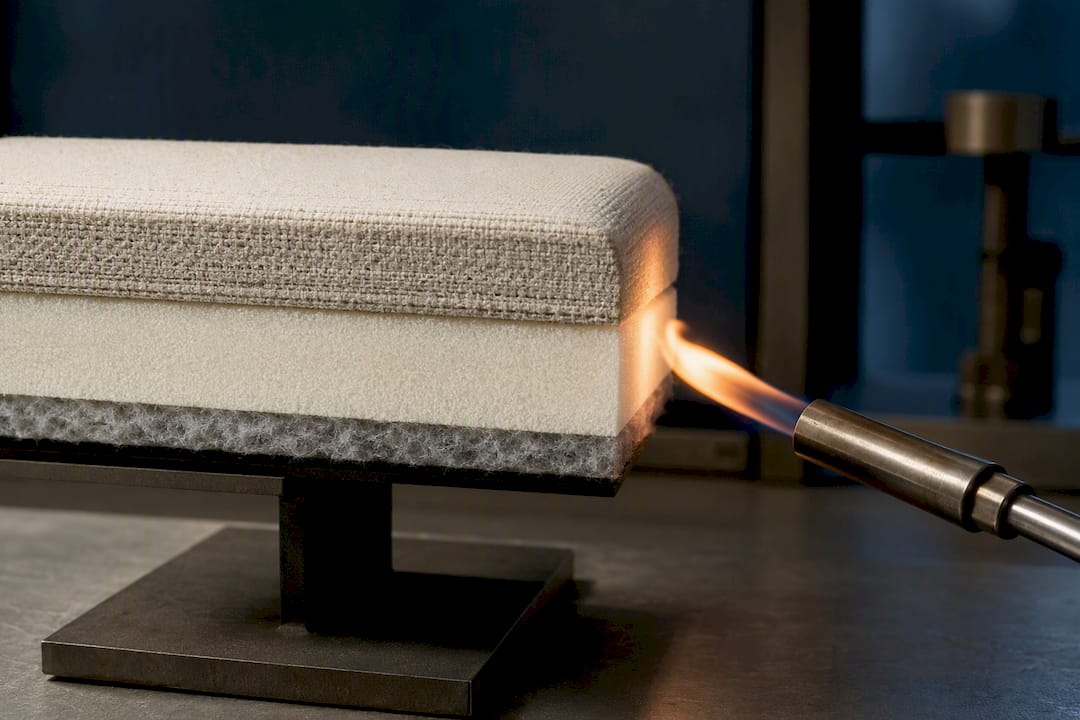
BS 7176 is the standard that tells you which ignition level your seating needs, based on where it’s used. It sorts furniture into hazard categories, and hospitality venues open to the public almost always fall into the medium hazard category, which is why Crib 5 has become the accepted baseline for café chairs, banquettes, and booth seating across the industry.
A few practical distinctions matter here:
Pro Tip: If a supplier quotes “fire-retardant fabric” without mentioning the foam or interliner, ask directly which composite was tested. A fabric swatch certificate and a finished-chair certificate are not interchangeable.
Fire officers and Trading Standards inspectors in hospitality settings rarely accept fabric-only reports when they’re checking whether your seating is compliant. What they want is evidence tied to the actual item sitting in your café.
Acceptable documentary evidence generally includes:
What won’t hold up on its own: a fabric mill’s generic flammability report, an “indicative” test that stops short of full completion, or a friendly email from a sales rep confirming the range is “fire safe.” When you verify a certificate, check that the testing lab is properly accredited, that the composite matches what’s actually on your chair, that the water-soak stage of testing was completed (some topical fire-retardant treatments fail this step), and that the model or serial number on the paperwork matches what arrived on your loading bay.
Your fire risk assessment is where all this documentation earns its keep. Furniture belongs in the FRA under three headings: fuel load (how much combustible material is in the room), escape route vulnerability (whether seating narrows or blocks exit paths), and the mitigation measures you’ve put in place to control both.
The GOV.UK guide to fire risk assessment for small and medium places of assembly sets out exactly what a café-scale assessment should weigh, alongside detection, firefighting equipment, and maintenance duties. Certificates for your seating slot directly into that record as the evidence base for your furniture-related fuel load judgement.
A few habits keep the record defensible over time:
Pro Tip: Re-testing isn’t just for new purchases. If you re-cover an existing chair with a different fabric, the old certificate no longer applies to that item, because the composite has changed.
Most café furniture compliance failures trace back to specification decisions made months before the chairs ever arrive.
The pitfalls worth naming plainly: accepting a fabric-only or “indicative” test because it’s cheaper or faster; re-covering chairs without commissioning a fresh test; and buying domestic sofas or topically treated fabrics for a café floor without confirming full water-soak completion during testing, since some topical treatments degrade and fail that stage even when the original test passed. Non-upholstered alternatives, solid wood chairs, metal-framed stools, laminate tabletops, sidestep the composite testing question entirely and are worth considering for high-turnover areas where reupholstery risk is harder to manage. When an item shows visible wear, sagging foam, or a missing label, replacement is usually cheaper than trying to retroactively prove compliance on damaged goods.
Most café operators aren’t fire safety specialists, and they shouldn’t have to become one to fit out a dining room properly. What a good contract furniture supplier should provide as standard is the composite certificate for each seating item, a permanent label fixed at the point of manufacture or supply, and documentation formatted so it drops straight into your fire risk assessment folder rather than needing translation first.
Some specialist contract furniture suppliers offer seating for hospitality fit-outs with options such as delivery, bulk pricing for multi-site orders, and returns policies if specifications don’t match what arrives. None of that replaces your legal duty as the responsible person, but a supplier who can hand over the right paperwork on request removes one of the biggest friction points in getting a café floor compliant on time.
Before you place an order, ask one question first: can you provide the finished-item certificate and full composite description for this exact chair? If the answer is vague, keep looking.
— Furniture
There are providers that offer contract-grade café seating for UK hospitality operators aiming to avoid chasing certificates after purchase, unlike generic furniture catalogues without fire-safety context.
Every fit-out starts with a specification decision, and getting that right at the outset saves the far more expensive job of retrofitting compliance later. If you’re sourcing seating for a café refit, start with Office Chairs for task and dining seating options, or look at Meeting Room furniture where you need heavier booth or banquette-style pieces for a larger floor plan. For back-of-house needs, keeping certificates and FRA paperwork organised is easier with proper Office Storage rather than a filing pile that grows every quarter. Certain suppliers offer free delivery to the UK mainland, bulk pricing for multi-site hospitality groups, and straightforward returns policies if an order doesn’t meet the fit-out brief.
Before you confirm any order, ask for the finished-item test certificate and permanent labelling in writing, and request them for every item, not just a sample from the range. It’s a five-minute email that saves a very uncomfortable conversation with an inspector later.
Keep these alongside your supplier certificates, not scattered across separate inboxes:
Cross-check any supplier procurement pack against Font Coffee Roasters’ coffee shop supplies checklist to make sure furniture documentation sits alongside your other fit-out records rather than as an afterthought.
This article is general information, not a substitute for advice from a qualified lawyer. Consult a qualified legal professional about your own circumstances before acting on anything here.
The Furniture and Furnishings (Fire) (Safety) Regulations 1988, updated by the 2025 amendment, set testing and labelling rules for upholstered furniture entering the UK market. Separately, the Regulatory Reform (Fire Safety) Order 2005 requires café operators to carry out and record a fire risk assessment covering that furniture once it’s in use.
No. UK upholstered furniture placed on the market must carry a permanent label confirming its ignition resistance testing, and selling without one breaches the Furniture and Furnishings Regulations. For café seating specifically, buyers should also insist on the finished-item certificate behind that label, not just the label alone.
The core framework dates back to the Furniture and Furnishings (Fire) (Safety) Regulations 1988, with amendments since, most recently in 2025, refining labelling and market scope for domestic upholstered furniture. The underlying testing standards, BS 5852 and BS 7176, have been refined alongside the regulations over that same period.
Check for a permanent label on the item itself stating its ignition resistance level, then ask the supplier for the finished-item certificate showing it was tested to BS 5852 Crib 5 at the BS 7176 medium-hazard level. A certificate covering only the fabric, without the foam and interliner tested together, isn’t sufficient evidence for café use.
Some suppliers provide contract-grade seating suited to hospitality fit-outs, often including delivery options and bulk pricing. Buyers should always request the finished-item certificate and permanent labelling for their specific order to confirm it meets BS 5852 Crib 5 and BS 7176 medium-hazard requirements.

Phone: 0330 043 4114
VAT no. GB 991 8681 60
Company no. 07250570