For most offices, eased and roundover (bullnose) edges are the best practical choice. They soften the sharp line that sits under forearms all day, resist chipping better than decorative profiles, and cost less to maintain across a fleet of desks. Chamfer, bevel, and knife edges earn their place where appearance matters more than daily contact, such as feature tables or reception counters.
Choosing between desk edge types comes down to three things:
The rest of this guide breaks down each profile so you can brief a supplier with confidence rather than guessing from a catalogue photo.
Eased and roundover edges suit the vast majority of office desks because they balance daily comfort, chip resistance, and low maintenance cost better than decorative alternatives.
| Point | Details |
|---|---|
| Default to rounded edges | Eased and roundover/bullnose profiles suit most workstations and hot-desking benches for comfort and durability. |
| Match profile to top thickness | Thin tops suit eased or pencil round edges; thicker tops can carry bullnose or waterfall profiles. |
| Reserve decorative edges | Knife, ogee, and live edge profiles work best on feature pieces, not shared daily-use surfaces. |
| Confirm details before ordering | Get overhang, finish, and warranty confirmed in writing, and request a physical sample swatch. |
| Source custom and bulk options | Furnitureforbusiness supplies custom edge details and bulk-order desks and boardroom tables for UK fit-outs. |
Walk into any furniture showroom and you’ll hear at least nine names thrown around for what is, in most cases, a variation on rounding, cutting, or layering the top edge of a desk. Here’s what each one actually looks and feels like.
Thinner tops generally suit eased, chamfer, or pencil round profiles, since there isn’t enough material to carve a deep bullnose or waterfall without adding an underbevel. Thicker tops can carry bolder profiles like full bullnose or waterfall without looking clumsy. FineWoodworking notes that overhang, top thickness, and wood type all affect which profile actually works, and that craftsmen often combine two profiles, such as a roundover with a narrow chamfer beneath it, to balance durability with visual interest.
Pro Tip: Ask for a physical edge sample before ordering more than a handful of desks. Photos flatten the difference between a pencil round and a full bullnose, and that difference is exactly what your team will feel every day.
Every edge profile is a trade-off between these three things, and no single profile wins on all of them.
Rounder profiles such as roundover and bullnose are widely recommended specifically for high-traffic environments, according to Cabinfield’s breakdown of table edge types, which flags safety as the main reason. That matters more in an office than it might sound: hot-desking areas, canteen tables, and reception counters all see repeated, unpredictable contact from people who aren’t paying attention to the furniture.
Live edge desks are worth a specific caution. They’re visually arresting as a single feature piece, but the irregular contour makes cable management awkward and can leave an unstable surface for monitor arms or docking stations. Reserve live edge for a director’s desk or a reception statement piece, not a bank of workstations.

The right profile depends heavily on what the desk is used for, not just how it looks in a render. Work through this before you request quotes.
Pro Tip: Get the overhang and thickness figures in writing before you sign off on bulk pricing. A supplier who can’t quote these numbers precisely usually hasn’t thought through the profile properly either.
The edge profile only tells half the story. The finish sitting on top of it determines how the desk actually ages.
Softer woods dent more easily under a bold profile, so if your desks are pine or a similar softwood, a simpler eased or roundover edge will hold up better long term than an intricate ogee.
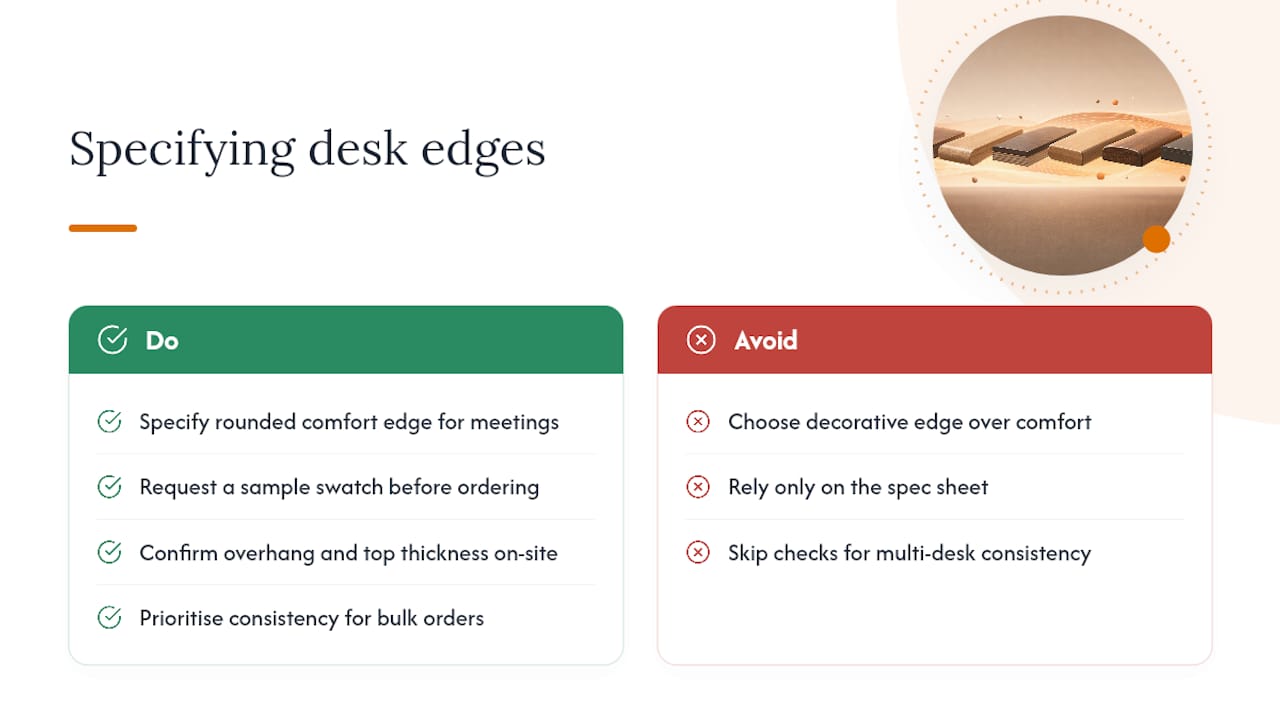
Across office fit-outs, the profile that gets specified most often for meeting rooms isn’t the most decorative one. It’s a rounded, comfort-style edge, because people rest forearms on a boardroom table for far longer stretches than they do at a standard desk, and that contact adds up over a two-hour meeting.
Furnitureforbusiness supplies custom edge details across its desk and boardroom ranges, including bulk orders for multi-desk fit-outs where consistency across dozens of units matters more than any single decorative flourish. Before placing a large order, always ask for a sample swatch and confirm overhang and top thickness against your actual room layout, not just the spec sheet.
— Furniture
Furnitureforbusiness stocks desks and boardroom tables with the edge profiles this guide actually recommends, so you’re not choosing blind from a swatch card and hoping the supplier delivers what you pictured. The office desks range covers eased and roundover profiles suited to daily workstations, while options like the Impulse scalloped edge desk show a comfort-style edge with integrated cable management built in, useful if your fit-out includes hot-desking benches.
For boardrooms, the high gloss writable boardroom table demonstrates a durable finish paired with a comfort edge suited to long meetings. If you’re specifying height-adjustable desks alongside fixed workstations, the height-adjustable desk setup guide covers which edge profiles pair well with sit-to-stand mechanisms and cable ports.
To move an order forward, request a sample swatch, confirm overhang and top thickness against your room measurements, and ask for bulk-pricing and lead times in writing before you commit. Browse the office desks category or get in touch through Furnitureforbusiness to start that conversation.

Phone: 0330 043 4114
VAT no. GB 991 8681 60
Company no. 07250570