For UK multi-shift operations, the OE Austin Heavy Duty Task Operator Office Chair from Furnitureforbusiness is the practical first choice. It is built for continuous-duty use, carries a reinforced frame, and comes with the kind of spare-parts and warranty support that procurement teams need to protect total cost of ownership across control rooms, security desks, and round-the-clock call centres.
Before you raise a purchase order, take these steps:
The term “24-hour chair” is used loosely in the market. Insist on documented evidence, not just a label.
A 24-hour chair, or continuous-duty chair, is rated for uninterrupted use across multiple shifts without the mechanism, frame, or upholstery degrading at the rate a standard task chair would. The difference is not cosmetic. Standard office chairs are typically tested and warranted for single-shift use, roughly eight hours per day. A genuine continuous-duty model is engineered and cycle-tested for round-the-clock occupation, often by different users of varying sizes across every shift.
The practical differences show up in three places: the mechanism (heavier-duty synchro or multi-tilt rated for higher cycle counts), the frame (reinforced steel or heavy-gauge aluminium base), and the upholstery (materials chosen for durability and cleanability rather than aesthetics alone).
Typical sectors that need this specification include:
When evaluating a supplier’s claim, look for these specific statements rather than vague marketing language:
The feature set below is not a wish list. Each item directly affects how long the chair performs and how quickly it can be adjusted between shift users.
The table below shows the minimum specification ranges procurement should include in tender documents or supplier RFPs.
| Feature | Minimum specification to request |
|---|---|
| Weight capacity | 120 kg minimum; 150 kg+ for heavy-duty models |
| Seat width | around 500 mm; 23-inch (584 mm) wide variants available for larger users |
| Seat depth adjustment | At least 50 mm of seat-slide range |
| Back height | Adjustable, minimum around 530 mm |
| Mechanism cycle rating | Supplier to confirm in writing; request the test report |
| Warranty | Minimum 2 years covering continuous use |
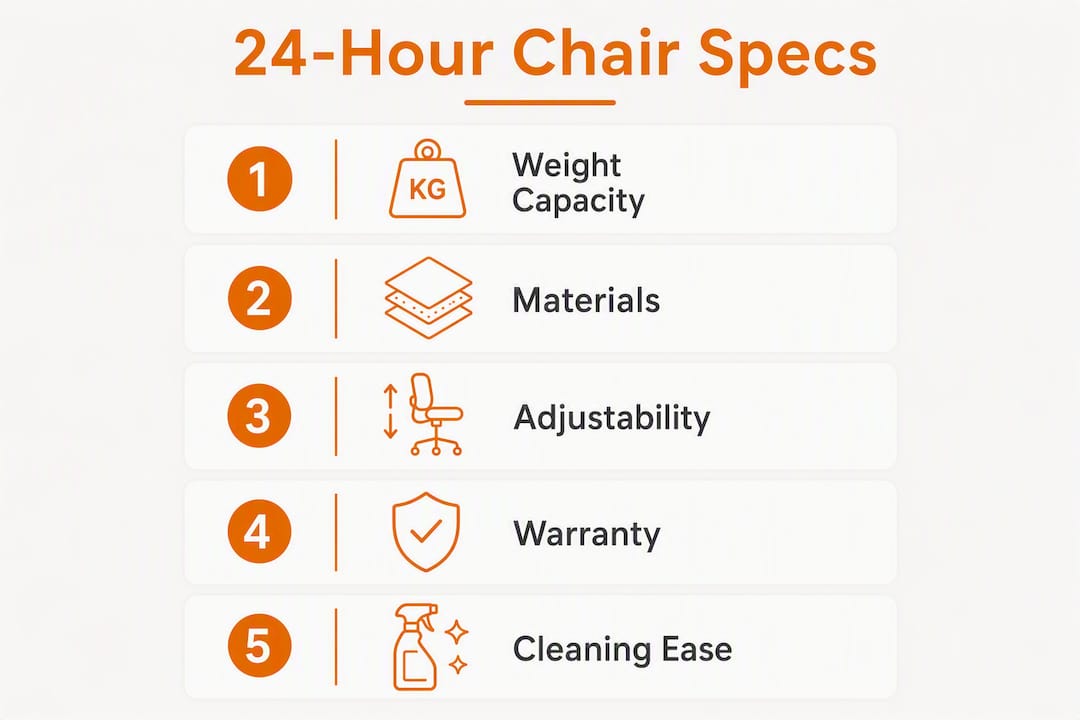
Some suppliers explicitly label models as approved for 24-hour use and include reinforced steel frames and air lumbar support as standard. Treat any model that lacks a stated cycle-test figure as unverified for continuous duty.
Material choice is where many procurement decisions go wrong. A chair that looks good in a showroom can become a hygiene liability within months if the upholstery cannot withstand daily wipe-downs with clinical or commercial cleaning agents.

PU and vinyl are the default choice for multi-shift settings. Both are wipe-clean, resistant to most commercial disinfectants, and do not absorb moisture or odour the way fabric does. The trade-off is breathability: on long shifts, heat build-up can become uncomfortable, particularly in warm control rooms.
Mesh offers superior airflow and is increasingly used in 24-hour environments where temperature is a concern. The limitation is cleanability. Open-weave mesh traps dust and is harder to disinfect thoroughly. If infection control is a priority (healthcare dispatch, for example), mesh requires a more rigorous cleaning protocol.
Heavy-duty fabric is rarely the right call for continuous-duty seating. It absorbs spills, retains odour, and degrades faster under repeated cleaning.
For most UK multi-shift sites, PU or vinyl upholstery with anti-microbial treatment is the practical specification. If you are in a healthcare or high-infection-risk environment, confirm that the upholstery is rated for the specific cleaning agents your facilities team uses.
Pro Tip: Specifying modular replaceable components such as removable arm pads and seat cushion covers materially reduces lifecycle cost. Replacing a worn seat pad costs a fraction of replacing the whole chair, and it keeps the chair in service rather than in a skip.

A single chair specification needs to fit a wide range of users without a technician adjusting it between shifts. That means adjustability range matters as much as the chair’s absolute dimensions.
For seat width, most standard 24-hour task chairs sit around 500 mm. If your workforce includes larger-framed users, look at wide-seat variants. The Concept Seating 3122 offers a 23-inch wide seat and reinforced mechanism, suitable for intensive-use environments. For weight capacity, certain intensive-use mesh task chairs are rated for high maximum loadings suitable for heavy users, though most UK heavy-duty models support moderate to heavy weights. Some UK-market suppliers list models with high capacity and BS5459 compliance.
The adjustability checklist for a shared-use chair:
When writing tender documents, capture these six dimensions as mandatory supplier returns. A supplier that cannot provide them in a datasheet is unlikely to have the product documentation needed for a compliant procurement.
Marketing phrases like “heavy duty” and “24/7 ready” carry no legal weight. The only way to verify a continuous-duty claim is through documented test evidence.
The standards most relevant to UK procurement are:
For warranty, the table below gives procurement a comparison template to complete for each shortlisted supplier.
| Warranty criterion | What to require | Notes |
|---|---|---|
| Warranty length | Minimum 2 years; 5 years preferred | Must explicitly cover continuous/24-hour use |
| Spare-parts availability | Confirmed in writing; state lead times | Ask for a spare-parts schedule as a contract attachment |
| On-site repair option | Available or not; response time stated | Relevant for large deployments (50+ units) |
| Exclusions | List any use-case exclusions | Reject warranties that exclude multi-shift or 24/7 use |
A two-year warranty that excludes continuous use is not a 24-hour chair warranty. Read the small print.
Buying 24-hour chairs at scale introduces logistics and commercial considerations that a single-unit purchase does not.
Pro Tip: When placing a large order, ask the supplier to include a refurbishment window in the contract: a scheduled review at year two or three where worn components (seat cushions, arm pads, casters) are replaced rather than waiting for failure. This extends chair life and keeps the fleet looking presentable.
Use this list in supplier calls, tender returns, or pre-purchase emails. Any supplier that cannot answer these clearly warrants further scrutiny.
Red flags to watch for:

The OE Austin Heavy Duty Task Operator Office Chair is Furnitureforbusiness’s recommended specification for UK multi-shift sites. It is built for continuous-duty use with a reinforced frame, heavy-duty mechanism, adjustable lumbar, 3D armrests, and PU upholstery suited to wipe-clean cleaning regimes. The full specification, including weight capacity and seat dimensions, is listed on the product page.
Furnitureforbusiness supplies commercial office furniture to businesses across the UK with free delivery to the UK mainland. For procurement teams ordering at scale, onsite trials are available for larger orders, bulk pricing is negotiable, and credit account options are available for organisations that require invoiced purchasing; you can also explore sandwich platters & office lunch menu to coordinate catering alongside your furniture deliveries. The full office chairs range includes heavy-duty and ergonomic models suited to diverse workforce needs.
To move forward: request a quotation or sample unit directly through the product page, ask for the continuous-duty test documentation at the same time, and confirm your lead time and delivery requirements. If you are fitting out a wider workspace, Furnitureforbusiness also covers height-adjustable desks and meeting room furniture as part of a complete fit-out.
Specifying a genuine 24-hour chair requires documented cycle-test evidence, an explicit continuous-duty warranty, and confirmed spare-parts availability — marketing labels alone are not sufficient.
| Point | Details |
|---|---|
| Verify continuous-duty claims | Request the named test standard (BS5459, ANSI/BIFMA X5.1) and the actual cycle-test report, not just a marketing label. |
| Minimum weight capacity | Specify at least 120 kg as a tender minimum; request explicit kg ratings and reinforced-frame confirmation in writing. |
| Warranty must cover 24/7 use | A minimum two-year warranty is standard; confirm it explicitly covers continuous or multi-shift use and includes spare-parts availability. |
| Trial before full commitment | Arrange an onsite trial for orders exceeding 10 units to validate user fit and cleaning suitability before raising the purchase order. |
| Furnitureforbusiness OE Austin | The OE Austin Heavy Duty Task Operator Chair covers continuous-duty use with reinforced frame, PU upholstery, and bulk-order support including free UK mainland delivery. |
The procurement mistake I see most often is treating “24-hour chair” as a product category rather than a performance claim that needs verification. A supplier can print “24/7 suitable” on a product page without a single cycle-test report to back it. The buyers who get this right are the ones who treat the test documentation as a non-negotiable tender return, not an optional extra.
The other thing worth saying plainly: the trial matters more than the spec sheet. Catalogue dimensions tell you the seat is 500 mm wide. A shift-cycle trial tells you whether your operators can actually adjust the chair in 30 seconds at handover, whether the lumbar holds its position under a heavier user, and whether the PU surface survives your cleaning protocol. Those are the questions that determine whether the chair is still in service in year three or heading for disposal.
Spare-part commitments deserve the same attention. A five-year warranty is worth little if the supplier cannot confirm that gas lifts and seat cushions are available as individual replacements. Get the spare-parts schedule attached to the contract before you sign.
Before finalising your specification or raising a tender, consult these pages and request the documents listed below from any shortlisted supplier.
Primary product and category pages:
Documents to request from any supplier:
| Document | Why you need it | When to request it |
|---|---|---|
| Cycle-test report | Verifies continuous-duty mechanism claim | Before shortlisting |
| Compliance certificate | Confirms named standard (BS5459/BIFMA) | Before shortlisting |
| Spare-parts schedule | Protects lifecycle cost and uptime | Before contract signature |
| Warranty document | Confirms 24/7 coverage and exclusions | Before contract signature |
| Installation terms | Clarifies white-glove scope and cost | At quotation stage |
Attach all supplier-returned documents to your tender evaluation file. If a supplier declines to provide any of the above, treat that as a red flag and proceed accordingly.

Phone: 0330 043 4114
VAT no. GB 991 8681 60
Company no. 07250570