Open desking is a workspace strategy where no desk belongs to any one person. Employees arrive, choose an available spot, and move on when they leave. No nameplate, no drawer full of personal effects, no territorial claim on a corner by the window. The goal is straightforward: use every square metre of office space as efficiently as possible while giving people the freedom to work where their tasks demand.
At its core, open desking means:
Open desking adoption reduces average office space per person by about 22% and can cut operating costs by up to 30% through optimised desk supply.
Open desking is not a single layout. It covers several distinct models, and most UK offices end up blending more than one.
The right model depends on your team’s daily rhythms. A legal team with occasional office days needs something different from a marketing team that is in five days a week.

The financial case is the most cited reason to switch, but it is far from the only one.
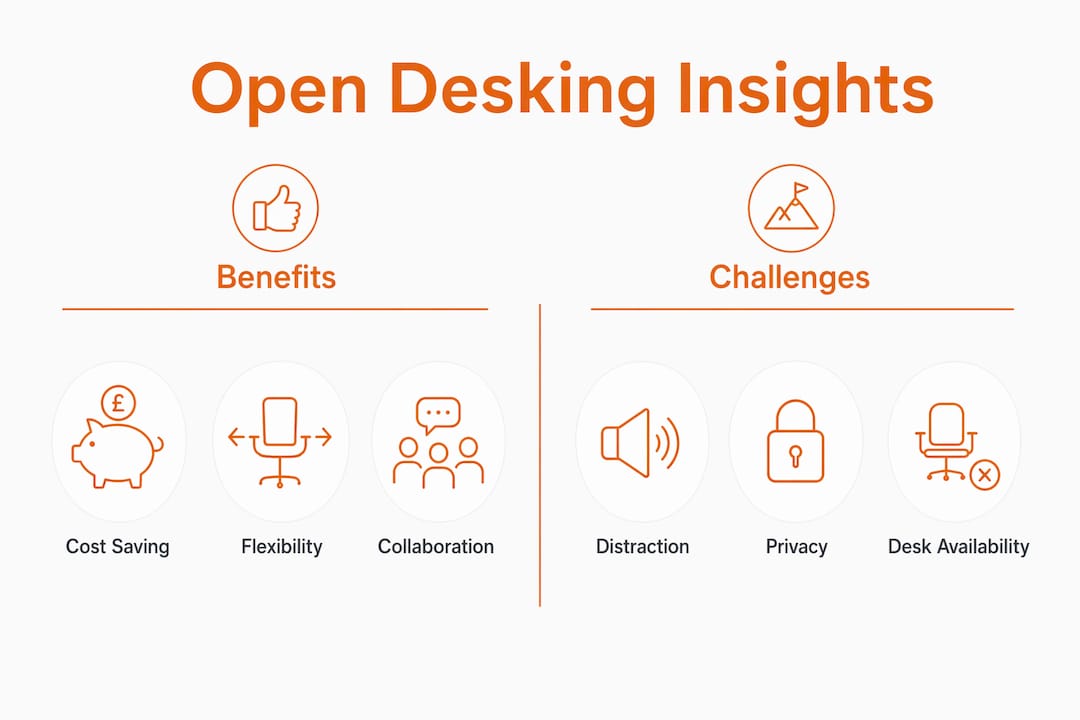
Open desking reduces office space requirements and can cut real estate and furnishing costs by matching desk supply to actual attendance rather than headcount. For a London business paying premium rent per square metre, that arithmetic is hard to ignore.
Beyond cost, the advantages include:
A Forbes survey found that 72% of companies have adopted flexible workspaces like open desking, citing employee autonomy and adaptability as primary drivers alongside cost reduction.

The benefits are genuine, but so are the problems. Ignoring them is how open desking gets a bad reputation.
None of these are reasons to abandon open desking. They are reasons to plan it properly.
Getting open desking right is mostly a planning problem, not a furniture problem.
Pro Tip: Run a four-week pilot on one floor or team before rolling out company-wide. Occupancy data from even a short trial reveals patterns that no headcount spreadsheet will show you.
Furniture does most of the heavy lifting in an open desking environment, and the wrong choices create problems that policies cannot fix.
Right-sized furniture that balances aesthetics, ergonomics, and acoustic function contributes directly to employee wellbeing in open-plan settings. For ergonomic guidance that extends to home setups used by hybrid workers, ergonomic home office advice from The Alto Home covers the principles that apply equally to any shared workspace.
Pro Tip: Specify chairs with a visible adjustment guide printed on the mechanism. In a hot desking environment where users change daily, self-service ergonomic adjustment is the only kind that actually happens.
The honest answer is that neither model works universally. The question is which trade-offs your team can live with.
| Factor | Open desking | Assigned seating |
|---|---|---|
| Space efficiency | High; desk-to-person ratio below 1:1 | Low; one desk per person regardless of attendance |
| Collaboration | Naturally higher due to proximity and movement | Depends on layout; can entrench silos |
| Privacy and focus | Lower without deliberate acoustic zoning | Higher; personal territory aids concentration |
| Cost | Lower real estate and furnishing costs | Higher fixed costs per head |
| Best suited to | Hybrid teams, creative roles, sales, tech | Legal, finance, HR, roles requiring confidentiality |
| Flexibility | High; easy to reconfigure | Low; changes require reassignment |
Finance and legal teams handling sensitive data consistently perform better with assigned or semi-private workstations. Marketing, design, and project-based teams tend to thrive in open arrangements. A blended layout that gives each group what it actually needs outperforms any single-model approach.
The research picture is mixed, and anyone telling you it is uniformly positive is selling something.
Studies on non-territorial working show that employees in flexi-desk arrangements report lower spatial comfort and reduced satisfaction with furnishing compared to those with fixed desks, particularly when the physical setup does not accommodate individual ergonomic needs. The feeling of being watched in an open layout is a documented source of anxiety, not an occasional complaint.
The counterpoint is autonomy. When employees choose where to sit based on their task rather than being assigned a non-territorial desk by policy, satisfaction and perceived productivity both improve. The distinction matters: open desking imposed top-down produces different outcomes from open desking adopted as a genuine choice. Workspace design that evolves based on occupant behaviour and real occupancy data, rather than static headcount estimates, consistently produces better results than a layout fixed at launch and never revisited.
Several well-known UK organisations have moved to open or activity-based layouts, with results that reflect both the benefits and the planning requirements.
HMRC has been consolidating its estate into modern, open-plan Government Hubs across the UK, including major sites in Leeds, Bristol, and Stratford. The programme explicitly uses flexible desking to reduce the total number of buildings while accommodating a workforce that splits time between home and office.
Deloitte UK redesigned its London office at 1 New Street Square around activity-based working, removing assigned desks entirely and creating zones for focused work, collaboration, and social interaction. The firm reported improved cross-team communication and a reduction in the physical footprint required per employee.
PwC UK followed a similar path at its More London offices, using desk booking technology and neighbourhood zoning to manage a workforce where a significant proportion work flexibly on any given day.
The common thread across these examples is that none of them simply removed desks and called it done. Each invested in booking systems, acoustic solutions, storage, and change management before the physical layout changed.
Open desking works best when it is designed around how people actually work, not just how many desks a floor plan can hold.
| Point | Details |
|---|---|
| Space and cost savings | Open desking reduces average office space per person by about 22% and can cut costs by up to 30% through optimised desk supply. |
| Model variety matters | Hot desking, hoteling, bench desking, and activity-based working each suit different team types and attendance patterns. |
| Acoustic planning is non-negotiable | Phone booths, quiet pods, and bookable rooms prevent noise from undermining the model’s productivity benefits. |
| Furniture must flex | Height-adjustable desks and ergonomic chairs with easy adjustment are essential when multiple users share the same workstation daily. |
| Autonomy drives adoption | Employees who choose where to sit report better satisfaction than those assigned to non-territorial desks by policy. |
Furnitureforbusiness supplies UK offices with the modular desks, ergonomic chairs, and storage solutions that open desking actually requires. From height-adjustable desks built for shared daily use to ergonomic office chairs that any employee can adjust in seconds, every product ships free to the UK mainland. Whether you are fitting out a single floor or a full building, Furnitureforbusiness offers bulk order pricing and a range designed for teams of 5 to 500.
Phone: 0330 043 4114
VAT no. GB 991 8681 60
Company no. 07250570