TL;DR:
- Creating a welcoming cafe environment involves carefully designing lighting, layout, sound, temperature, and materials to enhance customer comfort and satisfaction. Regular maintenance and thoughtful adjustments keep the ambiance consistent and inviting over time.
Creating a welcoming cafe ambiance is the process of crafting a sensory and spatial environment that makes customers feel comfortable, relaxed, and eager to return. Ambiance is not decoration. It is the sum of lighting, layout, sound, temperature, and material choices working together to shape how people feel the moment they walk through your door. Cafe owners who treat atmosphere as a business lever, not an afterthought, turn casual visitors into loyal regulars. This guide covers every layer of that process, from seating arrangement to acoustic treatment, using 2026 UK hospitality design standards.
The layout of your cafe is the foundation every other design decision rests on. Get it wrong and no amount of warm lighting or good coffee will compensate. Get it right and customers will feel at ease before they have even ordered.

Start by mapping the customer journey from entrance to till to seating. The first thing a customer needs when they walk in is a clear landing zone: a small, uncluttered space at the entrance that lets them pause, read the menu, and orient themselves without blocking the flow of other customers. This single detail reduces the low-level anxiety that makes people leave before they have settled.
Seating variety is equally important. A welcoming cafe accommodates brief visits and long stays equally, which means offering three distinct seating types:
Accessibility must be built in from the start, not added as an afterthought. Keep main circulation routes at least 900mm wide to meet UK building regulations and allow staff to move efficiently during peak hours. For practical guidance on cafe seating design, the principle is always the same: comfort and flow serve each other.
Pro Tip: Use the 3-5-7 rule when arranging decorative and seating elements. Group objects in odd numbers to create visual balance without making the space feel rigid or staged.
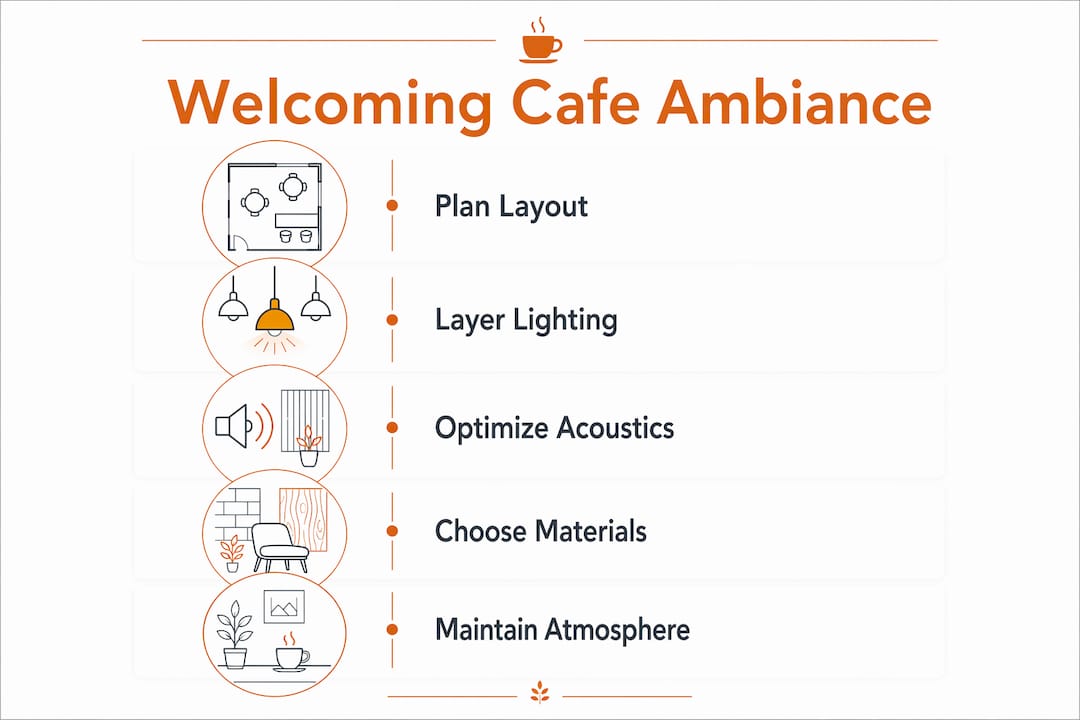
Lighting is the single most cost-effective lever a cafe owner can pull. Small lighting upgrades can transform how a space feels and directly influence how long customers stay. The science is straightforward: warm light signals safety and relaxation, while cold white light signals urgency and clinical environments.
Follow these steps to build a layered lighting scheme:
Pro Tip: Dim your lights by 10–15% during the afternoon lull. Customers subconsciously associate lower light levels with permission to slow down, which increases average dwell time.
A cafe that spends under £100 on warm bulbs and two pendant lights will see a measurable shift in atmosphere. The return on that investment shows up in longer visits and higher spend per customer.
Customers judge a cafe’s atmosphere subconsciously within seconds based on sound reverberation and temperature as much as visual decor. A beautiful space that echoes like a sports hall or feels stuffy will drive people out regardless of how good the coffee is.
The key acoustic and climate targets for a welcoming cafe environment are:
Sound and temperature contribute to ambiance in ways customers rarely articulate but always feel. Fix these two elements and the rest of your design work lands harder.
Authentic warmth comes from materials customers can physically touch, not from wall art or branded slogans. Tactile materials and sightline-conscious layouts create genuine comfort. Over-designing for social media trends often sacrifices the functional comfort that keeps people coming back.
The most effective material palette for a cosy cafe atmosphere uses contrast and texture:
| Material | Effect |
|---|---|
| Warm wood (oak, walnut) | Adds natural warmth; softens industrial elements |
| Linen and cotton fabrics | Creates tactile comfort on seating and cushions |
| Ceramic and terracotta | Grounds the space with earthy, handmade quality |
| Soft grey or warm white walls | Provides a neutral backdrop that makes other elements pop |
| Living plants | Softens hard edges and signals care and attention |
Colour choice sets the emotional tone before a customer notices anything else. Warm whites, soft beiges, and muted greens all read as calm and welcoming. Avoid high-contrast, trend-driven palettes that date quickly and create visual noise.
Decor layering works best when you follow one rule: choose one focal feature and let everything else support it. A plant wall, a hand-painted mural, or a display of your coffee products in warm-toned packaging can anchor the room. Pile on too many focal points and the space feels cluttered rather than characterful. Authentic materials like wood and soft fabrics foster a sense of belonging that generic decor cannot replicate.
For a practical starting point on essential cafe furniture, prioritise pieces that combine durability with tactile warmth.
A welcoming cafe environment is not a one-off project. It degrades without regular attention. The most effective maintenance approach is the weekly tune-up, not the annual refurbishment.
Pro Tip: Take a short video walkthrough of your cafe on your phone every month. Watching it back gives you the fresh-eyes perspective that daily familiarity removes.
Consistent ambiance builds trust. Customers return to places that feel the same every time, because predictability signals reliability.
A welcoming cafe ambiance requires layering lighting, layout, sound, temperature, and materials into a coherent sensory environment that customers feel before they consciously notice it.
| Point | Details |
|---|---|
| Layout sets the foundation | Create a clear landing zone and use mixed seating with at least 0.5m spacing between tables. |
| Lighting is the highest-return investment | Warm-toned bulbs at 2700K and pendant lights increase dwell time for under £100. |
| Sound and temperature are invisible but powerful | Keep music at 60–70 decibels and temperature at 20–22°C for optimal comfort. |
| Authentic materials outperform trends | Wood, linen, and ceramic create genuine warmth that generic decor cannot replicate. |
| Weekly tune-ups beat annual refurbishments | Fix flickering bulbs and draughts immediately; walk the space as a customer every week. |
Most cafe owners focus on the visual when they think about atmosphere. They spend money on a new mural or a branded neon sign, then wonder why the space still feels cold. The real work is sensory and sociological, not decorative.
The LTMS framework (Lighting, Temperature, Music, Space) is the most useful checklist I have encountered for cafe managers. It forces you to audit every non-visual element of your space before you touch the decor. In my experience, fixing the lighting and the acoustics alone accounts for the majority of the improvement customers actually feel.
The ‘third place’ concept, the idea that a cafe sits between home and work as a social anchor, is not just a sociological theory. It is a design brief. A true third-place cafe balances open social zones with quieter corners, familiar staff with consistent layout. When you design for that balance, you stop competing on coffee quality alone and start competing on belonging.
The uncomfortable truth is that design is the quietest, most profitable work a cafe owner can do. Most owners underinvest in it because the returns are not immediate. But the cafe that feels right keeps customers longer, generates higher spend per visit, and earns word-of-mouth that no marketing budget can buy. Treat ambiance as a business lever, not a finishing touch, and the numbers follow.
— Furniture
The right furniture is where ambiance design meets practical investment. A beautiful lighting scheme and a well-chosen colour palette lose their impact when customers sit in uncomfortable chairs or at wobbly tables.
Furnitureforbusiness supplies commercial-grade seating and furniture to hospitality venues across the UK, with free delivery to the UK mainland. The design soft seating range includes upholstered pieces built for the tactile warmth and durability that cafe environments demand. For cafe owners planning a fit-out or refresh, the full range at Furnitureforbusiness covers everything from lounge seating to counter-height stools, with bulk order pricing available. Good furniture is not the last thing you buy. It is the thing customers sit in for an hour and remember.
Lighting is the single most impactful element. Warm-toned bulbs at around 2700K and layered pendant lighting increase customer comfort and dwell time more cost-effectively than any other change.
Background music should sit at 60–70 decibels. This level supports comfortable conversation without customers needing to raise their voices.
The recommended indoor temperature for a cafe is 20–22°C. Temperatures outside this range, whether too warm or too cold, reduce customer comfort and shorten visit duration.
Replace harsh overhead lighting with warm-toned bulbs and add soft furnishings such as cushions, rugs, and curtains. These changes cost under £100 and have an immediate effect on how the space feels.
Conduct a brief walkthrough weekly during an off-peak period. Sit in different seats, check for flickering lights, draughts, and noise levels, and fix any issues before they affect the customer experience.

Phone: 0330 043 4114
VAT no. GB 991 8681 60
Company no. 07250570