TL;DR:
- Task-based furnishing involves selecting office furniture and lighting to support specific work activities in each zone. It emphasizes function over appearance, allowing for adaptable, ergonomic spaces that enhance productivity and comfort. Proper planning, including assessment, zoning, and user feedback, ensures a successful implementation.
Task-based furnishing is defined as a design strategy that selects and arranges office furniture, lighting, and spatial elements specifically to support the distinct activities users perform at work. Unlike aesthetics-led interior design, this approach treats every piece of furniture as a functional tool hired to do a specific job. The result is a workspace that reduces physical friction, supports varied work modes, and adapts to the evolving demands of hybrid working. For business decision-makers and interior designers in the UK, understanding this methodology is the foundation of any serious office refurbishment or fit-out in 2026.
Task-based furnishing is a system-level design exercise that maps workflow, reach requirements, and movement patterns before a single piece of furniture is selected. The industry term most closely aligned with this approach is “activity-based working,” though task-based furnishing goes further by specifying not just zones but the precise furniture and lighting within each zone. The goal is to remove friction from work sessions rather than simply filling a floor plan.

The distinction from traditional office design is significant. Conventional procurement tends to prioritise visual consistency, buying matching desks and chairs across an entire floor regardless of what people actually do at them. Task-based furnishing inverts this logic. A finance team processing data all day needs different ergonomic support than a creative team that moves between sketching, screen work, and group critique. Treating both groups identically wastes money and reduces output.
The Jobs-to-be-Done framework offers a useful mental model here. Instead of asking “what does this person need?” the question becomes “what job is this furniture being hired to perform?” That shift in framing leads to far more precise procurement decisions and avoids the common trap of buying furniture that looks right but performs poorly.
Ergonomic furniture tailored to specific tasks is the first pillar of this approach. The core categories include:
Lighting is the second pillar, and it is the one most frequently neglected. Task lighting systems use layered, independently dimmable desk-based solutions, typically in the 400–500 lumen range with a warm-neutral colour temperature of 3,500–4,000K, to reduce eye strain and screen squinting. Workers who switched to recommended task lighting reported a noticeable reduction in visual fatigue within 14 days. That is a measurable productivity gain from a relatively low-cost intervention.
Poor lighting negates the ergonomic benefits of even the best furniture. If a worker must constantly adjust their eyes to compensate for glare or insufficient ambient light, the resulting micro-pauses accumulate into significant lost time across a working week. The role of office lighting in concentration and comfort is well established, yet lighting is routinely treated as a finishing touch rather than a core design decision.
Pro Tip: Select your task lighting at the same stage as your furniture, not after installation. The height, angle, and colour temperature of desk lighting must be calibrated against the specific surface and screen positions in each zone.
Spatial zoning through modular shelving, mobile partitions, and acoustic dividers creates distinct work environments without the cost or permanence of structural walls. This approach allows offices to adapt dynamically to the shifting demands of hybrid and flexible work models. Furniture becomes a spatial tool that controls atmosphere and usage, not mere decoration.
Three primary zones emerge in most well-designed commercial offices:
| Zone type | Furniture approach | Best suited to |
|---|---|---|
| Individual focus | High-sided workstations, acoustic screens, personal task lighting | Deep work, data processing, writing |
| Collaboration | Modular benches, writable surfaces, mobile whiteboards | Team projects, brainstorming, workshops |
| Retreat and recharge | Soft seating, low tables, acoustic pods | Informal calls, mental breaks, one-to-ones |
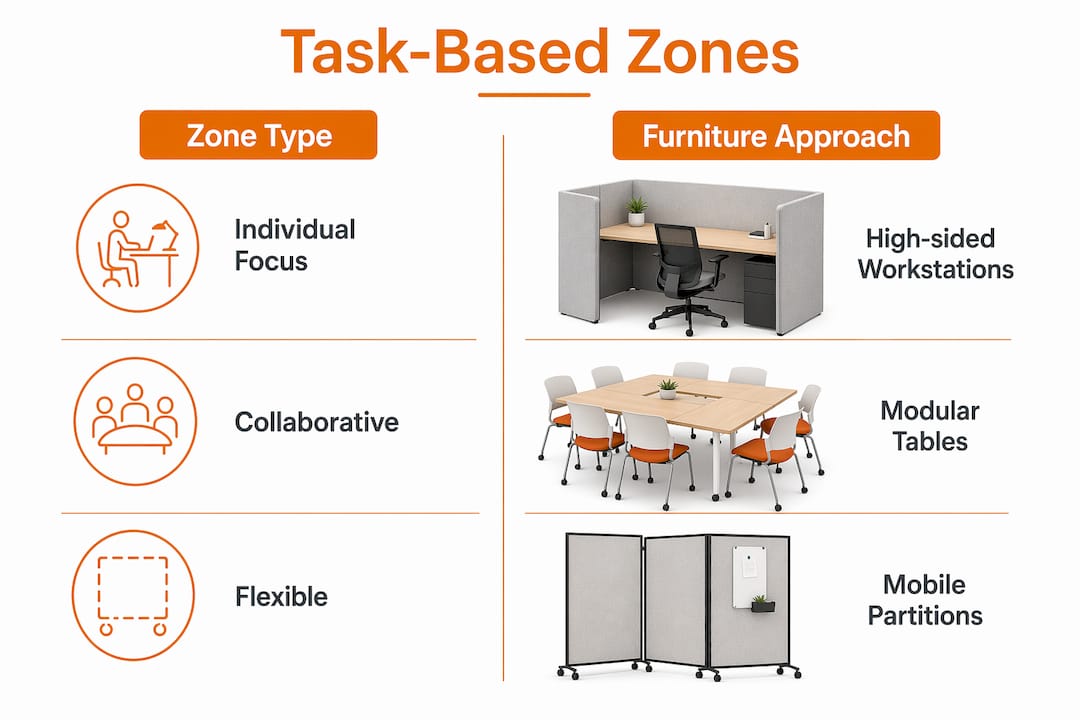
The benefits of modular furniture for this kind of zoning are considerable. Modular systems can be reconfigured as team sizes shift, as new working patterns emerge, or as a business grows. That adaptability protects the initial investment and avoids the expensive cycle of wholesale refurbishment every few years.
Acoustic dividers deserve particular attention. Open-plan offices are the dominant format in UK commercial property, yet unmanaged noise is one of the leading causes of concentration loss. Mobile acoustic partitions solve this without planning permission or construction costs. For businesses designing garden offices or annexe workspaces, the same zoning principles apply at a smaller scale.
Task furniture types include height-adjustable desks, ergonomic task chairs, focused workstations, and collaborative benches, each designed with specific work functions in mind. Selecting the right category for each zone requires a structured assessment process.
Map current work activities. Audit what your teams actually do across a typical week. Identify the ratio of screen-based work, meetings, phone calls, and collaborative tasks. This data drives every subsequent decision.
Match furniture to function. Height-adjustable desks support dynamic posture changes throughout the day, reducing the physical fatigue associated with fixed-height working. Ergonomic task chairs with adjustable lumbar support, seat depth, and armrests address the specific demands of prolonged computing. Collaborative benches with shared power access suit teams that move between individual and group tasks frequently.
Assess configurability. Furniture that cannot be adjusted to the user is furniture that will be used incorrectly. Check that height ranges, armrest positions, and back angles cover the full range of your workforce’s physical requirements.
Evaluate durability against use frequency. A chair used eight hours a day in a contact centre has different durability requirements than one used intermittently in a meeting room. Specify accordingly.
Plan for growth. Modular workstations that can be extended or reconfigured cost less over a five-year period than fixed units that must be replaced when headcount changes.
The office desks category illustrates this well. A standard fixed desk costs less upfront but limits posture variation. A height-adjustable desk costs more initially but supports both seated and standing work, reducing fatigue and the associated productivity loss over time.
Well-implemented task-based furnishing reduces fatigue, eliminates micro-pauses caused by physical discomfort, and aligns furniture with the actual demands of the work being performed. The benefits extend well beyond individual comfort.
Pro Tip: Involve team leads and end users in the furniture selection process before procurement. A 30-minute workshop with representatives from each department will surface task requirements that no floor plan can reveal.
Effective implementation requires system-level planning rather than piecemeal purchasing. Buying an ergonomic chair without assessing the desk height it will be used with, or specifying task lighting without knowing the monitor positions, produces a collection of good products that perform poorly together.
The most common pitfall is neglecting lighting until after furniture installation. At that point, the desk positions are fixed, cable routes are set, and retrofitting proper task lighting becomes expensive and disruptive. Lighting must be part of the initial brief.
| Planning stage | Key action | Common mistake to avoid |
|---|---|---|
| Assessment | Map work activities and movement patterns by team | Assuming all teams have identical needs |
| Selection | Match furniture categories to identified task zones | Prioritising aesthetics over function |
| Lighting | Specify task and ambient lighting alongside furniture | Treating lighting as a post-installation afterthought |
| Installation | Sequence furniture and lighting installation together | Installing furniture first, then retrofitting lighting |
| Review | Gather user feedback at 30 and 90 days post-installation | Assuming the brief was correct and not adjusting |
Considering evolving workstation needs early prevents costly redesigns within the first two years of a fit-out. The businesses that get the most value from task-based furnishing are those that treat the initial assessment as rigorously as the procurement itself.
Task-based furnishing delivers measurable productivity and wellbeing gains only when furniture, lighting, and spatial zoning are planned as an integrated system rather than selected in isolation.
| Point | Details |
|---|---|
| Definition matters | Task-based furnishing selects furniture to support specific work activities, not to fill space or match a visual theme. |
| Lighting is non-negotiable | Task lighting at 400–500 lumens and 3,500–4,000K must be specified alongside furniture, not added afterwards. |
| Zoning without walls | Modular partitions and acoustic dividers create distinct work zones without structural changes or planning permission. |
| Match furniture to function | Height-adjustable desks, ergonomic chairs, and collaborative benches each serve distinct task categories and should be specified accordingly. |
| Plan for change | Modular systems protect investment by adapting to headcount changes and evolving work patterns without full replacement. |
Working with commercial interiors over many years, the pattern is consistent. Businesses invest in good furniture and then wonder why productivity has not improved. The answer is almost always the same: the furniture was selected for the office, not for the work.
Task-based furnishing represents a genuine cultural shift in how organisations think about their physical environment. Furniture is not a backdrop. It is a system that either supports or obstructs the work happening within it. The businesses that grasp this early stop asking “what does the office look like?” and start asking “what does the office do?”
The next evolution of this approach will integrate sensor data and occupancy analytics to refine zone allocation in real time. Environmental considerations, including furniture longevity, repairability, and end-of-life planning, will also become procurement criteria rather than afterthoughts. The organisations that build task-based thinking into their procurement culture now will be far better placed to adapt as those expectations rise.
— Furniture
Furnitureforbusiness supplies ergonomic office chairs and height-adjustable desks designed specifically for the demands of commercial workspaces across the UK, with free delivery to the UK mainland.
Every product in the range is selected for task performance, not just appearance. The ergonomic seating collection covers everything from heavy-duty operator chairs for contact centres to executive chairs for boardrooms, with adjustment ranges that accommodate the full spectrum of user requirements. Height-adjustable desks support the dynamic posture changes that task-based design demands. Whether you are refurbishing a single floor or fitting out a new building, Furnitureforbusiness offers bulk order pricing and easy returns to make procurement straightforward.
Task-based furnishing is the practice of selecting office furniture and lighting to match the specific activities performed in each area of a workspace, rather than applying a uniform layout across the whole office.
Standard office design prioritises visual consistency and cost per unit. Task-based furnishing prioritises function, selecting each piece based on the work it must support, which typically produces better ergonomic outcomes and longer furniture lifespan.
The core categories are height-adjustable desks, ergonomic task chairs, focused workstations with acoustic screening, and collaborative benches. Each category addresses a distinct set of work activities and posture requirements.
Lighting directly affects concentration and physical comfort. Task lighting at the correct lumen output and colour temperature reduces eye strain and eliminates the micro-pauses caused by visual fatigue, making it as important as the furniture itself.
Begin by auditing what your teams actually do across a working week, then map those activities to zones. Select furniture and lighting for each zone based on task requirements, and review user feedback at 30 and 90 days after installation to refine the setup.

Phone: 0330 043 4114
VAT no. GB 991 8681 60
Company no. 07250570