TL;DR:
- Proper office lighting enhances productivity by supporting focus, reducing fatigue, and boosting satisfaction.
- Maintaining illuminance between 500 and 750 lux, controlling glare, and using layered, human-centric lighting are essential.
Most office managers think about lighting the same way they think about heating: set it once, forget it, and move on. That instinct is costing you more than you realise. The role of office lighting in productivity goes far beyond simply illuminating a room. It directly shapes how alert your people feel, how accurately they work, how fatigued they become by mid-afternoon, and how satisfied they are with the environment you have given them. Get it right, and lighting becomes one of the highest-return investments in your office. Get it wrong, and no amount of ergonomic furniture will compensate.
| Point | Details |
|---|---|
| Illuminance levels matter | Maintain 500 to 750 lux for screen-based work to support focus without causing discomfort. |
| Colour temperature affects alertness | Daylight-spectrum bulbs (5000K to 6500K) sharpen attention; warmer tones suit relaxation zones. |
| Layers beat overhead-only setups | Combining ambient, task, and accent lighting reduces glare and supports diverse work activities. |
| Natural light is the gold standard | Offices with insufficient daylight report higher eye strain complaints and lower job satisfaction. |
| User control drives performance | Giving employees control over their lighting significantly improves focus and reduces fatigue. |
Before you can make good decisions about your office lighting, you need to understand what the numbers actually mean in practice.
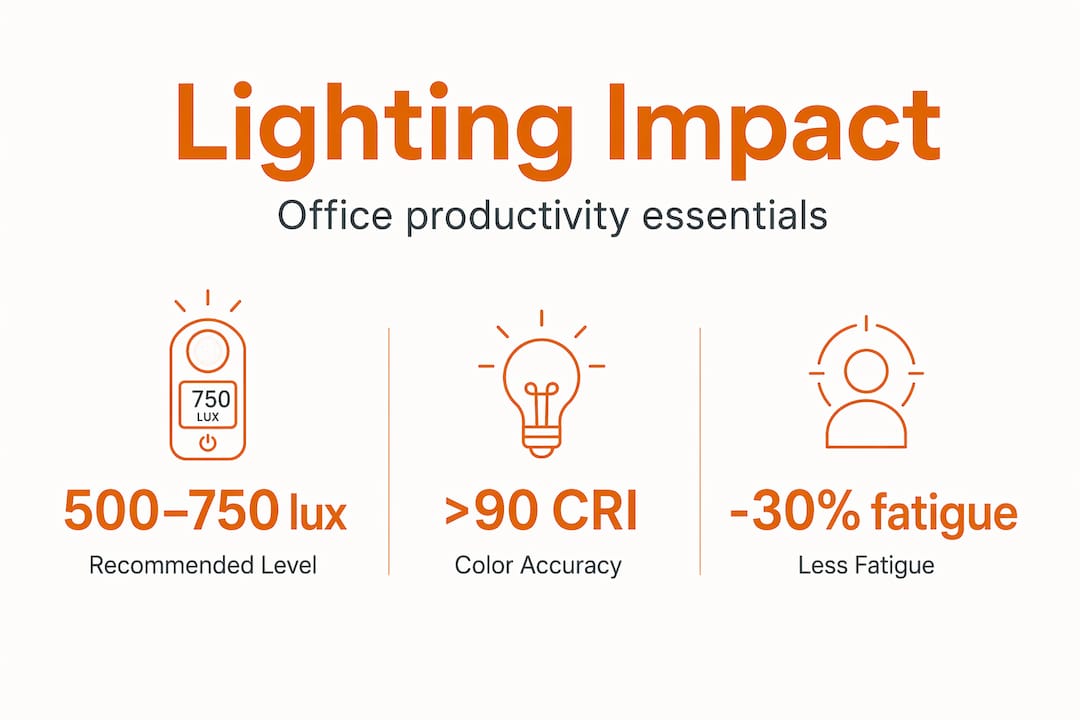
The European standard EN 12464-1 sets a 500 lux baseline illuminance for office workplaces, with an optimal working range between 500 and 750 lux for screen-based tasks. Below 500 lux, eye strain increases. Above 750 lux without proper glare control, visual discomfort follows quickly. That 250-lux window is where you want to operate.
Glare is the next metric worth knowing. The Unified Glare Rating, or UGR, measures how discomforting glare from a light source is likely to be. UGR ≤ 19 is the recommended maximum for office environments where people work on screens. Luminaires above this threshold may technically illuminate a space, but they actively harm the people working in it.
Colour temperature, measured in Kelvin, determines the character of light in your space. Daylight-spectrum LED bulbs in the 5000K to 6500K range simulate natural daylight and are strongly linked to alertness, particularly useful in spaces with limited window access. Warmer tones between 3000K and 4000K suit breakout areas or meeting rooms where you want people to feel comfortable rather than switched on.
Colour Rendering Index, or CRI, tells you how accurately a light source reveals the true colours of objects. High CRI of 90 or above is the benchmark for quality office lighting. Lower CRI values create a subtle distortion effect that most people cannot name but absolutely feel, typically as tired eyes and a vague sense of unease by late afternoon.
| Lighting parameter | Recommended value | Effect on workers |
|---|---|---|
| Illuminance | 500 to 750 lux | Reduces fatigue, maintains focus |
| UGR (Glare Rating) | ≤ 19 | Prevents visual discomfort on screens |
| Colour temperature (focus zones) | 5000K to 6500K | Promotes alertness and attention |
| Colour temperature (relaxation zones) | 3000K to 4000K | Supports comfort and calm |
| Colour Rendering Index | 90+ | Reduces eye strain, improves accuracy |
Research shows that increasing illuminance from 500 to 1000 lux significantly reduces psychological fatigue and improves response speed, with full-spectrum LED lighting amplifying those benefits further. The practical implication for office managers is clear: precision matters more than simply turning things up.
Pro Tip: Ask your lighting supplier or electrician to provide a lux measurement report for your floor plan before signing off any installation. Most will do this free of charge with a proper photometric study.
Static, uniform overhead lighting is one of the most common and costly mistakes in office environments. Human-centric lighting takes a different approach. It treats light as a variable that should respond to people’s natural rhythms and tasks rather than defaulting to one fixed state all day.

The science here is grounded in circadian biology. Your employees’ bodies regulate alertness, mood, and sleep based on the quality and intensity of light they receive throughout the day. A bright, cool-toned morning environment activates cortisol and signals wakefulness. A gradually warming light in the late afternoon prevents the jarring disruption that bright artificial light causes to evening sleep patterns. Adaptive lighting personalised to energy levels supports performance and reduces fatigue across the full working day.
A well-designed office lighting scheme uses three distinct layers:
“Lighting design is not just a technical task. It is a core part of spatial planning that shapes energy and identity in the workspace, reducing fatigue and supporting long-term employee commitment.” Office lighting as a strategic spatial element
The energy case for upgrading to modern LED systems is equally compelling. Automated LED systems reduce electricity consumption by 60 to 80 per cent compared to traditional lighting, while simultaneously giving you better control over the quality and character of light throughout the day. That is not a small saving across a 50-person office over five years.
Good office lighting design is not a single decision. It is a series of coordinated choices about sources, placement, controls, and integration with your physical space.
Natural light should always be your starting point. Natural light exposure sustains circadian rhythms, reduces stress, and contributes to better sleep and job satisfaction. Position workstations perpendicular to windows rather than facing them or sitting with your back directly to them. Both extremes create glare or silhouette problems that no amount of artificial lighting adjustment will fix.
Here are the practical considerations worth prioritising when improving your office lighting:
Pro Tip: When specifying luminaires for screen-heavy areas, filter supplier options to those with a published UGR value below 19. Many budget luminaires carry no UGR rating at all, which is itself a warning sign.
A well-planned office fit-out approach integrates lighting decisions alongside furniture placement, acoustic zoning, and circulation flow. Treating these elements in isolation typically leads to expensive retrofits six months after opening.
Even managers who invest in good lighting often undermine it through a handful of predictable oversights. Knowing what to watch for saves time, money, and unnecessary disruption.
Pro Tip: Run a quick informal audit. Ask five employees at different workstations whether they experience glare, eye strain, or find the space too bright or too dim. Their answers will tell you more than any single lux measurement.
What I have seen, working closely with businesses on office environments, is that lighting is almost always the last thing discussed and the first thing blamed when something feels off. Teams complain about headaches, low energy, and difficulty concentrating, and the instinct is to look at workloads or management style. Rarely does anyone open the ceiling and look up.
The truth is that poor lighting is among the top causes of low workplace morale and accidents. That is not a minor issue to fix with a quick bulb swap. It requires a genuine design conversation.
What I find most underappreciated is the link between lighting control and belonging. When you give employees the ability to adjust their environment, you signal that their comfort matters. That signal is more powerful than most leaders expect. I have seen teams in thoughtfully lit, well-controlled environments show noticeably stronger focus and better mood over sustained periods, not just in the first week when everything feels new.
My honest view is this: treat lighting the way you treat office space planning. It deserves a proper brief, professional input, and a considered budget. A quick fix mentality produces a quick fix result. The offices that genuinely perform well have leaders who understood that lighting, furniture, acoustics, and layout are not separate problems. They are one problem, solved together.
— Furniture

Lighting transforms what a space can do, but it works best when the furniture around it is equally well-considered. At Furnitureforbusiness, we supply ergonomic office chairs and height-adjustable office desks designed for sustained comfort across a full working day. Our range supports the kind of well-planned environments where great lighting can actually do its job. Whether you are refitting a single floor or equipping a whole building, we offer bulk order pricing, free delivery to the UK mainland, and a catalogue built for teams of 5 to 500. Good lighting sets the tone. The right furniture makes it count.
The EN 12464-1 standard recommends between 500 and 750 lux for screen-based office work. Below 500 lux increases eye strain, while exceeding 750 lux without glare control causes visual discomfort.
Cooler daylight-spectrum light (5000K to 6500K) promotes alertness and focus, making it suitable for deep work areas. Warmer tones (3000K to 4000K) suit breakout or meeting spaces where relaxed conversation is the priority.
Poor lighting is a leading cause of workplace eye strain, headaches, low morale, and reduced accuracy. Offices with insufficient daylight report more fatigue complaints and lower overall job satisfaction.
Yes. Research shows that adaptive lighting personalised by the user supports sustained performance and reduces fatigue compared to static uniform systems. Giving employees control is one of the most cost-effective improvements an office manager can make.
Automated LED systems reduce electricity consumption by 60 to 80 per cent compared to traditional lighting, while also delivering superior light quality and control options.

Phone: 0330 043 4114
VAT no. GB 991 8681 60
Company no. 07250570