TL;DR:
- Standing desks reduce sedentary time by 60 to 120 minutes daily, boosting health and productivity.
- They support compliance with UK DSE regulations and help prevent musculoskeletal issues.
- Effective implementation requires ongoing engagement, training, and workplace culture support.
The average UK office worker spends more than seven hours a day seated, and that figure has crept up steadily as hybrid working blurs the boundary between desk and sofa. Sedentary behaviour is no longer just a personal lifestyle concern; it is a measurable business risk that drives absenteeism, reduces output, and creates compliance headaches under Display Screen Equipment (DSE) regulations. Standing desks have moved well beyond a Silicon Valley trend. Research confirms that sit-stand interventions cut sitting time by 60 to 120 minutes per working day on average, delivering real gains in health, energy, and productivity that office managers and HR teams can actually measure.
| Point | Details |
|---|---|
| Fewer hours sitting | Standing desks reduce average sitting time at work by up to two hours each day, supporting employee well-being. |
| Boosted office productivity | Staff using standing desks report higher energy levels and better focus, translating into measurable productivity gains. |
| MSD risk management | Standing desks can help lower musculoskeletal discomfort and absenteeism, especially when paired with training. |
| Compliant and cost-effective | UK workplaces can meet DSE guidance and lower absence costs with strategic standing desk investment. |
| Culture drives success | Embedding ergonomic practices in office culture ensures lasting standing desk benefits, not just quick fixes. |
Most UK offices are aware that prolonged sitting is a problem, yet awareness alone changes very little. Conversations about wellness happen in town halls and staff surveys, but the furniture stays the same. Standing desks break that inertia because they make movement the path of least resistance rather than an act of discipline.
The evidence is clear. Sit-stand converters reduce sedentary time by an average of 60 to 120 minutes each working day. Across a team of 20 people, that adds up to roughly 400 to 800 person-hours per month where staff are not locked in static posture. That scale matters to HR professionals calculating wellness programme impact.
A Cochrane review on workplace interventions found that height-adjustable workstations are among the most effective tools available for reducing occupational sitting. Critically, the reduction is sustained during the working day rather than simply displaced to lunch breaks or commuting time.
From a regulatory standpoint, HSE DSE guidance requires employers to assess workstation risks and take steps to reduce discomfort from static posture. Standing desks directly support this obligation without requiring structural changes to the office.
Here is a snapshot of what standing desks deliver across a typical UK team:
If you are reviewing your current office desk options or want a clear explanation of how the technology works, our sit-stand desk guide walks through the mechanics and key buying considerations.
| Metric | Standard desk | Height-adjustable desk |
|---|---|---|
| Daily sitting time | 7 to 9 hours | 5 to 7 hours |
| Posture variation | Minimal | Regular |
| DSE compliance support | Partial | Strong |
| Absenteeism risk from MSDs | Higher | Lower |
While sitting less is a clear win, the real office breakthrough is what standing desks unlock for daily performance. Many decision-makers still think of these desks as a wellness purchase, almost like a gym membership that looks good on paper but is hard to justify financially. That framing underestimates the evidence.
Office workers using standing desks report better focus and energy throughout the working day. This is not just anecdotal. Participants in multiple studies recorded higher levels of engagement and motivation when they had the option to alternate postures. The physiology makes sense: standing gently activates leg muscles, encourages micro-movements, and promotes better circulation, all of which feed alertness.
“The ability to change posture throughout the day is one of the simplest and most effective ways to sustain cognitive performance across a full working shift.”
The productivity gains from sit-stand desk use are statistically significant in several trials, particularly for tasks requiring sustained attention. That is important context for HR managers who manage teams doing analytical or customer-facing work where concentration directly links to output quality.
Here are the most practical productivity benefits your team can expect:
Pro Tip: Encourage staff to alternate between sitting and standing every 30 to 45 minutes rather than standing for long continuous blocks. This rhythm gives the best of both worlds and avoids the fatigue that comes with static standing.
For a curated selection designed with performance in mind, see our guide to top ergonomic desks, which covers key features to look for in a commercial environment. The comfort and productivity case for sit-stand furniture is stronger than most procurement teams realise.
Beyond boosting day-to-day performance, standing desks also influence long-term comfort and health for employees. Musculoskeletal disorders (MSDs) are the leading cause of work-related ill health in the UK, accounting for a significant share of sick days each year. That cost lands directly on HR budgets and line managers.
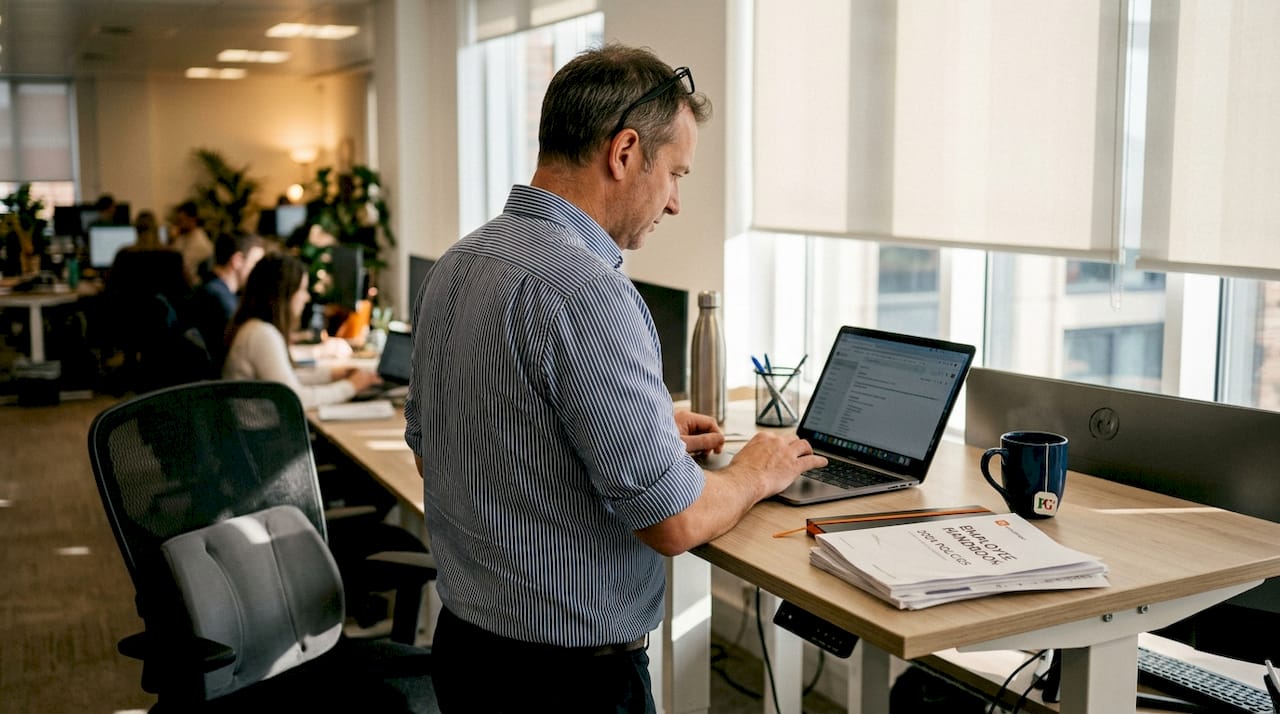
Standing desks help by decompressing the lower spine and breaking the cycle of sustained lumbar flexion that accumulates across a seven-hour desk shift. Research does show a reduction in back pain for many users, though it is important to be honest: the evidence is described as low-quality and suggestive rather than definitive. Standing desks are a tool, not a cure.
The musculoskeletal evidence base points towards meaningful symptom reduction when sit-stand desks are combined with ergonomic training and regular movement breaks rather than used in isolation.
Standing desks vs standard desks: MSD risk comparison
| Factor | Standard desk | Height-adjustable desk |
|---|---|---|
| Lumbar compression (sustained) | High | Reduced |
| Posture variety | Low | High |
| Risk of chronic lower back pain | Elevated | Lower |
| Neck and shoulder strain | Common | Reduced with correct setup |
Here is a practical sequence for combining standing desks with posture education:
Pro Tip: Avoid encouraging staff to stand for long unbroken periods. Static standing carries its own risks, particularly for leg and foot fatigue. Movement is the goal, not standing.
Our guide on how to reduce back pain in offices and our broader ergonomic furniture guide offer practical detail on building a setup that genuinely supports staff health.
With the physical and mental workplace impact clear, it is important to address how UK companies can put standing desks to best use. For many HR and facilities managers, the question is not whether standing desks work but whether the investment can be justified to senior leadership.
The answer starts with compliance. HSE DSE regulations require employers to assess workstation risks and take action to reduce them. Height-adjustable desks are a practical, auditable response to that duty. They demonstrate proactive effort in a way that an email to staff about taking breaks simply does not.
The cost argument follows from absenteeism data. MSD-related sick days cost UK businesses billions annually. Replacing even a fraction of those lost days with productive time at a height-adjustable workstation changes the return on investment calculation significantly. Long-term research on adherence shows that sustained use maintains these benefits, provided the rollout is properly supported.
Here are the essential steps for a successful implementation:
Pro Tip: Invest in a proper onboarding session when the desks arrive. Teams that receive training use their sit-stand desks consistently; those that do not often revert to sitting within weeks.
Our height-adjustable desk setup guide covers the practical configuration steps, and if you want a broader picture of the business case, the benefits of height-adjustable desks article is a useful reference for building your proposal to leadership.
Here is the uncomfortable reality: most offices that buy standing desks see only a fraction of the potential benefit. Not because the desks fail, but because the surrounding support structure is absent. The furniture arrives, a brief email goes out, and three months later the desks are stuck at the same height they were set on day one.
Standing desks are a prompt, not a programme. The offices that see genuine reductions in absenteeism and meaningful improvements in morale are the ones where managers actively model posture changes, where feedback loops are built in from the start, and where ergonomics is treated as a cultural priority rather than a one-off procurement decision.
“Furniture is only part of the story; engagement unlocks true value.”
A well-run pilot paired with regular check-ins beats a company-wide rollout with no follow-through every time. If you are planning a phased approach, our space-efficient desk planning guide can help you think through the layout considerations that make adoption easier.
The evidence for standing desks is compelling, and the regulatory case is clear. What remains is translating that into action for your specific team. Whether you are refitting a single floor or planning a phased ergonomic upgrade across multiple sites, the right starting point is a curated selection built for commercial use.
Browse our full range of office desks to find height-adjustable options suited to teams of all sizes, all with free UK mainland delivery. Our height-adjustable desk setup guide gives you a clear implementation roadmap, and for a thorough look at the business case, read our full breakdown of height-adjustable desk benefits. We support UK businesses from first enquiry to fully fitted office.
Aim for 1 to 2 hours of standing spread across the day, alternating every 30 to 45 minutes. Research confirms this rhythm reduces sedentary time meaningfully without causing standing fatigue.
Not for everyone. Evidence suggests back pain may reduce for many users, but results vary and standing desks work best alongside movement breaks and correct workstation setup.
No legal mandate exists, but HSE DSE regulations require employers to assess and reduce workstation risks, and height-adjustable desks are a strong, auditable response to that duty.
Pair the rollout with hands-on training and scheduled feedback sessions. Long-term adherence depends far more on behavioural support and management engagement than on the desk specification itself.

Phone: 0330 043 4114
VAT no. GB 991 8681 60
Company no. 07250570