Finding genuinely effective workspace solutions is often a challenge when trends come and go, but smart office furniture stands out for its adaptive intelligence. For office managers balancing hybrid teams and rising wellbeing expectations, understanding the real impact of smart technology in furniture makes a measurable difference. Discover how interactive, networked systems that optimise comfort and efficiency can transform your office from a static environment into a dynamic partner in productivity and employee satisfaction.
| Point | Details |
|---|---|
| Smart Office Furniture’s Functionality | It integrates sensors and connectivity to adapt the workspace based on user behaviour, improving comfort and productivity. |
| Common Misconceptions | Misunderstandings include the belief that smart furniture is just regular furniture with added gadgets, or that it can solve all workplace problems. |
| Cost Considerations | While initial investment is higher, long-term savings from reduced absenteeism and improved efficiency can justify the expense. |
| Implementation Strategies | Start with pilot programmes to mitigate risks and ensure infrastructure is ready before full-scale rollout. |
Smart office furniture is far more than just a desk with a built-in USB port. It’s networked furniture equipped with intelligent systems that sense, adapt, and respond to your workplace needs in real-time.
Think of it as furniture with a brain. Sensors monitor usage patterns, occupancy, temperature, and air quality. The system then adapts—adjusting desk heights, lighting levels, or climate settings automatically. Your team works better because the environment works with them, not against them.
True smart furniture goes beyond static design. It collects and processes data continuously, giving you insights into how your space is actually being used. This transforms furniture from passive objects into active participants in workspace efficiency.
Smart office furniture combines three core elements:
This means a height-adjustable desk doesn’t just move up and down—it learns your preferred positions and adjusts them automatically throughout the day. A smart chair monitors posture and sends alerts when you’ve been sitting too long. These aren’t gimmicks; they’re functional improvements rooted in genuine ergonomic science.
Smart furniture integrates various technologies for ergonomic comfort, user interaction, and space efficiency—transforming how teams experience their workplace every single day.
Many office managers dismiss smart furniture after encountering one or two false claims. Let’s clear the air:
Misconception 1: It’s just regular furniture with gadgets bolted on
Wrong. Quick-fix tech attachments don’t count. Real smart furniture embeds intelligence throughout its design—from the frame materials to the control systems. When you’re evaluating office desks, look for furniture with built-in sensors and integrated connectivity, not aftermarket add-ons.
Misconception 2: Smart furniture solves all workplace problems
It won’t. Smart furniture addresses specific challenges—ergonomics, space utilisation, environmental comfort. It won’t fix poor team communication or inadequate meeting spaces. Use it strategically to enhance what’s already working.
Misconception 3: It’s prohibitively expensive
Smart furniture costs more upfront, absolutely. But consider the returns: reduced sick leave from poor ergonomics, better space utilisation in expensive London or Manchester offices, and measurable productivity gains. The maths often work out within 18-24 months for medium to large enterprises.
Misconception 4: Employees will resist the technology
Experience shows the opposite. Staff appreciate furniture that adapts to them rather than forcing them to adapt. Automatic height adjustments, lighting that matches circadian rhythms, and climate control that responds to occupancy are genuinely popular.
You’re managing hybrid workforces, underutilised offices, and rising wellness concerns simultaneously. Smart furniture addresses all three. It tracks which spaces are actually being used, supports better ergonomics for remote-office hybrids, and demonstrates your commitment to employee wellbeing—a genuine recruitment advantage.
The technology has matured significantly over the past three years. It’s no longer experimental; it’s proven and increasingly affordable for mid-sized organisations.
Pro tip: Start small with one high-traffic area—a collaboration zone or executive floor—before rolling out smart furniture across your entire workplace. This lets you test the technology and build internal support before larger investment.
Smart office furniture isn’t a single category—it’s an ecosystem of interconnected solutions. The main types you’ll encounter combine IoT sensors, big data analytics, and adaptive mechanisms to transform how your team works and feels throughout the day.
Each type serves a specific purpose, but they work best when integrated into a cohesive strategy. Understanding what’s available helps you build a workspace that actually supports your people.
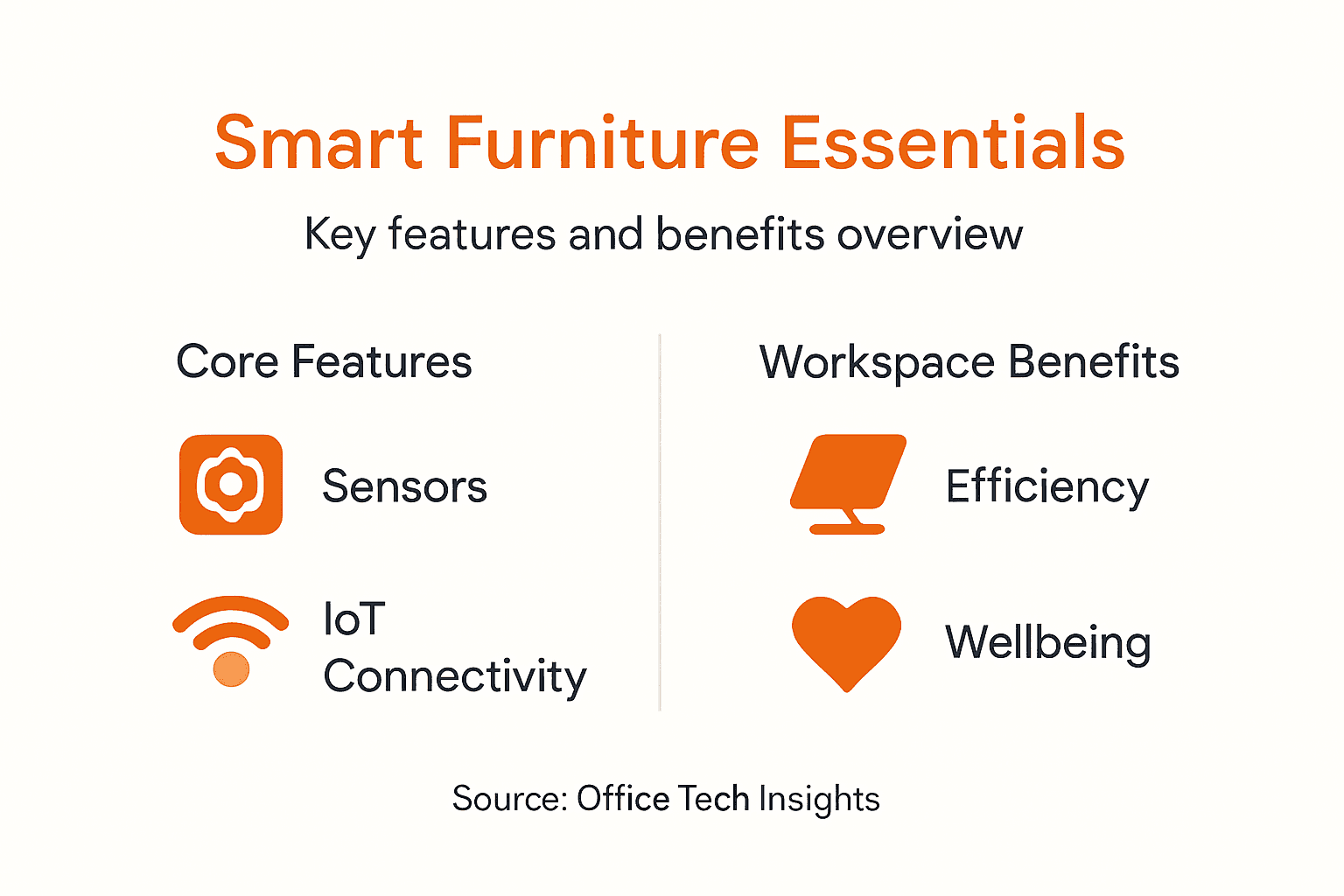
To help differentiate between types of smart office furniture, here’s a concise overview:
| Type of Smart Furniture | Key Functionality | Ideal Use Case | Business Impact |
|---|---|---|---|
| Smart Desk | Automated height adjustment and activity tracking | Flexible, hybrid workstations | Reduces strain; boosts productivity |
| Smart Chair | Real-time posture monitoring and adaptive support | All-day desk work | Cuts sick leave; improves comfort |
| Smart Table | Meeting engagement and usage analytics | Collaborative spaces and conferences | Improves space utilisation; drives effective meetings |
| Integrated System | Multi-device connectivity and central control | Entire office or department | Enhances overall efficiency; reduces energy costs |
Height-adjustable smart desks are the most visible smart furniture investment. They’re not just motorised platforms—modern versions include occupancy sensors, usage tracking, and automated movement patterns.
Here’s what makes them smart:
These desks support your hybrid workforce by adapting to different users sharing the same space. When employee A arrives, the desk recognises them and adjusts to their preferred configuration automatically.
Intelligent office chairs monitor posture, sitting duration, and movement patterns in real-time. Sensors detect when someone’s slouching or hasn’t moved in too long, triggering gentle alerts or automatic micro-adjustments.
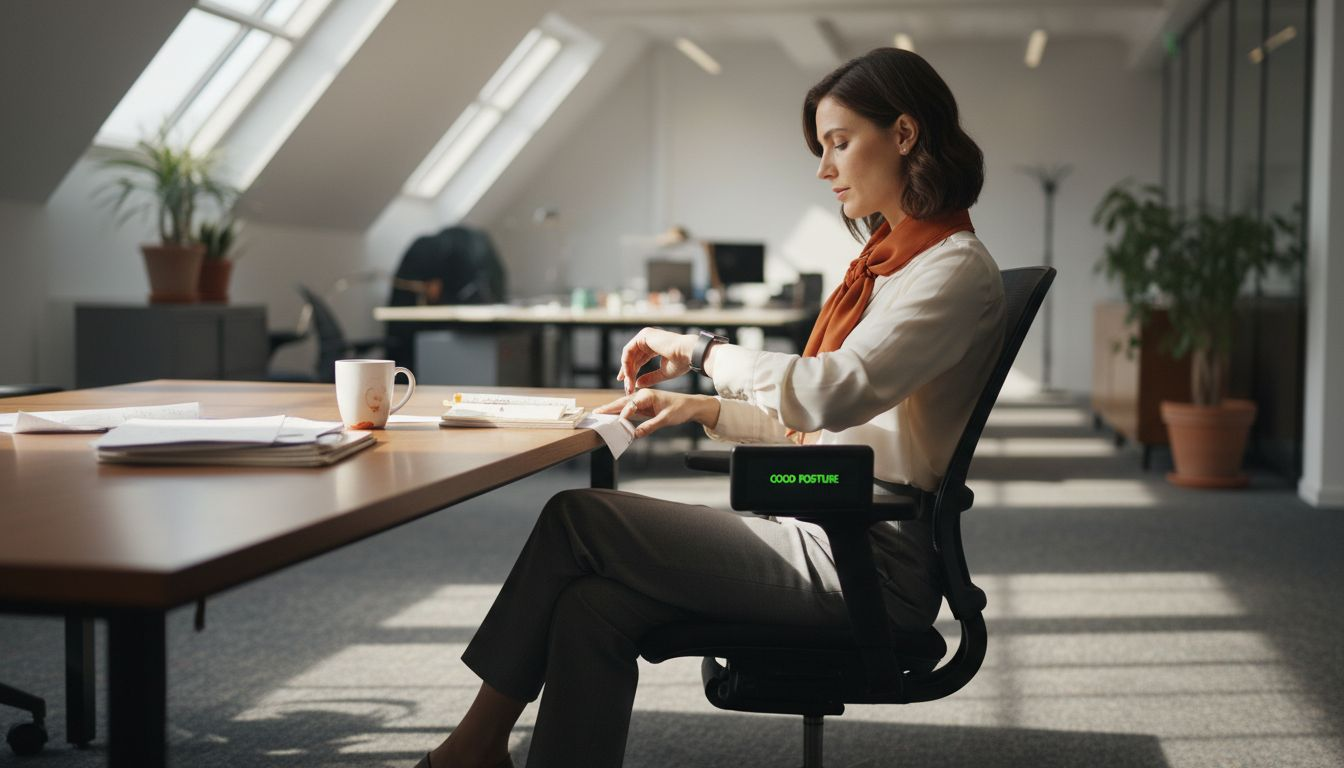
Advanced models include lumbar support that adapts to individual spinal curves and armrests that adjust based on working position. Some chairs even track circulation and suggest movement breaks before fatigue sets in.
This matters because poor seating contributes significantly to absenteeism. A chair that actively prevents discomfort reduces sick leave and boosts productivity simultaneously.
Conference tables with embedded sensors are transforming how teams collaborate. Smart furniture for active health monitoring now includes tables that track meeting duration, participant engagement, and room utilisation.
Some models feature integrated lighting that adjusts based on natural light levels and circadian rhythms. Others include surface sensors that detect activity levels and provide data on how effectively your meeting spaces are being used.
The smart furniture market is evolving rapidly. Current innovations include:
The most advanced smart furniture learns from user behaviour and environmental conditions, creating a truly adaptive workspace that evolves with your team’s needs.
Next-generation systems are moving towards artificial intelligence-driven adaptation. Rather than following preset rules, smart furniture will anticipate needs based on patterns—adjusting lighting before someone feels fatigued, raising a desk before posture deteriorates, or optimising meeting room climate based on occupancy predictions.
Behavioural tracking is also improving. Instead of just counting desk hours, systems now measure actual engagement levels and identify which spaces drive genuine collaboration versus those that sit empty.
You don’t need everything at once. Start with your highest-impact needs. If ergonomic-related absenteeism is a problem, prioritise smart seating and adjustable desks. If you’re struggling with office utilisation, focus on tables and desks with occupancy sensors first.
Integration matters more than individual features. Furniture that communicates with your building management system and employee wellness platforms creates compound benefits. Isolated smart pieces deliver value, but connected systems deliver transformation.
Pro tip: Pilot smart furniture in one department for 8-12 weeks before rolling out company-wide. This lets you gather real usage data, refine your approach, and demonstrate ROI to sceptical stakeholders before making larger capital commitments.
Smart office furniture works through a combination of sensors, connectivity protocols, and intelligent software that work together seamlessly. Understanding these core features helps you evaluate which solutions actually fit your organisation’s needs versus which are just marketing hype.
The technology behind smart furniture is sophisticated, but the user experience should feel invisible. Your team shouldn’t need to think about how it works—they should simply notice they feel better and work more effectively.
Embedded sensors form the foundation of smart furniture. These aren’t simple pressure plates—modern systems include multiple sensor types working simultaneously.
Common sensor types include:
Real-time health monitoring sensors optimise user comfort and productivity by continuously gathering data about how your team actually works. This information feeds into automated interventions—a chair adjusting lumbar support, a desk prompting movement, or lighting shifting to reduce eye strain.
Internet of Things connectivity allows furniture pieces to communicate with each other and your building systems. Without IoT, a smart desk and smart chair operate independently. With it, they work as an integrated ecosystem.
Data flows in real-time to a central platform, which then coordinates responses. When your calendar shows you’ll be in a video call, your desk height adjusts automatically and your chair’s posture monitoring increases sensitivity. When the office empties in the afternoon, lighting dims and climate control reduces energy consumption.
This integration matters because isolated features deliver modest benefits. Connected systems create exponential gains in comfort and efficiency.
Smart furniture doesn’t just collect data—it acts on it. Personalised interventions trigger automatically based on your patterns and preferences.
Common automated actions include:
These interventions are gentle by design. Rather than jarring notifications, most systems use subtle cues—a soft vibration, a gradual lighting change, or a quiet alert. Your team experiences comfort improvements without feeling monitored or interrupted.
The most sophisticated smart furniture integrates with your entire building infrastructure. IoT and wireless sensor networks enable automated controls for lighting, climate, and energy efficiency, creating a unified workspace that responds to occupancy and environmental conditions.
When a smart desk detects occupancy, it can simultaneously trigger overhead lighting, adjust air conditioning, and unlock security access. When everyone leaves, the system powers down non-essential systems automatically.
This interconnected approach reduces energy consumption whilst improving user experience—a rare combination that delivers both environmental and financial benefits.
Smart furniture balances automation with personal control. Most systems include mobile apps or touch interfaces letting users override automated settings, adjust preferences, and view their own health metrics.
You might want your desk to stop suggesting movement breaks after 4pm. Someone else might prefer aggressive posture correction whilst another person wants minimal intervention. Quality smart furniture systems accommodate these individual preferences without requiring IT involvement.
Effective smart furniture integrates seamlessly with your existing building systems and respects user autonomy, creating technology that serves people rather than constraining them.
Pro tip: When evaluating smart furniture systems, ask vendors specifically about data privacy and local storage options. Ensure health and usage data stays within your organisation’s control, and confirm whether cloud connectivity is required or optional for core functionality.
Smart office furniture delivers measurable improvements across two critical areas: how much your team accomplishes and how they feel doing it. These aren’t abstract benefits—they’re quantifiable returns that directly affect your bottom line and employee retention rates.
The data is compelling. Organisations implementing smart furniture report both efficiency gains and wellbeing improvements simultaneously, which is rare. Most workplace interventions require trade-offs. Smart furniture doesn’t.
Ergonomic designs coupled with data-driven health interventions directly boost output. When your team experiences less physical discomfort, they maintain focus longer and produce higher-quality work.
Consider the mechanics. Poor posture creates muscle fatigue, which reduces concentration. Constant sitting triggers circulation issues, causing mental fog. These problems compound over hours. Smart furniture prevents them proactively rather than waiting for complaints.
Here’s what actually improves productivity:
Smart office furniture significantly improves workspace efficiency by promoting active health and reducing mental fatigue, creating conditions where your team performs at their best.
Absenteeism costs UK businesses approximately £29 billion annually. Musculoskeletal disorders account for a significant portion—most of which are preventable through proper furniture and ergonomic support.
But there’s a bigger problem: presenteeism. Employees showing up whilst injured or unwell, operating at 60% capacity. Smart furniture addresses both by preventing the discomfort that causes absence in the first place.
Your team stays healthier because:
One medium-sized organisation reduced sick leave by 23% within eight months after implementing smart seating and desks across two departments. The investment paid for itself through reduced absence alone.
Wellbeing investments signal genuine organisational commitment. Employees notice when you invest in their comfort and health. It matters for retention, particularly when competing for skilled workers.
Sensors for occupancy, lighting, and environmental control support better space utilisation whilst creating safer, more comfortable work environments, which improves employee engagement directly.
This becomes increasingly important in hybrid work environments. Remote workers often have suboptimal home setups. Office-based colleagues deserve equally thoughtful environments. Smart furniture demonstrates this commitment visibly.
Occupancy sensors embedded in smart furniture reveal how your office is actually being used. Many organisations discover they’re paying for space nobody uses regularly. Smart furniture data drives better space planning decisions.
You can then:
Smart furniture creates a virtuous cycle: improved employee wellbeing increases productivity, which justifies the investment, which frees budget for further improvements.
Physical comfort directly influences mental wellbeing. Chronic discomfort causes stress and reduces resilience. Smart furniture eliminates this constant low-level suffering, improving emotional wellbeing alongside physical health.
Employees working in well-designed, adaptive environments report better work-life balance perception and reduced work-related stress.
Pro tip: Measure baseline absenteeism, productivity metrics, and employee engagement scores before implementing smart furniture, then reassess after six months. Real data demonstrating return on investment will silence internal sceptics and justify continued investment.
Smart office furniture isn’t cheap. Pricing runs higher than traditional furniture, which creates legitimate budget questions. The good news? Costs are dropping and implementation strategies exist to manage financial risk effectively.
Understanding actual costs, realistic timelines, and common mistakes helps you avoid expensive failures. Many organisations stumble not because smart furniture doesn’t work, but because they implement it poorly.
Initial investment varies significantly based on your choices. A single smart desk might cost £2,500-£4,500 compared to £800-£1,200 for a conventional adjustable desk. Multiply this across dozens of workstations and the numbers become substantial.
However, cost calculations often ignore long-term savings. When you factor in reduced absenteeism, better space utilisation, and energy savings over five years, the maths often favour smart furniture.
Typical cost breakdown includes:
Cost-effective implementation leverages low-cost platforms and open-source technologies to reduce upfront expenses. This approach works but requires technical expertise internally or through a trusted partner.
Integration with existing infrastructure causes most implementation delays. Your office building probably isn’t designed for smart furniture integration. Adding wireless networks, power systems, and data management requires careful planning.
Common pitfalls include poor integration with existing office infrastructure and scaling challenges that derail otherwise promising projects.
Real obstacles include:
One large organisation implemented smart desks across 300 workstations without upgrading their wireless network first. The system worked sporadically, frustrating users and creating negative perceptions that took months to overcome.
Pilot programmes reduce risk dramatically. Start with one team or floor, work through problems, then scale. This approach costs slightly more upfront but prevents costly mistakes and builds internal support.
Your implementation sequence should be:
Don’t rush this. Quick rollouts create problems that undermine the entire initiative.
A summary of frequent pitfalls and mitigation strategies for implementing smart furniture:
| Common Pitfall | Consequence | Prevention Strategy |
|---|---|---|
| Poor network upgrades | Unreliable furniture performance | Upgrade wireless infrastructure before rollout |
| Lack of staff training | Low usage and negative perception | Provide onboarding and ongoing support |
| Inadequate data privacy | Legal and reputational risks | Ensure robust local and cloud security protocols |
| Rushed rollout | Expensive mistakes and low ROI | Pilot programmes to test and adapt |
Technology adoption fails when users don’t understand the benefit. Your team needs clear communication about why this matters, how it works, and what to expect.
Many organisations treat smart furniture implementation as purely technical. It’s actually a change management project. Staff training, ongoing support, and visible leadership commitment determine success more than technology quality.
Successful smart furniture implementation requires equal investment in change management and technology infrastructure—underestimating either one creates expensive failure.
Health and occupancy data requires careful protection. Ensure your vendor clearly explains data ownership, storage location, and security protocols before committing.
Ask these questions directly:
Data breaches involving employee health information create legal and reputational damage far exceeding the furniture cost.
Pro tip: Negotiate a pilot phase into your contract with a clear exit clause if integration proves problematic. This protects your investment and gives vendors incentive to support successful implementation rather than simply installing hardware and leaving.
The challenges of enhancing workplace wellbeing, boosting productivity, and optimising office space demand more than ordinary furniture. As highlighted in the article “What Is Smart Office Furniture and Why It Matters”, smart furniture goes beyond gadgets to deliver ergonomic comfort, real-time sensing, and seamless integration with your evolving workspace. If you are seeking practical ways to reduce absenteeism and empower your team with adaptive office environments, start by exploring height-adjustable desks and ergonomic seating solutions designed for real business needs.
Take advantage of expert-curated collections at Furniture For Business where smart design meets durability and function. Discover products that align with your goals for active health support and space efficiency without compromising style or budget. Invest now to create an office that works as hard as your team does and experience the difference intelligent workspace design makes every day.
Smart office furniture refers to networked furniture equipped with intelligent systems that sense, adapt, and respond to workplace needs in real-time, enhancing workspace efficiency and comfort.
Smart office desks feature automated height adjustment and activity tracking. They monitor how long users sit, learn their preferred heights, and can adjust automatically based on calendar schedules or occupancy.
Yes, smart furniture is designed to support ergonomic health, reducing discomfort and the risk of injuries. It promotes better posture and encourages movement, which can lead to improved physical and mental wellbeing.
When selecting smart office furniture, look for embedded sensors for real-time monitoring, connectivity for integration with other systems, automated interventions for comfort adjustments, and user customisation options to cater to individual preferences.

Phone: 0330 043 4114
VAT no. GB 991 8681 60
Company no. 07250570